Mind Is Different From Soul And Mind Is Not Eternal Like Soul
It may not be eternal like the soul.
This is because we have constant periodic software upgrades happening. You buy a software, install it, and every time your software provides upgrades, your software is also upgraded. They go through so many changes. After some time, the software would have gone through so many changes, it may not in any way look like the original one you purchased. The functionality and features could be entirely different. You may not even be able to identify it with the one you purchased.
This is what happens to the mind also. After many births, through constant experiencing, the nature of the mind changes. The qualities of the mind change. Nothing of this sort happens to the soul. That is why we say atma is sashawata and mind is not saswata.
Mind definitely goes from one birth into the next, or from this world into the next.
प्रकृतिबन्ध – अविद्या – कर्म – संस्कार रुचिविपाकेभ्यः आवरणेभ्यः
रुचि is asakti – likes and dislikes – another cause of attachment. And the vipakas of all these – the effects and results generated from all these – all kinds of complexities and complications arising therefrom – the secondary and tertiary effects from all these.
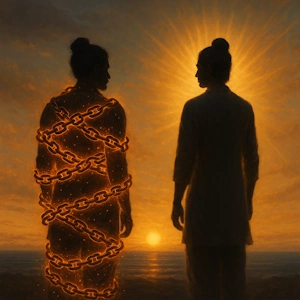
They all become avaranas – covers – that bind. They are like metal suits all around you that restrict your free movement, that tie you down. You can’t escape from these sheaths. Every action, every asakti becomes a metal sheath around you. They are like body wraps used by police to immobilize a person.
So – प्रकृतिबन्ध – अविद्या – कर्म – संस्कार रुचिविपाकेभ्यः आवरणेभ्यः एकान्ततः अत्यन्ततश्च विश्लिष्टा मुकताः – someone who has achieved release from each and every one of these body wraps, absolutely completely, is called a mukta. And devotion to Sri Hari, taking refuge in him, makes this possible.
तत्सुकृतदुष्कृते विधूनुते – both punya and papa are relinquished by them. They are not interested in either.
अश्व इव रोमाणि विधूय पापम् चन्द्र इव राहोर्मुखात्प्रमुच्य – the horse shakes away its fallen hair. You may have seen this. It is quite natural to the horse. This action. That is how the mumukshu shakes away his papa. And as how moon comes out of an eclipse, he comes out of his ignorance and attains liberation.
नामरूपे विहाय – he goes beyond both name and form. Name and form are only in this existential world. He goes beyond them. He no more has a physical form, he no more has a name.
तदा विद्वान्पुण्यपापाद्विमुक्तः – then the scholar, the jnani, becomes free from both punya and papa.
When does it happen? When you have known Sri Hari.
ज्ञात्वा देवं मुच्यते सर्वपाशैः – all ropes are cut loose then, all shackles are broken.
When does this happen? When you have known him, when you have known Sri Hari.
-
Is the mind the same as the soul?
No. The mind is a changeable instrument; the soul is the unchanging witness. The mind thinks, feels, and remembers. The soul simply is. -
If the soul is constant, why do I feel different over time?
Because the mind keeps getting new impressions and habits. Those layers shift your personality, not the soul. -
What exactly travels from one birth to another?
The subtle body: mind, senses, samskaras, and tendencies. The physical body drops; the soul remains untouched. -
What binds a person to suffering?
Avidya, karma, samskara, and ruchi (likes and dislikes). Their outcomes (vipaka) form coverings that limit freedom. -
How do likes and dislikes become chains?
Attachment makes you react compulsively. You chase what you like and resist what you dislike. Both keep the mind restless. -
Why speak of coverings or sheaths?
Because each action and attachment adds a layer of conditioning. More layers mean less inner freedom. -
Can good deeds also bind?
Yes, if done with ego and craving for results. Seek purity of intention and offer outcomes to Bhagavan. -
Why let go of both punya and papa?
Because clinging to reward or fear of punishment keeps the mind revolving. Freedom is beyond both. -
What does going beyond name and form mean?
Realizing that your essence is not any label or shape. It is awareness itself, which cannot be boxed in. -
Does devotion really dissolve bondage?
Yes. Sincere surrender to Sri Hari aligns the mind with truth, burns ego-driven karma, and steadies knowledge. -
Is knowledge or devotion primary?
They complete each other. Knowledge clears vision; devotion melts resistance. Together they mature into freedom. -
How do samskaras lose their grip?
Through vigilant living, meditation, self-inquiry, selfless action, and remembrance of Bhagavan. Repetition rewires habit. -
Do I lose individuality on liberation?
You lose false identification, not awareness. What remains is luminous clarity without the compulsions of ego. -
How do I know I am progressing?
Fewer compulsions, quicker recovery from disturbances, natural kindness, and a stable joy that does not depend on circumstances. -
What is practical surrender?
Do your best with full integrity, offer the result to Sri Hari, and accept outcomes without inner drama. -
Is detachment cold or uncaring?
No. True detachment removes ego from action and makes compassion cleaner, steadier, and less possessive. -
What role does guilt or shame play?
Learn the lesson, atone where needed, and move on. Guilt that lingers becomes another chain. -
Can one be devoted while living a busy life?
Absolutely. Keep remembrance in the background, make work an offering, and choose actions that reduce craving and harm. -
What is the core daily discipline?
A simple triad: sit quietly, serve selflessly, remember Sri Hari. Do it every day; depth follows consistency.





English
Vishnu Sahasranama
Click on any topic to open
7
30
Astrology
Bhagavad Gita
Bhagavatam
Bharat Matha
Devi
Devi Mahatmyam
Ganapathy
Garuda Puranam
Glory of Venkatesha
Hanuman
Kathopanishad
Mahabharatam
Mantra Shastra
Mystique
Practical Wisdom
Purana Stories
Radhe Radhe
Ramayana
Rare Topics
Rigveda Explained
Rituals
Sages and Saints
Shiva
Spiritual books
Sri Suktam
Story of Sri Yantra
Temples
Vedas
Vishnu Sahasranama
Yoga Vasishta
26
17
10
0


