Description of the Path to Brahmaloka
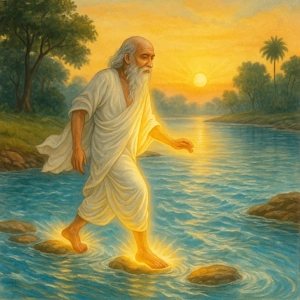
मायामेतां तरन्ति ते – and the maya is crossed thus by them. They have swum across the ocean of maya.
निरञ्जनः परमं साम्यमुपैति –
Samyam means tulyatvam – he becomes equal to Sri Hari. Who becomes? निरञ्जनः, one who has discarded punya and papa and has become clean, spotless, blemishless.
इदं ज्ञानमुपाश्रित्य मम साधर्म्यमागताः।
सर्गेऽपि नोपजायन्ते प्रलये न व्यथन्ति च
Says Gita. With this knowledge, they attain sadharmya with me. After that, they are neither born at the time of creation, nor are they annihilated at pralaya.
After achieving him what do they do?
इमाँल्लोकान् कामान्नीकामरूप्यनुसंचरन्
They move about in all the worlds assuming whichever form they want. Because they have become one with Paramatma, they have all the siddhis. They can assume any form they want.
Kaushitaki Upanishad describes how one reaches Brahmaloka and attains Brahmatva. There are two paths after the mortal body is left behind: Pitruyana and Devayana. Pitruyana is for the common man, which would lead him to Pitru-loka or Yama-loka. Devayana is for the muktas.
He takes this path and reaches Agniloka, thereafter Vayuloka, thereafter Suryaloka, then Varunaloka, then Indraloka, and then Prajapatiloka. Then he proceeds towards Brahmaloka. On the way there is a water body called Aara. If he has observed penances out of kama and krodha to attain Brahmaloka, then such punya is removed at a place called येष्टिहा. Then he comes to a river called Viraja; there his old age will be discarded. He will get permanent youth there. Then he sees a tree called Ila. After that is a city called Salajya, full of lakes, gardens, and rivers. Many devas reside there. There is a courtyard at the centre of that city. Beyond that is Aparajita, the dwelling place of Brahma. The clouds, Indra, and Vayu stand guard at the gate of Aparajita.
There is a mandapa called Vibhupramati there and a vedi at its centre called Vichakshana. Brahma’s throne is called Amitauja. That is life force - prana itself. All living and non-living beings are flowers in Brahma’s garden. A river called Ambaya flowing there can confer Brahma-jnana. Only a jnani liberated person can reach Brahmaloka.
As he approaches Brahmaloka, 500 apsaras would come running to welcome him. They will adorn him with divine anointments. He takes a bath in Aara and leaves his punya and papa on the banks of the river Viraja. The punya that he leaves behind would go to his well-wishers and family. His papa, if any, would go to people who had animosity and scorn towards him. From the tree called Ila, Brahma-gandha, the fragrance, will get into him. As he approaches Aparajita, he will be filled with Brahma-tejas. The vedi Vichakshana would give him divya drishti, the divine vision. Now he climbs into the throne of Brahma; he attains Brahmatva.
-
What does it mean to cross maya?
It means the mind stops getting fooled by appearances. Cravings, fears, and identity trips lose grip. You see things as they are and act without inner compulsion. -
Who is a ‘niranjanah’?
One who has dropped both punya and papa from their ledger. Clean, steady, and free from the stains of guilt and pride. -
Does ‘samyam’ or ‘sadharmya’ make one equal to Bhagavan?
Equal in qualities, not in lordship. Freedom from fear, clarity, compassion, and unwavering truthfulness match Bhagavan’s qualities, but Bhagavan remains the supreme refuge. -
Why are liberated beings said to take any form and move anywhere?
Because action no longer comes from lack. With the ego dissolved, will aligns with dharma. Form becomes a tool for helping, not for showing off. -
What are the two paths spoken of after death?
Pitriyana is for mixed, result-seeking living and leads to ancestral realms. Devayana is for upasana-driven living and leads upward toward knowledge and final freedom. -
Is Brahmaloka just another heaven?
No. It is a summit school of realization. From there, the journey culminates in freedom from rebirth and from cosmic dissolutions. -
Why the sequence of lokas like Agni, Vayu, Surya, and others?
It shows graded refinement. Vital energies get purified layer by layer, supervised by deities who embody those layers. -
What is the significance of ‘Viraja’?
‘Viraja’ means free of rajas. Crossing it signals the end of aging and restlessness. The seeker gains unfading vitality fit for knowledge. -
Why mention a tree, a city, a gate, and a throne?
They are markers of inner attainment. Ila hints nourishment of insight, the city signals harmony, the gate tests purity, and the throne stands for established life in truth. -
Why do merits go to well-wishers and faults to enemies?
Karmic ties share momentum. When a person drops their ledger, the residual currents flow along the channels they were fed by: goodwill strengthens friends, hostility burdens haters. -
Are apsaras and honors distractions?
No. They symbolize the cosmos honoring purity. The liberated are past temptation; honors do not hook them. -
If one becomes like Bhagavan, is worship still meaningful?
Yes. Love deepens, not ends. Nearness increases humility and gratitude. Relationship matures from need to free devotion. -
Do the liberated act in the world?
They act without selfish motive. Action is precise, timely, and healing, done for loka-sangraha, not for name or gain. -
What protects this state from collapse later?
Knowledge rooted in direct seeing, not belief. Once ignorance is burned, rebirth cycles and cosmic dissolutions do not shake it. -
Is the journey literal, symbolic, or both?
Both. The map works as outer destiny for the qualified and as an inner purification scheme for practice now. -
What is the practical doorway into this path today?
Clean conduct, steady japa and upasana, study of shastra, honest self-audit, reducing kama and krodha, service without bargaining, and surrender to Bhagavan. -
Does this contradict other paths?
Details vary across schools, but the spine is the same: purify, know, love, and let go. The outcome is freedom from compulsion and rebirth. -
How do I gauge progress without fooling myself?
Less reactivity, more cheerfulness, stable attention, easy forgiveness, honest effort, and devotion without bargaining. If these grow, you are on track.





English
Vishnu Sahasranama
Click on any topic to open
7
30
Astrology
Bhagavad Gita
Bhagavatam
Bharat Matha
Devi
Devi Mahatmyam
Ganapathy
Garuda Puranam
Glory of Venkatesha
Hanuman
Kathopanishad
Mahabharatam
Mantra Shastra
Mystique
Practical Wisdom
Purana Stories
Radhe Radhe
Ramayana
Rare Topics
Rigveda Explained
Rituals
Sages and Saints
Shiva
Spiritual books
Sri Suktam
Story of Sri Yantra
Temples
Vedas
Vishnu Sahasranama
Yoga Vasishta
26
17
10
0


