Do You Know About Goloka?
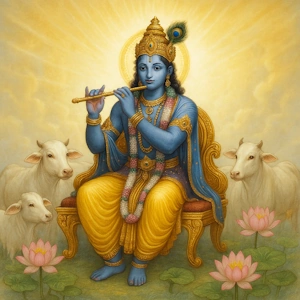
Goloka is filled with bright light which itself is Para Brahma, Paramatma. Within that bright light you can see a form, of the color of a rain cloud, the Shyama Varna.
His eyes are like lotus petals. The Purna Chandra of Sharad Rutu is nothing to the beauty of his face. Kamadeva is supposed to be very handsome, but one thousand Kamadevas are not equal to him in beauty.
He is the abode of leelas. His hands hold the flute, with that sweet enchanting smile always on his face. Clad in yellow clothes - Peethambara. Beautiful gem-studded ornaments adorn his body from head to toes. His body is anointed by Chandana, Kasthuri, and Kumkuma.
You can see Sreevatsa on his broad chest. Kaustubha Mani also shines there.
He is seated on a royal throne, his Vanamala stretches up to his knees.
This is Sri Hari, Paramatma, in Goloka.
He is ever youthful, he does not age. His style of dressing is like a Gopa.
This is Sri Hari, eager to bless his devotees.
He sits there without action - निरीहः - he does not have to act physically, whatever he desires only happens on its own.
He is Nirvana - without adaptations and modifications.
And he is Paripurnatama, most complete in every aspect.
He alone is the Raaseswara of Raasamandala, most benevolent of all.
He is the seed of Paramananda, bliss.
Eternal, Lord of all Siddhis.
He is addressed by so many names, sung by so many praises.
This is the form a devotee of Sri Hari should meditate upon.
And Sri Hari, when he is by your side, he will go to any extent, he will even pick up enmity with Devas to be on your side.
See, how he helped Agni Deva!
Agni developed indigestion.
There was a king called Shwetaki. As strong as Indra and as famous also as him. An ardent performer of Yajnas. A great Danee.
His thoughts were always on performing Yajnas and giving charities.
His priest became tired — Yajnas day in and day out, and all that smoke. Their eyes started paining.
They became so tired that they all ran away.
He got himself another group of priests and continued.
Then he wanted to do another Yajna lasting one hundred years.
He went looking around for priests. He pleaded with everyone, but they all refused. His Yajnas, by then, had become notorious for the physical strain involved.
They all said - 'Your Yajnas never stop. You want to keep on doing. And we are very tired of doing Yajnas for you.'
'We humans cannot do this. You go to Mahadeva, he only can do your Yajnas.'
So the king went to Mahadeva and prayed that the Lord may officiate his Yajna.
-
What is meant by the bright light being Para Brahma and Paramatma?
It refers to the ultimate reality and supreme self, the source from which all creation emerges and where it ultimately rests. -
Why is the rain cloud color considered so significant in describing divinity?
It symbolizes depth, mystery, and beauty, often linked to a cooling, comforting presence that draws the heart towards devotion. -
What is the importance of features like lotus-petal eyes and the beauty surpassing Kamadeva?
These features show the ideal of spiritual beauty, where divine charm far exceeds all worldly standards. -
Why are ornaments, fragrances, and attire described in such detail?
They reflect not just external beauty but the completeness of divine presence, appealing to both heart and senses of the devotee. -
What does it mean for one to be without action yet have all desires fulfilled instantly?
It means supreme power operates effortlessly; the will alone is enough to make things happen. -
How can one be most complete in every aspect?
It shows that there is no deficiency—physical, spiritual, or emotional—in the supreme being. -
Why is the title Raaseswara significant?
It emphasizes mastery over blissful divine play, especially in the sacred dance of joy and love. -
What does it mean to be the seed of bliss?
It means all true happiness originates from and is sustained by this supreme source. -
Why would divinity take sides even against other celestial beings?
It shows the personal bond with a devotee, where protection and loyalty surpass all other considerations. -
What does the story of a long, exhausting Yajna reveal?
It highlights the limits of human endurance and the need for divine intervention in great undertakings.





English
Vishnu Sahasranama
Click on any topic to open
7
30
Astrology
Bhagavad Gita
Bhagavatam
Bharat Matha
Devi
Devi Mahatmyam
Ganapathy
Garuda Puranam
Glory of Venkatesha
Hanuman
Kathopanishad
Mahabharatam
Mantra Shastra
Mystique
Practical Wisdom
Purana Stories
Radhe Radhe
Ramayana
Rare Topics
Rigveda Explained
Rituals
Sages and Saints
Shiva
Spiritual books
Sri Suktam
Story of Sri Yantra
Temples
Vedas
Vishnu Sahasranama
Yoga Vasishta
26
17
10
0


