Do You Have Any Idea How Powerful Innocent Bhakti Can Be?
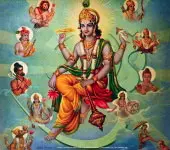
मेधावी – 'मेधा' means boundless, all-knowing intellect, referring to Sri Hari’s supreme intellect.
निस्सीम-भूमानुगुण नित्य सर्वज्ञलक्षणा |
मॆधा यस्यास्ति स प्रॊक्तः मॆधावीति विचक्षणैः
Intelligence without any limit – this is what Bhagawan has. That’s why we call him Jagadguru. All knowledge comes out of him. Medha Bahugrantha Dharana Samarthyam. We say multi-tasking, doing many things at the same time. Doing several intellectual activities at the same time is what medhavis can do.
Sant Shiromani Namdev Maharaj was a great saint who lived between the years 1270 and 1350 in Maharashtra, an ardent devotee of Vithoba of Pandharpur. He is one of the most celebrated saints of the Varkari Sampradaya.
As a young boy, Namdevji had a lot of interest in the worship of the lord. He used to make dolls from wood or keep stones, dress them up as Bhagawan, and offer flowers and naivedya. Bhakti was natural to him. When he used to do this, tears used to roll down his cheeks – tears of happiness.
There was a full-fledged puja at home everyday done by his grandfather, Vamdevji. It was a regular traditional puja with the idol of Sri Hari. Young boy Namdevji kept on asking his grandfather, 'when are you going to allow me to worship him?' After some time, Vamdevji told him, 'whenever I go out for some time, I will allow you.' Like that, an opportunity came. Vamdevji was going somewhere for three days. He called young boy Namdevji and told him, 'I will not be here for three days, take care of the Lord very well. Offer him milk every day.' Namdevji was so happy.
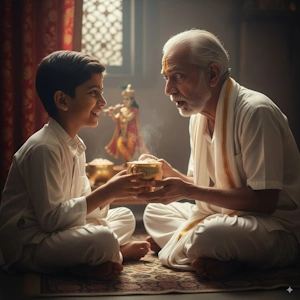
Grandfather went away. Next day morning, Namdevji got fresh milk, boiled it well, mixed cardamom and sugar in it, took it in a beautiful cup, and placed it before the Lord. Then he put the curtain of the puja room like his grandfather used to do and waited outside anxiously for Bhagawan to drink the milk. After some time he went inside and checked; the milk was as it was. Bhagawan had not taken it.
Namdevji was disappointed. He didn’t know what to do. The Lord did not drink milk meant he must be hungry. How can I eat something if the Lord is hungry? Namdevji also did not eat anything or drink anything that day. He felt ashamed to tell his parents also what happened, that the Lord did not accept the milk that he had offered.
The next day also the same thing happened. Young boy Namdevji did not sleep in the night, worried. He kept on crying silently. The third day he again went to the Lord with milk. Kept it near him and waited outside. When he went back the milk was still there. He told the Lord, 'tomorrow nanaji is going to come back. When he finds out that I kept you hungry for three days, he is never going to allow me to worship you again. What is the point in living like this?' He took out a knife and held it to his own throat, about to cut it.
Bhagawan held his hand. As he was looking, the level of milk started going down in the cup. Namdevji said, 'wait, wait, don’t drink the whole thing. Leave a little bit of prasada for me. Nanaji always gives me some milk as prasada after his puja.' Bhagwan left a little milk at the bottom of the cup. Namdevaji drank it and became very happy.
Next day when Vamdevji returned, Namdevji narrated everything to him. Vamdevji could not believe what he heard. He said, 'if this is true, show it to me, show me how Bhagawan drinks milk.' Namdevji boiled milk as usual, mixed sugar and cardamom, and kept it near the Lord. Nothing happened.
Nanaji started looking at him with suspicion. 'is this boy lying?' Namdevji told the Lord, 'look what you are doing to me, you are making him think that I am a liar.' He again took out the knife and kept it to his throat. Milk started disappearing from the cup. Vamdevji was shocked. 'I have been doing puja for so many years, I have never had this experience.' Bhagawan also left a little bit at the bottom of the cup for Namdevji to have as prasada.
This is the power of bhakti. Pure bhakti, innocent bhakti. Develop this innocence and the Lord will perform miracles even for you. See, a small boy could make Bhagawan do this for him only because of innocent bhakti. He wanted nothing. He didn’t ask for toys or anything for himself. He wanted to give to the Lord, not get anything from him. He had no doubt that how can an idol drink milk.
When we place an offering before the Lord, we are doing it with the firm conviction that it will be there as it is. We even plan beforehand what to do with it later, whom to give it to even. It is just like showing it to him and snatching it away, not even allowing him to take it. We are sure, he will not take it. This is the difference between innocent bhakti and rituals that are just mechanical routine.
-
How does pure devotion manifest such extraordinary events?
Pure devotion, or bhakti, is a profound connection to the divine that transcends ordinary perception. It's a state where the devotee's love and trust in the Lord are so absolute that the boundaries between the physical and the spiritual blur. In such a state, the Lord, in His infinite grace, responds to the sincerity of the heart. This isn't about magical tricks, but rather the universe aligning to the pure energy of devotion. The chanting of Vishnu Sahasranama and consistent nama japa (repetition of divine names) are powerful practices that help cultivate this unwavering faith, purifying the mind and opening the heart to such divine experiences. -
Is such unshakeable faith possible in today's world with all its distractions?
Absolutely. While modern life presents many distractions, the human heart's capacity for faith remains constant. The key is consistent effort and sincerity. Just as a plant needs regular watering to grow, faith needs daily nourishment. Incorporating practices like chanting Vishnu Sahasranama, even for a few minutes daily, can create a sanctuary of peace amidst the chaos. This practice strengthens one's resolve and helps maintain focus, allowing faith to deepen and flourish, even in the busiest of lives. -
How does this kind of devotion impact a person's physical and mental well-being?
Deep devotion has a profound impact on overall well-being. When one's mind is centered on the divine through practices like nama japa, it fosters a sense of inner peace and reduces stress. This mental tranquility can positively influence physical health, as a calm mind often leads to a healthier body. Regular chanting of Vishnu Sahasranama, with its rhythmic vibrations and focus on divine attributes, can soothe the nervous system, improve concentration, and cultivate a positive outlook, contributing to both mental and physical vitality. -
Can such devotion also strengthen family bonds and relationships?
Yes, devotion can significantly strengthen family relations. When individuals in a family share a common spiritual practice, it creates a bond beyond everyday interactions. Engaging in communal chanting of Vishnu Sahasranama or performing nama japa together can foster a sense of unity, mutual respect, and shared purpose. The values inherent in devotion—love, compassion, patience, and forgiveness—naturally extend to family members, promoting harmony and understanding within the household. It also instills a sense of shared heritage and spiritual legacy, enriching the family fabric. -
Why would the Lord choose to respond to a simple act of a child and not to years of ritualistic worship?
The Lord's grace is boundless and transcends the need for elaborate rituals if the heart is pure. The story highlights that the divine is drawn to absolute sincerity and innocent love, rather than the complexity or duration of external observances. While ritualistic worship has its place in spiritual discipline, the purest form of devotion, especially from a child's innocent heart, resonates deeply with the divine. The child's lack of doubt and genuine desire to please the Lord created an open channel for divine interaction. Vishnu Sahasranama chanting and nama japa are powerful precisely because they focus on the internal connection to the divine, emphasizing the quality of devotion over mere ritualistic adherence. It’s the purity of intent that truly moves the Lord.





English
Vishnu Sahasranama
Click on any topic to open
7
30
Astrology
Bhagavad Gita
Bhagavatam
Bharat Matha
Devi
Devi Mahatmyam
Ganapathy
Garuda Puranam
Glory of Venkatesha
Hanuman
Kathopanishad
Mahabharatam
Mantra Shastra
Mystique
Practical Wisdom
Purana Stories
Radhe Radhe
Ramayana
Rare Topics
Rigveda Explained
Rituals
Sages and Saints
Shiva
Spiritual books
Sri Suktam
Story of Sri Yantra
Temples
Vedas
Vishnu Sahasranama
Yoga Vasishta
26
17
10
0


