Do Pitrus Evolve or Remain Fixed?
This is where most people think in a very static way.
They imagine pitrus as frozen beings.
Like once someone becomes a pitru, everything stops.
That is not how the system works.
Nothing in the dharmic framework is fixed except the ultimate reality.
Everything else moves.
Pitrus also move.
But understand this carefully.
Their movement is not random.
It is structured.
How a person becomes a pitru in the first place
When a descendant dies, he does not directly become a pitru.
First comes the transition.
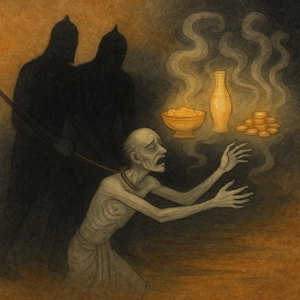
Preta state.
Unstable. Sensitive. Dependent.
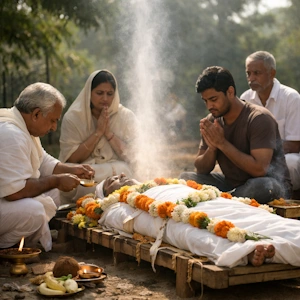
This is why antyeshti and post-death rites exist.
10th day. 12th day. 13th day.
These are not social rituals.
They are transformation steps.
They move the being from preta to pitru.
Only after this, entry into the pitru system happens.
Without this, the being does not settle properly.
What happens when he enters the pitru system
Now understand this properly.
He does not just ‘join ancestors’.
He is placed.
There is a structure.
A lineage chain.
The newly deceased becomes the nearest pitru.
The earlier generation shifts one level upward.
The older ones move deeper into subtle layers.
This is a living system.
Always adjusting. Always reorganizing.
Not emotional. Functional.
Do pitrus evolve?
Yes. They evolve.
But their evolution depends on three things:
– Their own karma
– Proper shraddha and tarpana from descendants
– Continuity of lineage remembrance
When these are aligned, movement happens.
Refinement increases.
Dependence reduces.
Clarity improves.
If these are absent:
Stagnation starts.
Heaviness builds.
Movement slows down.
Not punishment. Just consequence.
Can they remain stuck?
They are not permanently stuck.
But they can appear stuck.
This happens when:
– Death was disturbed
– Rites were not done properly
– Lineage breaks
– Strong karmic residue exists
In such cases, the being does not transition cleanly.
He stays in an unstable or slow-moving state.
This is where confusion starts.
People say ‘trapped soul’.
Not accurate.
It is incomplete transition.
Interaction with other pitrus
There is no physical meeting.
But there is alignment.
Lineage memory stabilizes.
Identity merges into the ancestral stream.
Connection becomes continuous.
He is now part of the same flow.
What determines his condition there
Not everyone in pitruloka has the same experience.
It depends on:
– Personal karma
– Mental state at death
– Quality of rituals performed
– Ongoing support from descendants
Same family. Different states.
Final direction of every pitru
No one remains a pitru forever.
Movement continues.
Either:
– Return to birth
– Move to higher subtle states
– Eventually towards liberation
The system is dynamic.
Always.
The real point most people miss
Shraddha is not respect.
It is participation.
You are not doing something ‘for the dead’.
You are maintaining a living chain.
Their movement depends partly on you.
And your life is shaped by that same chain.
So when you ignore them,
you are not just neglecting the past.
You are interrupting a process
that includes you.
That is the real understanding.
1
Question: Why is the Pitru state not considered final or permanent
Answer: Because the system is dynamic. A being does not freeze after becoming a Pitru. It continues to move through stages based on karma, support from descendants, and overall alignment. Continuity, not stagnation, defines this framework.
2
Question: What is the real role of the Preta phase before becoming a Pitru
Answer: It is a transition stage. The being is unstable and requires structured support. The post-death rites stabilize and prepare it for entry into the Pitru system. Without this phase being handled properly, settlement is delayed.
3
Question: What happens structurally when a new Pitru enters the lineage
Answer: The system reorganizes. The newly departed becomes the nearest Pitru. Earlier generations shift upward. This shows that the lineage is active and constantly adjusting, not a static collection of individuals.
4
Question: What factors influence the evolution of a Pitru
Answer: Three main factors. Personal karma. Proper Shraddha and tarpana. Continuity of remembrance by descendants. When these are aligned, refinement and movement happen naturally.
5
Question: What is the deeper meaning of Shraddha in this context
Answer: It is participation in an ongoing system. Not just remembrance. It supports the movement of the Pitru and maintains the continuity of the lineage. It connects past, present, and future in a functional way.
1
Objection: This sounds like ancestors depend completely on the living
Reply: Dependence is partial, not total. Their own karma plays a major role. Descendants provide support that helps stabilization and movement, but they do not override the entire process.
2
Objection: The idea of shifting levels in a lineage feels abstract
Reply: It is a way of describing structured continuity. Even in living systems, roles shift as new members enter. The same principle is applied here to explain movement within the ancestral chain.
3
Objection: If movement continues, why perform Shraddha regularly
Reply: Because continuity matters. Regular support maintains stability and assists progression. Gaps in support can slow the process, even if they do not stop it entirely.
4
Objection: The concept of incomplete transition sounds like superstition
Reply: It reflects a process where stabilization has not occurred fully. The description may use symbolic language, but the idea of transition phases and incomplete adjustment is consistent with structured systems.
5
Objection: This makes the system seem too complex for ordinary people
Reply: The complexity lies in explanation, not in practice. The actual requirement is simple. Perform duties with sincerity and continuity. The system handles the rest.





English
Garuda Puranam
Click on any topic to open
7
30
Astrology
Bhagavad Gita
Bhagavatam
Bharat Matha
Devi
Devi Mahatmyam
Ganapathy
Garuda Puranam
Glory of Venkatesha
Hanuman
Kathopanishad
Mahabharatam
Mantra Shastra
Mystique
Practical Wisdom
Purana Stories
Radhe Radhe
Ramayana
Rare Topics
Rigveda Explained
Rituals
Sages and Saints
Shiva
Spiritual books
Sri Suktam
Story of Sri Yantra
Temples
Vedas
Vishnu Sahasranama
Yoga Vasishta
26
17
10
0


