Can a Daughter Perform Shraddha for her Parents?
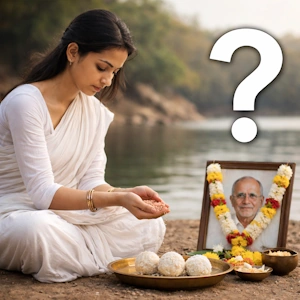
This is one of those topics where people either become defensive or become careless.
Both reactions miss the point.
Let us deal with it properly.
Why only sons traditionally perform Shraddha — and modern clarity
First understand one thing clearly.
The traditional rule did not come from the idea that daughters are lesser.
It came from how the grihastha and lineage system was structured.
Shraddha is not just an emotional remembrance ritual. It is a lineage-linked duty. It belongs to the continuity of the family line, the gotra-based ancestral stream, and the responsibility passed through the male line in the classical household system.
That is the traditional foundation.
Why sons were given this role
In the old dharmic framework, the son remained the ritual continuator of the father's line.
He carried forward: the gotra, the family lineage, the ancestral obligations, the annual rites, and the continuity of offerings to pitrus.
This is why so much importance was given to putra in dharma texts.
The son was not valued merely as a biological child. He was valued as the one who would continue the pitru-karya. He stood in ritual continuity with the ancestors.
That is the core logic.
So the rule was functional. Not sentimental. Not anti-woman. Functional.
Why daughters were generally not placed in that role
Because after marriage, in the traditional structure, the daughter became part of another household's ritual flow.
Her primary dharmic alignment shifted to the family she entered through marriage.
That meant her central ritual duties were now linked there.
So the issue was not lack of love for parents. It was ritual jurisdiction.
This is the part modern people often miss.
Shraddha is not based only on affection. It is based on adhikara.
This word means more than just responsibility. It means the right and qualification to perform a specific ritual role. A combination of eligibility, duty, and standing within the lineage system.
You may deeply love someone. That alone does not automatically define who performs which samskara in the dharmic system.
Love and ritual role are not always the same thing.
Why this feels difficult in modern times
Because the old family structure has changed.
Today many families have: only daughters, no children, sons who do not care, children living abroad, broken family links, or total ignorance of rituals.
So the old system is no longer operating in a clean traditional way in many homes.
That creates a real question: if there is no son, then what?
And this is where modern clarity becomes necessary.
What should be understood today
The deeper principle of Shraddha is not that pitrus must be abandoned if there is no son.
The deeper principle is that ancestors must not be neglected.
That is the real dharmic concern.
If a qualified son exists, willing and able, traditionally he should perform it. That remains the cleanest alignment within the old system.
But if there is no son, or the son is absent, incapable, indifferent, hostile, or completely disconnected, then the ritual duty does not vanish into emptiness.
Dharma is not stupid. Dharma is not a machine that says: 'No son, so let the ancestors go uncared for.'
That is not serious understanding.
In such situations, other pathways have always been used in practice. These are not all equally equivalent. They follow a rough order of classical preference.
A grandson comes first. Then an adopted son formally brought into the lineage. Then other male relatives from the paternal line. Then a priest acting formally on behalf of the family. And in present-day situations where none of these exist, a daughter taking responsibility with sincerity.
This is where people need maturity.
Tradition gives structure. Reality demands application.
Can daughters do Shraddha?
This has to be answered carefully.
If you ask from the strict classical household model, the primary duty was assigned to the son or male ritual successor of the lineage.
That is the traditional position.
But if you ask from the standpoint of real modern family situations, many learned people now accept that when no son is available, a daughter should not be stopped from ensuring that Shraddha, tarpana, or memorial rites are properly done.
A natural question arises here.
If the daughter's ritual jurisdiction shifted to her husband's family after marriage, how can she perform rites for her birth family?
The answer is this. When there is no male ritual successor left in the birth family, the daughter's duty toward her birth parents takes precedence over the default structural rule. The structure existed to serve the ancestors. When the structure itself is absent, the duty to the ancestors remains.
Because neglect is worse than technical rigidity.
A sincere daughter who takes responsibility for her parents is closer to dharma than a son who is alive but careless, arrogant, or absent.
This has to be said plainly.
Empty biological status is not higher than actual responsibility.
There is also a practical pathway many families use.
A daughter can assign her husband to perform Shraddha on behalf of her birth parents.
The husband acts here not as a ritual successor of that lineage, but as a representative fulfilling the duty on his wife's behalf.
This has been accepted in practice in many sampradayas.
It is a clean and dignified solution when no male successor exists in the birth family.
At the same time, one should not twist this into careless slogan-making such as: 'There is no difference at all, all rules are outdated.'
That is also wrong.
There was a difference. There was a reason. The traditional structure had internal logic. It should be understood respectfully, not mocked.
But where the structure itself has collapsed, dharma must still be preserved through the best possible means.
That is the balanced understanding.
What matters most
Three things matter most.
Intention. Proper procedure. Continuity.
If the rite is done with reverence, with correct guidance, and with genuine responsibility toward the ancestors, it carries meaning.
If someone is unsure, the safest route is simple: consult a competent traditional priest from your sampradaya, follow the family custom where available, and do not let ego, politics, or modern shouting destroy pitru-karya.
Because this subject is not about social point-scoring.
It is about gratitude. It is about continuity. It is about not cutting yourself off from those through whom your life came.
The straight understanding
Traditionally, sons performed Shraddha because they carried the ritual continuity of the paternal line.
That was a structural dharmic rule, not a statement that daughters are inferior.
In modern conditions, where that traditional framework is often broken, the higher principle is this: the ancestors should not be left uncared for.
Respect the traditional rule where it can be followed. Where it cannot, ensure the duty is still fulfilled in the most sincere and dharmic way possible.
1
Question: Why was the role of Shraddha traditionally assigned to sons
Answer: Because Shraddha is tied to lineage continuity, not just emotion. The son carried forward the gotra, ancestral duties, and ritual obligations. The role was assigned based on structure and continuity, not preference or superiority.
2
Question: What does adhikara mean in the context of Shraddha
Answer: It means rightful eligibility based on position within the lineage system. It is not just willingness or love. It is a combination of duty, qualification, and placement within the traditional framework.
3
Question: Why does the traditional rule feel difficult to apply today
Answer: Because the original household structure has weakened. Many families no longer have a clear ritual successor. Migration, disconnection, and lack of knowledge have broken the continuity that the rule depended on.
4
Question: What is the core principle that must not be lost in modern application
Answer: That ancestors should not be neglected. The system exists to maintain continuity with them. When the original structure is not available, the duty remains and must be fulfilled through the closest possible means.
5
Question: What is the most balanced way to approach this topic today
Answer: Respect the traditional framework where it is intact. Where it is not, act with sincerity and responsibility to ensure Shraddha is still performed. Avoid both rigid rejection and careless dismissal of the system.
1
Objection: This rule clearly shows bias against daughters
Reply: The rule was based on lineage structure, not value judgment. It defined roles within a system. It did not measure worth or affection. Modern application must understand the structure before judging it.
2
Objection: If daughters can perform Shraddha today, why keep the traditional rule at all
Reply: Because the rule reflects how the system was designed to function. Removing it completely ignores its logic. The correct approach is to adapt when needed, not erase the structure entirely.
3
Objection: If intention matters most, why worry about who performs the ritual
Reply: Intention alone does not define ritual effectiveness. Structure ensures proper alignment. Both intention and correct method are required for the system to function fully.
4
Objection: Allowing daughters or others to perform Shraddha will dilute tradition
Reply: Dilution happens when understanding is lost, not when responsibility is taken seriously. Ensuring continuity with sincerity preserves the purpose even when the form adapts.
5
Objection: This topic creates unnecessary complexity in modern life
Reply: The complexity already exists because the original structure has changed. Ignoring it does not simplify anything. Clear understanding allows practical and respectful solutions.





English
Garuda Puranam
Click on any topic to open
7
30
Astrology
Bhagavad Gita
Bhagavatam
Bharat Matha
Devi
Devi Mahatmyam
Ganapathy
Garuda Puranam
Glory of Venkatesha
Hanuman
Kathopanishad
Mahabharatam
Mantra Shastra
Mystique
Practical Wisdom
Purana Stories
Radhe Radhe
Ramayana
Rare Topics
Rigveda Explained
Rituals
Sages and Saints
Shiva
Spiritual books
Sri Suktam
Story of Sri Yantra
Temples
Vedas
Vishnu Sahasranama
Yoga Vasishta
26
17
10
0


