Mukta's Dialogue with Brahma in Brahmaloka
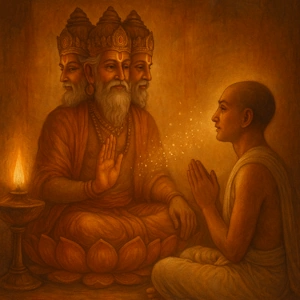
As he puts his foot on its steps, Brahma asks him, 'Who are you?'
He replies, 'I am originated from the Svayambhu, Svayam Prakasha Iswara, who is the cause of the universe. I am beyond the limitations of the bhutas. I am the cause of the bhutas. I am the truth. I am Atma, so are you,' he tells Brahma. 'Whatever you are, that I am.'
Brahma asks again, 'Who am I?'
He says, 'You are the truth.'
Brahma asks, 'What is truth?'
He says, 'You are truth who contains everything.'
ते ब्रह्मलोकेषु परान्तकाले
परामृताः परिमुच्यन्ति सर्वे
At death, they enter Brahmaloka and attain immortality, becoming permanently detached from all the shackles of samsara.
We have seen that Brahma described here is none other than Sri Hari. Brahmatva is sayujya with Sri Hari.
मामुपेत्य तु कौन्तेय पुनर्जन्म न विद्यते
Upon reaching me, there is no rebirth.
सर्वाज्जीवे सर्वसंस्थे बृहन्ते
अस्मिन् हंसो भ्राम्यते ब्रह्मचक्रे
पृथगात्मानं प्रेरितारं च मत्वा
जुष्टस्ततस्तेनामृतत्वमेति
Brahmachakra – existence is compared to a wheel. It is not a straight line with a beginning and an end. It is a wheel. You mark a point on a wheel, start rotating it, and the point will keep on coming back to you. After every rotation, the same point will come back. Everything in this universe occurs in cycles.
It is obvious. Sunrise – day – sunset – night – again sunrise – day – sunset – night. The seasons keep on repeating in cycles.
The narrow view of modern life is – life is short, live passionately. Life is a one-time offer, use it well. Do not dwell in the past, do not dream of the future, concentrate the mind on the present moment.
Why do we think that life is a one-time affair? Why do we behave as if we are not seeing this natural phenomenon of cycles? Life repeats – take birth – live – die – again take birth – live – die.
A man of intelligence and discretion would treat life accordingly – with long-term goals, not just what pertains to day-to-day life or is limited to this birth. You are responsible for the consequences of what you do. So act intelligently, accept facts, accept truth, and live accordingly.
The intelligent man recognizes who rotates this Brahmachakra. He recognizes Paramatma. He understands that only the mercy of that Paramatma can ever take him out of these cycles. When he develops this understanding, Paramatma shows mercy upon him and makes him a jeevan mukta – liberated.
यथा नद्यः स्यन्दमानाः समुद्रेऽस्तं गच्छन्ति नामरूपे विहाय
तथा विद्वान् नामरूपात् विमुक्तः परात्परं पुरुषमुपैति दिव्यम्
After Ganga flows into the ocean, does it exist as Ganga anymore? After Godavari flows into the ocean, does it exist as Godavari anymore? Both their individual names and forms disappear.
This is what happens when the mukta attains Sri Hari. His individuality will be gone. He attains oneness with Sri Hari. He will lose his individual name and form.
Does air have a definite form? Still, it can strike as a storm, move a ship, and impart life. Does lightning have a definite shape? Every strike of lightning has a different shape, yet look at its power. Do the clouds have a definite form? Still, they drizzle, they pour, they cause cloudbursts, they sustain life on earth.
So, an individual form is not necessary. The jeevatma, after discarding its sheaths, merges into Paramatma. The mukta, the liberated one, can assume any form he wants and move about anywhere he wants. His limitations will be gone. He can be the air, he can be the lightning, and he can be the rain in the clouds.
स हि नारायणो ज्ञेयः सर्वात्मा पुरुषो हि सः । न लिप्यते मलैश्चापि पद्मपत्रमिवाम्भसा । कर्मात्मात्वपरो योसौ मोक्षबन्धैस्स युज्यते । स सप्तदशकेनापि राशिना युज्यते पुनः ।
Sri Hari Narayana is the soul of everything. He is Paramatma. Just as water rolls off the surface of a lotus leaf, impurities do not get attached to him. Karmatma or jeevatma is different – it gets engaged in and attached to action. With the seventeen tattvas, the jeevatmas appear in innumerable permutations and combinations. But in reality, there is only one Paramatma – that is Sri Hari.
-
How can two selves be the same Self?
The deeper Self is one, like space appearing inside many pots. Pots differ, space does not. Realizing this ends the sense of separation. -
What does truth mean here?
Truth is what never changes. Bodies, thoughts, and roles change. The witness of all change is the truth of you. -
Why compare reality to a wheel?
Because events run in lawful cycles. Birth, growth, decay, renewal. Seeing the pattern makes life intelligible, not random. -
If life runs in cycles, what is real progress?
Progress is inner clarity and virtue that carry forward. Wisdom upgrades; habits drop. The spiral rises even as cycles repeat. -
What actually breaks the cycle of rebirth?
Self-knowledge joined with surrender to the supreme. Effort prepares; grace completes. Together they end bondage. -
What is immortality in this teaching?
Freedom from birth and death. It is abiding as the changeless Self, not living forever in a body. -
Does losing individuality erase love and creativity?
No. Ego falls, love expands. Action flows without grasping. Creativity becomes unobstructed and harmless. -
How can a liberated one still act?
Like wind or lightning, action happens without bondage. There is doing, but no inner doer-claim. -
If the supreme is untouched, why do my actions matter?
Actions sculpt your mind and fitness for insight. Karma is the classroom; freedom is graduation. -
What is Brahmaloka in practical terms?
A highest state of understanding and nearness to the supreme. It is more about realization than geography. -
Is self-effort enough by itself?
No. Self-effort is essential discipline. Grace is the decisive release. Both operate lawfully. -
How do I align long-term goals with this view?
Prioritize character, knowledge, devotion, and service. Choose what remains when circumstances change. -
How do I recognize the mover of the cosmic wheel?
Through study, reflection, meditation, and loving service. The mind becomes clear; recognition dawns. -
What happens to the fear of death?
It dissolves when identity shifts from body-mind to the witnessing Self. Death becomes a change of costume. -
Is oneness a blank void?
No. It is full, intelligent, blissful presence. Silence that knows, not emptiness that lacks. -
Does worship of a personal form clash with nonduality?
No. Form is a doorway to the formless. Devotion ripens into recognition. -
If all is one, what about moral responsibility?
Oneness deepens it. Hurting another is self-harm. Compassion becomes rational, not optional. -
Can science and this philosophy coexist?
Yes. Science maps patterns in phenomena. This inquiry addresses the ground of being those patterns arise in.





English
Vishnu Sahasranama
Click on any topic to open
7
30
Astrology
Bhagavad Gita
Bhagavatam
Bharat Matha
Devi
Devi Mahatmyam
Ganapathy
Garuda Puranam
Glory of Venkatesha
Hanuman
Kathopanishad
Mahabharatam
Mantra Shastra
Mystique
Practical Wisdom
Purana Stories
Radhe Radhe
Ramayana
Rare Topics
Rigveda Explained
Rituals
Sages and Saints
Shiva
Spiritual books
Sri Suktam
Story of Sri Yantra
Temples
Vedas
Vishnu Sahasranama
Yoga Vasishta
26
17
10
0


