Consecration: When the Divine Takes Seat
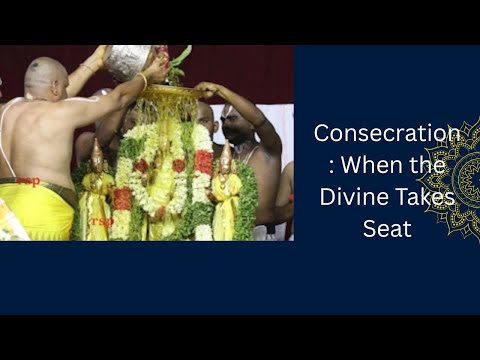
What exactly does ‘consecration’ mean? Is it just a ritual or something deeper?
Consecration isn’t just about a ceremony. It's the act of bringing down the Divine into form. You're not just placing an idol or opening a temple — you are invoking life into matter. In Sanskrit, this is known as prāṇa pratishṭhā — literally, establishing life-force (prāṇa) into a murti, space, or symbol.
Imagine placing your deepest devotion, your surrender, your entire being into a gesture that invites the Infinite to dwell in the finite.
So, no, it's not just a ritual. It is a living invitation to the Divine.
What is the role of the devotee in a consecration? Are they just spectators?
Not at all. The devotees are not just audience. Devotees are co-creators of the sacred.
In a consecration, the spiritual intent (bhāva) of the devotee charges the atmosphere. It's not about passively watching priests chant — it's about aligning your own inner fire with the outer invocation.
Consecration is not merely a transfer of power, but a merging of presence. Devotees open the channel through which that sacred presence flows.
So the devotee is not a bystander — they are a vessel.
Why is consecration considered so powerful or necessary at all? Isn’t God everywhere anyway?
Yes — God is indeed everywhere. But here's the twist: consecration is about concentration.
Think of it like this: sunlight is everywhere, but when passed through a magnifying glass, it becomes a fire. Consecration is that magnifying glass. It focuses the ever-present Divine into a tangible, palpable, and relatable experience.
The Divine gets clothed in form, sound, rhythm, and scent — and becomes accessible to our limited human senses. It’s a doorway through which you don’t just believe in God, you meet God.
Is consecration limited to temples and idols only?
Not at all.
Consecration can happen to:
- a place
- an object
- a body
- or even an intention.
In yogic traditions, even a person can be consecrated — becoming a living temple. A master can consecrate their disciples. A mother can consecrate a child through her love and sankalpa. Consecration is the art of making something sacred through presence, awareness, and energy.
So yes, temples are one form. But the whole world — and even your own body — can become a sanctum.
What happens after a place or object is consecrated?
After consecration, it becomes alive. Yes, truly alive.
The space begins to pulse with chaitanya — consciousness. People may feel stillness, tears, or an unexplainable pull. Time slows down. Thoughts quieten. Grace becomes tangible.
But here's the secret: that consecrated space begins to shape you. It doesn't just radiate energy — it begins to work on you, silently, patiently, reshaping your inner world.
You don’t just visit a consecrated temple — it begins to dwell inside you.





English
Temples
Click on any topic to open
7
30
Astrology
Bhagavad Gita
Bhagavatam
Bharat Matha
Devi
Devi Mahatmyam
Ganapathy
Garuda Puranam
Glory of Venkatesha
Hanuman
Kathopanishad
Mahabharatam
Mantra Shastra
Mystique
Practical Wisdom
Purana Stories
Radhe Radhe
Ramayana
Rare Topics
Rigveda Explained
Rituals
Sages and Saints
Shiva
Spiritual books
Sri Suktam
Story of Sri Yantra
Temples
Vedas
Vishnu Sahasranama
Yoga Vasishta
26
17
10
0


