Mayuresha Ganapathy: Lord Ganesha’s Peacock-Mounted Form
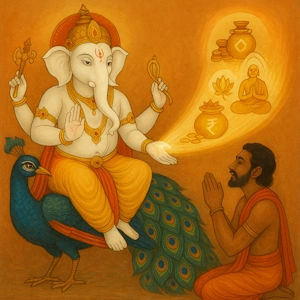
Mayuresha Ganapathy (also known as Mayureshwar or Moreshwar) is a celebrated form of Lord Ganesha. According to the Ganesha Purana, in the Treta Yuga Ganesha incarnated in this form to defeat a powerful demon named Sindhu.. In this incarnation, Ganesha was born to Shiva and Parvati with a white complexion and six arms, a form uniquely suited to battle evil .The name Mayuresha (from Mayura, meaning peacock) comes from his unusual mount – a divine peacock – which he rode instead of the familiar mouse vehicle.
One legend describes how Ganesha obtained the peacock as his vehicle. When Ganesha was a child, he accidentally cracked open a mystical egg from which a peacock emerged. The peacock agreed to serve as Ganesha’s vahana (mount) on the condition that its name be prefixed to the lord’s name. Ganesha accepted, thus being called Mayureshwar.
The primary origin story of Mayuresha centers on the demon king Sindhu and Ganesha’s battle against him. Sindhu was the son of King Chakrapani and Queen Ugra. He was born by the grace of the sun god Surya, after Ugra invoked a powerful mantra to conceive. However, the fetus radiated such intense heat that Ugra cast it into the ocean. The ocean deity returned the child to Chakrapani, and the boy was aptly named Sindhu (meaning “ocean”). As Sindhu grew, he performed severe penance to please Surya and was rewarded with a bowl of amrita (nectar of immortality). Surya warned that Sindhu would remain invincible as long as the nectar bowl was intact, so the cunning Sindhu swallowed the bowl to safeguard it. Empowered by this boon, Sindhu became arrogant and unleashed terror on the gods, even imprisoning divine beings like Indra and Vishnu.
The desperate gods turned to Lord Ganesha for help. Ganesha promised to be born as Parvati’s son and destroy the demon. Fulfilling this promise, Ganesha took birth in Parvati’s womb on Bhadrapada Shukla Chaturthi (the fourth day of the bright half of the Bhadrapada month). When he reached the age of ten, circumstances led Ganesha and his parents to confront Sindhu. Ganesha mounted the divine peacock Mayur and marched to battle, accompanied by Shiva’s army.
During the fierce confrontation, Ganesha first slew Sindhu’s two sons and the demon general Kamalasura. Finally, Ganesha faced Sindhu himself. Seated on the peacock, he invoked his power and hurled his Parashu (battle-axe) at Sindhu. The axe struck Sindhu with precision. It split open the demon’s belly, shattering the nectar vessel within and spilling the life-giving liquid. With the source of his immortality destroyed, Sindhu was instantly slain. The gods rejoiced as Lord Ganesha achieved victory, liberating the heavens from Sindhu’s tyranny.
After the defeat of Sindhu, several auspicious events followed. The creator god Brahma built a shrine at the spot (Morgaon) to honor Ganesha’s triumph. Brahma also arranged the marriage of Ganesha to Siddhi and Buddhi (also known as Riddhi and Siddhi), personifications of spiritual power and intellect, to celebrate the victory. At the end of this incarnation, Ganesha returned to his divine abode, but not before rewarding the faithful peacock. He entrusted the peacock mount to his brother Skanda (Kartikeya), which is why a peacock is generally associated with Kartikeya thereafter.. In some local traditions, however, it is believed that Ganesha remained at Morgaon in spirit, blessing the land by his presence. Either way, the legacy of this event was the establishment of Lord Mayureshwar at Morgaon, where devotees could thereafter worship Ganesha in his peacock-riding form.
Symbolism and Iconography
Mayuresha Ganapathy’s form is rich in symbolism, reflecting attributes that distinguish it from other depictions of Ganesha:
- Peacock Mount (Mayura) – The peacock (mayura) is the most striking attribute of Mayuresha. Riding the peacock signifies Ganesha’s mastery over pride and vanity (qualities the peacock can symbolize). It is a unique departure from Ganesha’s usual mouse vehicle and highlights the special purpose of this incarnation. In the temple at Morgaon, both the peacock and the mouse are depicted in front of the deity, acknowledging Ganesha’s role as Mayureshwar as well as his more typical aspect (with the mouse vahana).
- Complexion and Eyes – Mayuresha is described as having a white complexion in scriptures. The color white symbolizes purity, spiritual wisdom, and sattva (harmony). This sets him apart from many popular images of Ganesha which are often depicted in red or golden hues. Additionally, the idol of Mayureshwar at Morgaon is said to have three eyes, the third eye representing divine insight and equating him with aspects of Shiva (who also bears a third eye). The presence of the third eye reinforces Mayuresha’s role as a destroyer of evil (as Shiva’s third eye does) and a guardian of cosmic balance.
- Snake and Other Features – Another Shaivite symbolic element in this form is the cobra. At Morgaon, a cobra’s hood is carved protectively over Ganesha’s head and the snake’s fangs extend over his forehead .Snakes often symbolize energy (kundalini) and protection in Hindu iconography. Ganesha’s trunk in this form is turned to the left side, wrapped with a serpent, indicating a calm and auspicious nature of the deity. The eyes and even the navel of the idol are embedded with diamonds at the temple, signifying the preciousness of divine vision and life-force.
- Consorts Riddhi and Siddhi – Mayuresha Ganapathy is often flanked by his two consorts: Riddhi (prosperity, or sometimes interpreted as intellect) and Siddhi (spiritual power or success) .In the Morgaon icon, small images of these goddesses are placed alongside Ganesha. The inclusion of Riddhi and Siddhi in Mayuresha’s iconography emphasizes completeness and fulfillment – Ganesha as Mayureshwar not only removes great obstacles (like the demon Sindhu) but also grants spiritual success and material prosperity to his devotees. Many common Ganesha depictions do not show consorts, so their presence here underlines the special status of Mayuresha as a giver of boons after his victory.
- Appearance and Bearing – Like most Ganesha idols, Mayureshwar is depicted seated calmly, even though his origin story is warlike. At Morgaon, the deity is in a seated posture with one leg folded under (lalitasana). Despite the battle associations, the expression is gentle and benevolent, indicating that the form is meant to be worshipped for blessings, not feared. The idol is anointed with a thick coat of sindoor (vermilion), giving it an orange hue. In fact, over centuries the layers of vermilion have increased the apparent size of the idol; the core image is much smaller, believed to be a naturally arisen stone (a svayambhu form) in the shape of Ganesha. This self-manifested nature adds to its sanctity, as devotees believe the idol was not man-made but divinely appeared.
Overall, the symbolism of Mayuresha Ganapathy integrates valour and benevolence. The peacock mount and weaponry highlight Ganesha’s role as a warrior-avatar who vanquished evil for the gods, while his serene posture, pot-belly, and the presence of sweets and consorts remind devotees of his ever-gentle, boon-giving aspect. This blend of attributes makes Mayureshwar a uniquely multifaceted form of Ganesha, embodying both the remover of obstacles and the vanquisher of demons in one image.
Significance in Pilgrimage
Mayuresha Ganapathy holds a special place in worship, especially within the state of Maharashtra, India. He is one of the famed Ashtavinayaka, the eight forms of Ganesha venerated in eight ancient temples across Maharashtra. In fact, Mayureshwar of Morgaon is traditionally regarded as the most important of the Ashtavinayaka temples. The pilgrimage of Ashtavinayaka begins and ends at Morgaon, signifying its primacy – devotees typically start their tour by seeking Mayureshwar’s blessings and conclude the tour by returning to thank him again. It is often said that the Ashtavinayaka yatra is incomplete without a final visit to Morgaon’s Mayureshwar temple.
Beyond the Ashtavinayaka circuit, Morgaon is revered as a major center of the Ganapatya sect, a Hindu tradition that worships Ganesha as the Supreme Being. In medieval times, the Ganapatya devotees established Morgaon as an adhya pitha, or primary seat of Ganesha worship. Both of the principal Ganapatya scriptures praise Morgaon’s sanctity: the Mudgala Purana devotes 22 chapters to extolling Morgaon, and the Ganesha Purana lists Mayurapuri (Morgaon) as one of the three greatest abodes of Ganesha across the cosmic realms (the other two being Kailash in the heavenly realm and a subterranean abode.
Regionally, Mayuresha Ganapathy has been deeply embedded in the religious culture of Maharashtra. The very name of Morgaon village is linked to the deity – Mor in Marathi means peacock, referencing either the abundant peacocks that once lived there or the peacock-riding lord himself. The temple and its lore have been part of the collective memory and spiritual life of the people for centuries. The devotion to Morgaon’s Ganesha was popularized by saints and supported by rulers. For example, the saint Morya Gosavi (14th–15th century), a prominent Ganapatya devotee, frequented Morgaon for worship before establishing his own shrine at Chinchwad. Later, in the 17th–18th centuries, the Peshwa rulers of the Maratha Empire, who considered Ganesha their kuladaivat (family deity), became patrons of the Morgaon temple. They donated land and funds, which helped in renovating the temple and maintaining regular festivals. This royal patronage further cemented Mayureshwar’s importance in the region’s religious landscape.
Devotees believe that Mayuresha Ganapathy is particularly powerful in granting boons and removing obstacles. A local tradition maintains that Morgaon’s soil is so sacred that prayers offered here never go unanswered. It is even compared to Kashi (Varanasi) in holiness – a saying in the Ganapatya texts is that liberation (moksha) is assured for those who pass away at Morgaon, just as it is for those who die in Kashi. The temple is sometimes referred to as Bhuswanandipur (abode of earthly bliss) in devout literature, emphasizing the divine bliss one experiences in this holy space. All these factors make Mayuresha not just a mythological figure, but a living focal point of worship – a form of Ganesha who is both the fierce demon-slayer of scripture and the compassionate obstacle-remover invoked in daily devotion.
In summary, within Hinduism, Mayuresha Ganapathy symbolizes Ganesha’s protective and victorious aspect, and his worship highlights themes of triumph of good over evil. Regionally, especially in Maharashtra, this form is of paramount importance – anchoring pilgrimages, inspiring folklore, and functioning as a guardian deity for countless devotees who affectionately call him Moreshwar. The blend of pan-Hindu scriptural significance and strong local devotion makes Mayuresha a revered and enduring form of Lord Ganesha.
Festivals and Rituals Associated with Mayureshwar
As one of the foremost Ganesha temples, the Morgaon Mayureshwar shrine observes all major Ganesha festivals with great fervor, along with some unique local traditions:
- Ganesh Chaturthi (Bhadrapada) – This is the famous Ganesha festival that falls in late summer (around August/September). At Morgaon, Ganesh Chaturthi is the grandest celebration of the year. Devotees flock in tens of thousands on Bhadrapada Shukla Chaturthi, commemorating the day Parvati’s worship brought Ganesha to life and, by extension, the day associated with Mayureshwar’s birth. The festival at Morgaon doesn’t end in a single day – the celebrations continue for more than a month, until Ashwin Shukla Dashami (the tenth day of the next month). Throughout this period, special pujas (ritual worship), bhajans (devotional songs), and cultural programs are held daily. A highlight is the procession (palkhi yatra): a decorated palanquin carrying an idol or symbolic image of Ganesha is brought from the Mangalmurti temple in Chinchwad (established by Morya Gosavi) to Morgaon. This yatra reinforces the historical link between the two sites and the devotion of the Ganapatya saints. On the Chaturthi day and final immersion day, processions of drumming, dancing, and chanting devotees wind through Morgaon’s streets, and the temple is open almost round the clock for darshan (seeing the deity).
- Ganesh Jayanti (Magha) – Ganesh Jayanti, also known as Maghi Ganesh Chaturthi, falls on the 4th day of the bright half of Magha (usually January/February). In Maharashtra, this day is considered Ganesha’s birthday by some traditions. At Morgaon, Ganesh Jayanti is another major occasion when crowds of pilgrims arrive to celebrate Lord Mayureshwar. Festivities include early morning abhishekam (ritual bathing of the idol) and a special abhishek with 21 different herbs and scented waters, as per local priests. Devotees often observe a fast until they have offered prayers on this day. As on Ganesh Chaturthi, a palanquin procession from Chinchwad’s temple comes to Morgaon, symbolizing that the distant devotees are coming home to Mayureshwar for the celebration. The Magha Chaturthi day is also linked to Mayureshwar’s legend: a local story says Ganesha was particularly pleased on this day and granted darshan on the peacock, giving rise to the name Mayureshwar. Thus, many consider Magha Chaturthi the appearance day of Mayuresha Ganapathy.
- Monthly Chaturthi Observances – Apart from these yearly festivals, the temple observes every Shukla Chaturthi (4th day of the bright lunar fortnight) and Krishna Chaturthi (4th of the dark fortnight) with special prayers. Ganesha’s worship days come twice a month, known as Vinayaki Chaturthi (waxing phase) and Sankashti Chaturthi (waning phase). On Sankashti Chaturthi, especially if it falls on a Tuesday (called Angaraka Sankashti), the temple sees larger crowds coming to perform rites to alleviate problems and obstacles in their lives. Devotees offer durva grass, modak sweets, and recite the Atharvashirsha Ganesha Upanishad in the temple premises on these days. The belief is that a vow of observing 21 consecutive Sankashti Chaturthi fasts and visiting Morgaon at least once in that period can fulfill cherished wishes, by Lord Mayureshwar’s grace.
- Vijayadashami (Dassera) – On Vijayadashami (the tenth day of Navaratri, around Octobre), Morgaon’s temple holds a smaller fair. Though primarily a festival for goddess Durga, Vijayadashami is considered auspicious for new beginnings, and devotees visit Mayureshwar to start ventures or purchases (some bring new vehicles for blessing). A palakhi of Ganesha might be taken out around the temple complex, and weapons of the deity (like the symbolic axe) are worshiped, aligning with the victory theme of the day.
- Daily Rituals – The temple has three main aartis (prayer ceremonies with lamps) every day: early morning around 7 AM, midday, and night around 8 PM. During these times, priests perform ritual worship by bathing the idol, dressing it in fresh clothes, adorning it with flower garlands, and waving lamps while singing Ganesha’s praises. Devotees often try to attend the Kakad Aarti (morning dawn aarti) for a serene experience, and the Shej Aarti (last aarti at night) which is done before the deity is symbolically put to rest. Prasad (sacred offering) in the form of modaks, fruits, and coconut is distributed to visitors. Many pilgrims also circumambulate the temple along a defined path (perform a pradakshina), which often includes encircling the entire village as a mark of complete devotion, since the whole village is considered sacred.
In the radiant form of Mayuresha Ganapathy, we witness a perfect fusion of might and mercy — a divine warrior who rose on a peacock’s wings to defeat evil, and a tender lord who blesses with prosperity and peace. His legend is not just a tale from ancient texts but a living force that still draws devotees to Morgaon, seeking hope, healing, and higher purpose. Whether as demon-slayer or wish-giver, Mayureshwar stands as a beacon of strength and sanctity. To walk in his path is to walk with courage, with clarity, and above all, with the assurance of divine grace clearing every obstacle.





English
Temples
Click on any topic to open
7
30
Astrology
Bhagavad Gita
Bhagavatam
Bharat Matha
Devi
Devi Mahatmyam
Ganapathy
Garuda Puranam
Glory of Venkatesha
Hanuman
Kathopanishad
Mahabharatam
Mantra Shastra
Mystique
Practical Wisdom
Purana Stories
Radhe Radhe
Ramayana
Rare Topics
Rigveda Explained
Rituals
Sages and Saints
Shiva
Spiritual books
Sri Suktam
Story of Sri Yantra
Temples
Vedas
Vishnu Sahasranama
Yoga Vasishta
26
17
10
0


