Concept of Time in the Vedas – Part 2
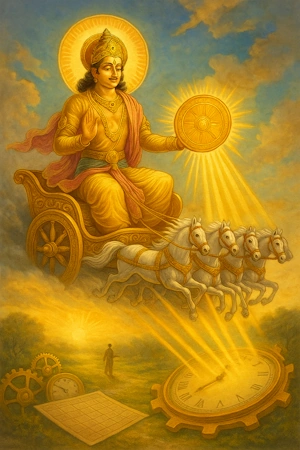
We have been looking at the Vedic reference to the concept of time as the controller of everything, controller of the world experience.
We have also seen that this concept is validated by the four sources of authentic knowledge as well.
Then we saw that we are able to perceive time due to the kindness of Surya Deva.
It is because he produces rays and sends them down, we are able to recognize and synchronize our activities with time.
नदीव प्रभवात् काचित्
अक्षय्यात् स्यन्दते यथा
तां नद्यः अभिसमायन्ति
सोरुः सती न निवर्तते
Time is being compared to a river – a mahanadi, a big river.
It keeps on coming out of its source.
It never stops.
It doesn’t halt even for a moment.
You can’t halt time even for a moment.
This flow of time is in the unit of samvatsaras – years.
Samvatsara or year is the primary unit of time that is unique, that keeps on repeating itself.
Understand this clearly.
The other units of time are not unique.
Take day – the sunrise today and tomorrow will not be at the same time. They are different.
Months are not unique – the duration of the months vary, the weather in different months are different.
But the only unit of time that repeats itself with all its constituents such as seasons is the year — samvatsara.
Here, samvatsara – the year – is compared to the mahanadi whose source never dries up,
And the other smaller units of time such as days, months, seasons to the tributaries who add up to the flow of the mahanadi.
Ultimately they all merge into single unity.
This is what is explained in the next mantra:
एवं नानासमुत्थानाः
कालाः संवत्सरं श्रिताः
अणुशश्च महशश्च
सर्वे समवयन्त्रि तम्
The other units of time — both big and small — months, pakshas, even the smaller units such as kala, muhurta —
They don’t have independent existence.
They all depend on the year and they all merge into year.
You take a month, according to our calendar — let’s say Bhadrapada — it can’t just come and go as it wants.
It has to come at a certain point of time in the yearly cycle.
It has to come during Sharad Rutu, when the weather is of a particular nature.
It has to come when the sun is at a particular place in the zodiac.
So none of the other units of time are independent.
The primary unit of time which is independent, which simply repeats itself, is the year.
The next mantra:
स तैः सर्वैः समाविष्टः
उरुः सन्न निवर्तते
अधिसंवत्सरं विद्यात्
तदेव लक्षणे
Even units bigger than the year — just as smaller units are dependent on it — the bigger units, for example take a millennium, they are a number of years added together.
A number of years identical with each other added together.
So, the bigger units are also dependent on this unit called year.
This is the unit of time that repeats itself without break, like how a river flows.
So for all practical purposes, year is the basic unit of time.
अणुभिश्च महद्भिश्च
समारूढः प्रदृश्यते
संवत्सरः प्रत्यक्षेण
नाधिसत्त्वः प्रदृश्यते
Even without knowing all these, this is what we follow also for all practical purposes.
We say somebody is thirty years old, fifty years old.
We don’t say someone is so many seconds old or so many seasons old.
We celebrate birthdays which are annual events.
We celebrate sixtieth birthday — they are all based on this unit of time called year.
We retire people when they are fifty-eight years old or sixty years old.
We give license to do something for five years, ten years.
Academic curriculum is in terms of number of years.
So even without knowing this Vedic principle, this is what we do — by default.





English
Vedas
Click on any topic to open
7
30
Astrology
Bhagavad Gita
Bhagavatam
Bharat Matha
Devi
Devi Mahatmyam
Ganapathy
Garuda Puranam
Glory of Venkatesha
Hanuman
Kathopanishad
Mahabharatam
Mantra Shastra
Mystique
Practical Wisdom
Purana Stories
Radhe Radhe
Ramayana
Rare Topics
Rigveda Explained
Rituals
Sages and Saints
Shiva
Spiritual books
Sri Suktam
Story of Sri Yantra
Temples
Vedas
Vishnu Sahasranama
Yoga Vasishta
26
17
10
0


