Do You Know Why Kaala and Varuna Are Called Gods?
Some youngsters think that religion is all about God and prayers.
At least in the case of Sanatana Dharma, that is not the case.
Of course divinity is at the core of Sanatana Dharma, no doubt.
Sanatana Dharma is about every aspect of human life.
Sanatana Dharma expands your thinking.
Sanatana Dharma challenges your intellect.
It is capable of taking you to realms and levels, that you would have never imagined existed.
We are discussing about the concept of time in the Vedas. Some aspects of it. Not everything.
We are looking at a particular set of mantras from Taittiriya Aranyaka, which is part of the Vedic corpus.
Already we have done two parts, if you have not heard the other parts, they are available in Vedadhara website, in the Mantras Explained section.
The earlier mantras reveal two important aspects of time –
It is because Surya Deva in kindness produces rays and they reach us that we are able to recognize time.
And also that the year is the primary unit of time which is unique.
All other units are not unique.
Year is the block of time that keeps on repeating itself.
The next mantra:
पटरो विक्लिधः पिङ्गः
एतद्वरुणलक्षणम्
यत्रैतदुपदृश्यते
सहस्रं तत्र नीयते
These two important points, why is it that we are not able to recognize these on our own, unless Vedas reveal these to us. We don’t think in this direction.
You will remember that what we are talking about here is that time is the controller of world experience.
If time runs backwards or time runs with breaks, then the whole world experience is going to be different.
It is because time comes out of its source perpetually like a river that we are able to have this present world experience.
What happens if time stops for some time?
What happens if time goes backward for some time?
We have seen time travel movies like Back to the Future.
How perplexing they are.
Veda says that the world experience is only because of this nature of time – that it flows incessantly and it flows in the forward direction.
That’s the way time wants us to experience the world.
For some reason.
Time has created a whole system around this nature of itself.
We keep on creating systems.
Offices work from 9 to 5 or 10 to 6.
Shops open from 10 to 9.
A lot of activities are aligned around this.
What if offices were to work in the night?
And shops can open only for half an hour every day?
Our whole functioning changes.
This is what time is doing here.
Giving us a certain world experience by flowing forward and flowing without break.
Then why are we not recognizing this?
Why are we so obsessed with this world experience, which is at the beck and call of time?
Time can start flowing backwards tomorrow onwards, we don’t know.
It may or may not happen.
Have you thought about this, what will happen if this happens tomorrow?
We don’t generally think.
It is very difficult to think and visualize.
Only some exceptional brains can do this.
Not everyone.
This mantra is revealing the reason for this.
That why we are not able to think like this.
Because our world experience is based on our sensory organs alone.
Here by using three terms – patarah, viklidhah, and pingah – the mantra is pointing towards the eye, the sensory organ eye, which represents all the other four sensory organs.
Primarily eye, because eye is the sensory organ directly linked to time.
We are not normally able to go to these levels of thinking because we are obsessed with information that the sensory organs provide us with.
The mantra calls the eye or the sensory organs as Varuna.
So, that means, the God Varuna stands for the sensory experience.
He is associated with the sensory experience.
And where is Varuna?
He is not in Swarga.
He is also there in Swarga.
But he is not just in Swarga.
He is in your body as the sensory organs.
So here we are seeing two divinities:
Kaala – time as the controller of world experience, and
Varuna – the senses who interact with time and give us this particular experience.
Understand this, this is what Veda is about.
When we say Veda means knowledge, this is what it means.
These are the kinds of thoughts that can trigger a scientist’s brain and end up in a product like virtual reality or even a time travel machine.
A lot of our scriptures have ended up in Europe.
This is what they do there.
Stimulate thinking.
Our scriptures give so much clarity.
Our day and the day of the Devas are different.
We count a day as a day because – sun rises every twenty-four hours.
Where the Devas are, their sun rises only once in a year.
It could be a different sun for them.
It is because this particular sun is visible to us that we have days that are twenty-four hours long.
Devas could be seeing a sunrise only once a year, as per our time unit.
See how fluid the concept of time is.
But we are obsessed because the divinity called Kaala – time – flows for us in a certain manner.
See here also.
Suppose you are standing on the banks of river and see that the river is flowing from your left to right.
Then you cross and stand on the other side, you will see that the same river is flowing from your right to left.
See how relative these concepts are.
They are not absolute.
This is what Vedas teach us.
So our own sensory organs or the divinity called Varuna, the God, is making us experience in thousand different ways – because the experience is again individual.
Some common and a lot individual.
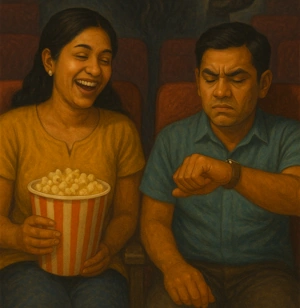
Two people are sitting and watching the same movie.
One enjoys it – for him the time runs.
The other is bored – for him time doesn’t move at all.
So why our sages call Kaala and Varuna as Gods?
Because when they realize their power and capability, they are in awe.
Such great powers.
That’s why they call them Gods.
This is how Vedic concept of divinity stands apart from other religions.
Even Trimurtis you see – the process of creation is a God – who is called Brahma.
The process of management of the created is a God – who is called Vishnu.
The process of elimination is a God – who is called Shiva.
Don’t look at it as if they do these.
That’s how it is presented because it can be understood by common man.
Because in the common we are used to seeing the doer as different from action.
In the Vedic realm, the doer and the action are one and the same.
The sages called these powers of the nature as divinities because the scale of what they do –
Can a man do this?
No.
So they are different, much more powerful.
Is there anything wrong in calling them Gods?
Don’t even think that the sages came out with these concepts.
They are already there in the Vedas.
They were just revealed to them.
And they gave it to us.
Passed it on to us.





English
Vedas
Click on any topic to open
7
30
Astrology
Bhagavad Gita
Bhagavatam
Bharat Matha
Devi
Devi Mahatmyam
Ganapathy
Garuda Puranam
Glory of Venkatesha
Hanuman
Kathopanishad
Mahabharatam
Mantra Shastra
Mystique
Practical Wisdom
Purana Stories
Radhe Radhe
Ramayana
Rare Topics
Rigveda Explained
Rituals
Sages and Saints
Shiva
Spiritual books
Sri Suktam
Story of Sri Yantra
Temples
Vedas
Vishnu Sahasranama
Yoga Vasishta
26
17
10
0


