Can a Leader Ever Stop Working?
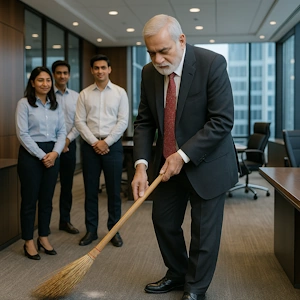
We see this — people who have founded great organisations, they have achieved, they have reached their goal. Still, they continue to work.
Why do they do this?
Materially, there is nothing more they would need or need to achieve.
Still, why do they continue working?
Bhagawan says in Gita –
'न मे पार्थास्ति कर्तव्यं त्रिषु लोकेषु किञ्चन
नानवाप्तमवाप्तव्यं वर्त एव च कर्मणि'
I am not under any compulsion to do anything. Not just here, anywhere, in the three worlds.
There is nothing that I have not attained or achieved so far. There is nothing that is yet to be achieved by me.
Still, I work. You will see me in action throughout.
I am here with you as your charioteer, guiding you. Not only this — so many things happening around, I am involved in everything.
You know why?
'यदि ह्यहं न वर्तेयं जातु कर्मण्यतन्द्रितः।
मम वर्त्मानुवर्तन्ते मनुष्याः पार्थ सर्वशः'
If I am not alert, if I sit back and relax, then others will start imitating me.
They will also stop working.
They will become lazy.
Because I am leader, everyone imitates me, everyone looks up to me.
They do as I do.
So, as a leader, I cannot afford to stop working.
It is not for any personal gain. I have nothing left to be achieved.
Still, as a leader, I have to do this.
'उत्सीदेयुरिमे लोका न कुर्यां कर्म चेदहम्।
सङ्करस्य च कर्ता स्यामुपहन्यामिमाः प्रजाः'
If I stop working, the others will become directionless. They will not know what to do henceforth.
There will be chaos, and the world will move towards destruction in no time.
Bhagawan is highlighting the role of the leader — the manager, the head of the family.
He or she can never stop working.
'सक्ताः कर्मण्यविद्वांसो यथा कुर्वन्ति भारत।
कुर्याद्विद्वांस्तथासक्तश्िचकीर्षुर्लोकसंग्रहम्'
Ordinary humans work with selfish motives — for money, for power, for recognition, for promotion.
They work with so many strings attached, attachments.
But the leader, who doesn’t have to work but still works — there is a difference.
He works with dispassion — as 'असक्तः', without asakti. This is the major difference.
This is an advantage, because there is nothing to be achieved. Asakti, or passion or attachment, can be easily avoided.
So these leaders, they go about working just as others do — but the difference is that they are not attached to what they do.
They are not looking for money, power, or recognition.
'कर्मणैव हि संसिद्धिमास्थिता जनकादयः।
लोकसंग्रहमेवापि संपश्यन्कर्तुमर्हसि'
Even great realized souls like Raja Janaka — they also did this.
They worked for the benefit of the world.
Even when there was no personal interest, they still worked for the benefit of the world.
So that the ordinary day-to-day rules of the world, which are essential for orderly functioning of the world, are not flouted.
Because ordinary people, they look up to the leader and do exactly as he does.





English
Practical Wisdom
Click on any topic to open
7
30
Astrology
Bhagavad Gita
Bhagavatam
Bharat Matha
Devi
Devi Mahatmyam
Ganapathy
Garuda Puranam
Glory of Venkatesha
Hanuman
Kathopanishad
Mahabharatam
Mantra Shastra
Mystique
Practical Wisdom
Purana Stories
Radhe Radhe
Ramayana
Rare Topics
Rigveda Explained
Rituals
Sages and Saints
Shiva
Spiritual books
Sri Suktam
Story of Sri Yantra
Temples
Vedas
Vishnu Sahasranama
Yoga Vasishta
26
17
10
0


