Brahma’s Answer to Suffering: Vasishta’s Arrival
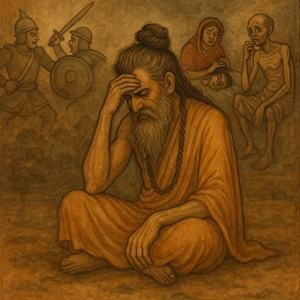
This is the 10th Sarga of the Mumukshu Vyavahara Prakarana in the Yoga Vasishta. Here, Sage Vasishta narrates how Brahma, moved by deep compassion for suffering beings, created him to guide the world toward liberation. Vasishta, though born as a jnani, had to first fall into ignorance and taste human sorrow — only then could he truly guide others out of it. This sarga unveils the origins of Vasishta’s wisdom, his purpose on earth, and the supreme truth that only self-knowledge (jnana) can free one from the cycle of samsara.
१।
श्रीवसिष्ठ उवाच ।
यथास्थितं ब्रह्मतत्त्वं सत्तानियतिरुच्यते ।
सा विनेतुर्विनेतृत्वं सा विनेयविनेयता ॥
Brahma-tattva means what simply is — without trying to become anything.
It is the fixed rhythm behind existence.
In a teacher, it expresses as the power to guide.
In a student, it appears as surrender and readiness to transform.
It’s not personal — it’s functional.
Truth becomes the sculptor and the stone.
Like electricity lighting both lamp and stove — same current, different expression.
Don’t mistake the form for the Source.
When real learning happens, it’s not ego passing knowledge.
It is Truth remembering itself, through itself.
The teacher and student dissolve — only understanding remains.
२।
अतः पौरुषमाश्रित्य श्रेयसे नित्यबान्धवम् ।
एकाग्रं कुरु तच्चित्तं शृणु चोक्तमिदं मम ॥
Hold on to effort like your dearest companion.
It never leaves your side.
Not when you’re lost. Not even when you're enlightened.
Your mind must become like a sword — single-pointed, sharp, and steady.
Rama, focus fully.
This teaching is not meant for lazy ears.
It won’t work unless the flame inside you is lit.
Make your mind your weapon, not your weakness.
What I will say isn’t casual talk.
It’s a map to liberation — one line, one breath, one realization at a time.
Get ready. This isn’t reading — it’s resurrection.
३।
अवान्तरनिपातीनि स्वारूढानि मनोरथम् ।
पौरुषेणेन्द्रियाण्याशु संयम्य समतां नय ॥
Desires pop up like spam notifications.
Each one hijacks your inner focus.
They ride your senses and push you into shallow pleasures.
Take charge.
Like a skilled driver grabbing the wheel.
Use effort to calm your senses.
Not by suppressing — by realigning.
Bring them into balance.
Modern life glorifies indulgence.
But peace is born from discipline, not distraction.
Stillness is the true luxury.
Without it, you’ll keep falling — again and again —
even if the world claps for your success.
४।
इहामुत्र च सिद्ध्यर्थं पुरुषार्थफलप्रदाम् ।
मोक्षोपायमयीं वक्ष्ये संहितां सारनिर्मिताम् ॥
This path I will show works here and hereafter.
It gives results not just after death, but in daily life.
It doesn’t reject the world — it reorders it.
It’s not a mix of fluff and fantasy.
It is essence — like fragrance from crushed petals.
Rama, I offer you a distillation, not decoration.
This is not religion.
It is recovery.
This will change how you see — and who you are.
If you’re ready, this knowledge will walk beside you forever.
५।
अपुनर्ग्रहणायान्तस्त्यक्त्वा संसारवासनाम् ।
संपूर्णौ शमसंतोषावादायोदारया धिया ॥
Throw away the inner seed that keeps dragging you back.
That itch for 'one more life,' 'one more try,' 'one more thing.'
It’s the cause of rebirth — nothing else.
Replace craving with calm.
Shama — that quiet strength that doesn’t need noise.
Santosha — the contentment that says, I am enough.
Let a generous, dignified mind hold these like sacred flowers.
Don’t try to escape samsara with anxiety.
Let go with fullness, not lack.
That’s the only way the wheel stops turning.
६।
सपूर्वापरवाक्यार्थविचारविषयाहतम् ।
मनः समरसं कृत्वा सानुसंऽधानमात्मनि ॥
Drop the obsession with past and future.
Don’t over-chew every word and meaning.
Analysis has its place — but not forever.
Bring your mind to rest.
Merge it back into itself.
Let it rest like water settling in a clear bowl.
Turn inward.
Feel the heat of your own presence.
This is not suppression — it’s integration.
A quiet mind is not empty.
It’s luminous.
७।
सुखदुःखक्षयकरं महानन्देककारणम् ।
मोक्षोपायमिमं राम वक्ष्यमाणं मया शृणु ॥
What I’m about to give you
burns both pleasure and pain.
They rise and fall — but beyond them both is ananda.
Not thrill. Not numbness.
A joy that doesn't need a reason.
This is the secret door.
Beyond reactions, beyond rewards —
there is freedom.
Not escape — realization.
That’s what I’m opening before you.
Walk through it if you dare.
८।
इमां मोक्षकथां श्रुत्वा सह सर्वैर्विवेकिभिः ।
परं यास्यसि निर्दुःखं नाशो यत्र न विद्यते ॥
Listen deeply — and don’t walk alone.
Travel with the wise.
With those who are burning for truth, not comfort.
This teaching will carry you to a place where sorrow cannot touch.
Where even death can’t find your address.
It’s not fantasy — it’s the most real thing of all.
You won’t disappear.
You’ll dissolve into what you always were.
No fear. No end.
Just vastness.
९।
इदमुक्तं पुराकल्पे ब्रह्मणा परमेष्ठिना ।
सर्वदुःखक्षयकरं परमाश्वासनं श्रियः ॥
This isn’t my invention.
This wisdom is ancient — spoken by Brahma in the beginningless beginning.
It has the power to end sorrow completely.
Not just patch it.
This is not a motivational speech.
It’s the medicine the soul has forgotten.
This is the wealth of those who know.
And once heard — it never leaves you.
१०।
श्रीराम उवाच ।
केनोक्तं कारणेनेदं ब्रह्मन्पूर्व स्वयंभुवा ।
कथं च भवता प्राप्तमेतत्कथय मे प्रभो ॥
Rama steps in, alert.
He wants origin.
Who first taught this?
Why?
And how did it reach you, O sage?
What is the chain of light through which this fire came down?
He’s not asking for gossip.
He’s asking for the root.
Only roots give real nourishment.
The rest is just fallen fruit.
११।
श्रीवसिष्ठ उवाच ।
अस्त्यनन्तविलासात्मा सर्वगः सर्वसंश्रयः ।
चिदाकाशोऽविनाशात्मा प्रदीपः सर्वजन्तुषु ॥
There is That which moves as all,
yet never stirs.
The silent heart behind all noise.
It is everywhere.
It supports everything — but remains untouched.
Like sky inside and sky outside.
It’s the light glowing inside every being.
Not a thing. Not a god.
It’s the flame in your chest when all else breaks.
You don’t have to imagine it.
It’s what’s looking through your eyes right now.
Unborn. Undying.
This is the true Self.
It’s not far.
It’s just hidden beneath your noise.
१२।
स्पन्दास्पन्दसमाकारात्ततो विष्णुरजायत ।
स्यन्दमानरसापूरात्तरङ्गः सागरादिव ॥
From that silent awareness,
a ripple rose.
Stillness vibrated.
Vishnu was born — not from a mother, but from overflowing rasa.
Like a wave that can’t help but rise.
A pulse of delight.
Not a person — a presence.
He emerged like beauty flows from still thought.
Creation began not from need,
but from joy spilling over.
१३।
सुमेरुकर्णिकात्तस्य दिग्दलाद्धृदयाम्बुजात् ।
तारकाकेसरवतः परमेष्ठी व्यजायत ॥
In the center of Vishnu’s being,
from a heart-lotus glowing like starlight,
Brahma bloomed.
He did not fall from heaven —
he unfolded like a flower.
Sumeru was his axis.
The cosmos was his body.
This was no accident.
This was consciousness becoming creator.
१४।
वेदवेदार्थविद्देवमुनिमूण्डलमण्डितः ।
सोऽसृजत्सकल सग विकल्पौघं यथा मनः ॥
Brahma knew the Vedas.
Not just the chants — the meaning behind them.
Sages surrounded him like orbiting planets.
And from him burst creation —
with all its choices, opposites, and dualities.
Just like the mind spins a dream at night,
Brahma spun the world from thought.
He imagined. It became.
१५।
जम्बूद्वूपिस्य कोणेऽखिरवर्षे भारतनामनि ।
ससज जनसर्गौधं ह्याधिव्याधिपरिप्लुतम् ॥
In one corner of Jambudvipa,
a land was formed —
called Bharatavarsha.
It was rich with people,
but soaked in struggle.
Diseases of body and mind ran wild.
The river of humanity flowed —
but filled with noise, pain, and confusion.
It looked alive — but something inside was dying.
१६।
भावाभावविषण्णाङ्गमुत्पातध्वसतत्परम् ।
सर्गेऽस्मिन्भूतजातीना नानाव्यसनसकुलम् ॥
People were weary.
Lost in the push and pull of 'mine' and 'not mine.'
Creation itself trembled.
There was violence without reason.
Fear without form.
Every species had its suffering.
Vice wore the mask of pleasure.
And no one remembered why they were alive.
१७।
जनस्यैतस्य दुःखं तद्दृष्ट्वा सकललोककृत् ।
जगाम करुणामीशः पुत्रदुःखात्पिता यथा ॥
Brahma saw this.
He didn’t ignore it.
He felt it — deeply.
Like a father watching his child cry,
He was shaken.
He had created the world.
And now, he couldn’t bear its tears.
Compassion burned in him.
Divine sorrow.
A god’s helplessness.
१८।
क एतेषां हताशानां दुःखस्यान्तो हतायुषाम् ।
स्यादिति क्षणमेकाग्रं चिन्तयामास भूतये ॥
Is there an end to this?
He wondered.
Can these shattered beings be rescued?
They die too soon.
They hurt too much.
In that one-pointed silence,
he searched for a cure.
Not to fix the world —
but to free it.
१९।
इति संचिन्त्य भगवान्ससर्ज स्वयमीश्वरः ।
तपो धर्म च दानं च सत्यं तीर्थानि चैव हि ॥
So Brahma created responses.
Tapas — the fire of discipline.
Dharma — the order behind chaos.
Dana — the gift that opens the heart.
Satya — the sword of truth.
Tirthas — sanctified places to remember who you are.
But still… something was missing.
These were medicines.
Not the root cure.
२०।
एतत्सृष्ट्वा पुनदवाश्चिन्तयामास भूतकृत् ।
पुंसां नानेन सर्गस्य दुःखस्यान्त इति स्वयम् ॥
Even after giving all that,
suffering continued.
So Brahma asked again:
Will this really end sorrow?
Will rituals, offerings, and pilgrimages be enough?
Or are they just painkillers for a deeper wound?
He knew the answer.
So he prepared something higher.
२१।
निर्वाणं नाम परमं सुखं येन पुनर्जनः ।
न जायते न म्रियते तज्ज्ञानादेव लभ्यते ॥
True freedom is not found in success.
Not in rituals, rewards, or heavens.
It’s in nirvana — the state where you don’t return.
No more birth. No more dying.
The soul rests, forever.
And how is this attained?
Only through jnana — true knowing.
Not belief. Not learning.
But direct seeing.
Until you know who you are beneath all names,
you will keep coming back.
Even with all your scriptures.
But once you know — truly know —
the wheel stops.
२२।
संसारोत्तरणे जन्तोरुपायो ज्ञानमेव हि ।
तपो दानं तथा तीर्थमनुपायाः प्रकीर्तिताः ॥
There’s only one bridge across samsara:
Jnana.
Everything else — tapas, dana, tirtha — are great.
But they’re ladders that only go partway.
They can prepare you.
But not carry you across.
Without self-knowledge, they become routine.
With knowledge, they become sacred.
So don’t settle for steps.
Reach for flight.
That flight is jnana.
That knowing is the soul’s only passport to peace.
२३।
तत्तावदुःखमोक्षार्थ जनस्यास्य हतात्मनः ।
प्रत्यग्रं तरणोपायमाशु प्रकटयाम्यहम् ॥
Brahma’s heart swelled with urgency.
These beings are tired.
They are broken.
Let me give them something direct.
Not a path that takes lifetimes.
A swift bridge.
A flame that burns clean.
He resolved to manifest a new channel —
someone who would carry this wisdom
with clarity, with power, with compassion.
He prepared to send a teacher made of light.
२४।
इति संचिन्त्य भगवान्ब्रह्मा कमलसंस्थितः ।
मनसा परिसंकल्प्य मामुत्पादितवानिमम् ॥
Brahma sat in the heart of his lotus.
From pure thought — no touch, no noise —
he created me.
Not with hands.
Not with rituals.
With intention alone.
I was born not to live —
but to liberate.
२५।
कुतोऽप्युत्पन्न एवाशु ततोऽहं समुपस्थितः ।
पितुस्तस्य पुनः शीघ्रमूर्मिरूर्मेरिवानघ ॥
I rose from nowhere.
No direction. No delay.
Just appeared — like a wave from the sea.
Like a thought returning to its thinker.
Drawn to my source —
Brahma, my father, my fountain.
२६।
कमण्डलुधरो नाथः सकमण्डलुना मया ।
साक्षमालः साक्षमालं स प्रणम्याभिवादितः ॥
He held a kamandalu.
I held one too.
He wore a rosary.
So did I.
He bowed to me —
and I to him.
It was not formality.
It was silence recognizing silence.
२७।
एहि पुत्रेति मामुक्त्वा स स्वाब्जस्योत्तरे दले ।
शुक्लाश्च इव शीतांशु योजयामास पाणिना ॥
He said, Come, my son.
He seated me on the northern petal of his lotus.
Cool, white, radiant — like moonlight resting on snow.
With his own hand,
he placed me into position.
My role had begun.
२८।
मृगकृत्तिपरीधानो मृगकृत्तिनिजाम्बरम् ।
मामुवाच पिता ब्रह्मा सुहंसः सारसं यथा ॥
He wore deer skin.
So did I.
Symbol of renunciation, not poverty.
He looked at me — calm like a swan.
He spoke like a lake sings to the sky.
Words flowed —
clear, deep, full of grace.
२९।
मुहूर्तमात्रं ते पुत्र चेतो वानरचञ्चलम् ।
अज्ञानमभ्यास्रशतु शशः शशधरं यथा ॥
He warned me.
Your mind, even if pure, will flicker.
Just for a moment.
Like the moon being eclipsed by a rabbit-shadow.
You will forget your Self.
Just for a while.
That forgetfulness is part of your mission.
Fall — so you know how to help others rise.
३०।
इति तेनाशु शप्तः सन्विचारसमनन्तरम् ।
अहं विस्मृतवान्सर्वे स्वरूपममलं किल ॥
The curse hit instantly.
Not as punishment — as purpose.
My clarity vanished.
My pure Self faded into mist.
I forgot everything.
Not because I failed —
because I had to understand maya from within.
I became like the people I was sent to save.
This is divine empathy.
३१।
अथाहं दीनता यातः स्थितोऽसंबुद्धया धिया ।
दुःखशोकाभिसंतप्तो जातो जन इवाधनः ॥
I was confused.
Directionless.
Wounded by sorrow.
Like a beggar unaware of his own treasure.
I didn’t even know what I had lost.
I felt pain like any human.
Fear. Grief.
I had become a seeker —
in my own story.
३२।
कष्टं संसारनामायं दोषः कथमिहागतः ।
इति चिन्तितवानन्तस्तूष्णीमेव व्यवस्थितः ॥
I began to wonder —
What is this world I’ve fallen into?
How did I get here?
Why does it hurt?
There was no answer yet.
Only silence.
But that silence had depth.
It wasn’t emptiness —
It was the edge of awakening.
३३।
अथाभ्यधात्स मां तातः पुत्र किं दुःखवानसि ।
दुःखोपघातं मां पृच्छ सुखी नित्यं भविष्यसि ॥
Then Brahma spoke again.
Why are you grieving, my son?
Ask me what causes suffering —
and you will know joy forever.
It was an invitation.
A lifeline.
Not from outside —
but from the source within.
३४।
ततः पृष्टः स भगवान्मया सकललोककृत् ।
हेमपद्मदलस्थेन संसारव्याधिभेषजम् ॥
I sat on a golden lotus petal.
And I asked.
With a heart scorched by experience.
Not curiosity — desperation.
What is this disease called samsara?
Where is its cure?
३५।
कथं नाथ महादुःखमयः संसार आगतः ।
कथं च क्षीयते जन्तोरिति पृष्टेन तेन मे ॥
Two questions.
How did this sorrow-filled cycle begin?
And how does it end?
That’s all.
Everything else in philosophy is detail.
These two are the spine of all seeking.
I asked them not with words —
but with my being.
३६।
तज्ज्ञानं सुबहु प्रोक्तं यज्ज्ञात्वा पावनं परम् ।
अहं पितुरभिप्रायः किलाधिक इव स्थितः ॥
He spoke the truth.
Layer by layer.
And with every word, something returned in me.
I remembered what I had forgotten.
Not as memory — as realization.
And suddenly, I stood higher than before.
Not greater than him.
But rooted, unshakable.
३७।
ततो विदितवेद्यं मां निजां प्रकृतिमास्थितम् ।
स उवाच जगत्कर्ता वक्ता सकलकारणम् ॥
Brahma saw I was back.
No more confusion.
I had touched my original nature again.
Now I could speak —
not as a man,
but as a mirror of truth.
I was ready.
३८।
शापेनाज्ञपदं नीत्वा पृच्छकस्त्वं मया कृतः ।
पुत्रास्य ज्ञानसारस्य समस्तजनसिद्धये ॥
He said — I made you fall.
So you could rise and carry others.
Your forgetfulness had a purpose.
Your pain had a plan.
Now you are the son of jnana.
Born not just for yourself —
but for all.
३९।
इदानीं शान्तशापस्त्वं परं बोधमुपागतः ।
संस्थितोऽहमिवैकान्माऽकनक कनकादिवत् ॥
The curse is over.
Your light is back.
Now you stand like me —
pure gold forged in fire.
No more effort.
Just effortless radiance.
You are free —
yet grounded.
४०।
गच्छेदानीं महीपृष्ठे जम्बूद्वीपान्तरस्थितम् ।
साधो भरतवर्ष त्वं लोकानुग्रहहेतुना ॥
Now go.
To Jambudvipa.
To Bharatavarsha.
That land of seekers, pain, and promise.
Be a guide.
Not to preach.
But to awaken.
Let your words be medicine.
Let your silence be sanctuary.
४१।
तत्र क्रियाकाण्डपरास्त्वया पुत्र महाधिया ।
उपदेश्वाः क्रियाकाण्डक्रमेण क्रमशालिना ॥
Meet them where they are.
Don’t fight their rituals.
Use them.
Teach them through their own language.
Let their steps lead them inward.
You are the bridge —
not the judge.
४२।
विरर्क्ताचेत्ताश्च तथा महाप्राज्ञा विचारिणः ।
उपदेश्यास्त्वया साधो ज्ञानेनानन्ददायिना ॥
And to those who are ready —
who are tired of the outer game —
give them pure jnana.
Pour joy into them.
Not theory — clarity.
Let them see.
Let them dissolve.
४३।
इति तेन नियुक्तोऽहं पित्रा कमलयोनिना ।
इह राघव तिष्ठामि यावद्भूतपरम्परा ॥
That’s why I’m here, Rama.
Brahma sent me.
Not as a guru.
As a reminder.
And I will remain
as long as beings wander.
४४।
कर्तव्यमस्ति न ममेह हि किंचिदेव
स्थातव्यमित्यतिमना भुवि संस्थितोऽस्मि ।
संशान्तया सततसुप्तधियेह वृत्या
कार्य करोमि न च किंचिदहं करोमि ॥
I have no duties.
No desires.
But I stay.
Calm. Clear.
I move in the world like a dreamer who knows he’s dreaming.
I act, but I do nothing.
I speak, but silence moves through me.
This is not indifference —
this is freedom.
-
The highest truth is impersonal awareness — the same presence flows as guidance in the teacher and surrender in the student.
-
Real learning is when ego disappears and understanding arises from stillness.
-
Constant inner effort (purushartha) is essential — even liberation doesn’t excuse you from it.
-
Desires constantly disrupt clarity; sense control through discipline brings peace and alignment.
-
The teachings offered bring both worldly benefit and ultimate freedom — not abstract, but practical.
-
Liberation comes not through running from the world, but by letting go of craving with calm strength.
-
A quiet mind is luminous and complete — not empty, but whole.
-
True joy (ananda) lies beyond both pleasure and pain — it's not emotional, it's existential.
-
Walking the path with fellow seekers ensures strength, clarity, and deeper transformation.
-
These teachings are eternal — not inventions, but rediscoveries from the cosmic memory of Brahma.
-
Rama seeks the source of this wisdom, not out of doubt but out of reverence for its roots.
-
The Self is changeless awareness, pervading all, glowing silently in every living being.
-
Vishnu arises as a ripple in this stillness — not as a deity, but as blissful vibration.
-
Brahma emerges from Vishnu — a creator formed from joy, not necessity.
-
From Brahma's mind arises creation — dualities, opposites, and the drama of life.
-
Bharatavarsha, though sacred, is filled with struggle, ignorance, and suffering.
-
Brahma, seeing the suffering of the world, is moved like a father grieving his child.
-
Even after creating disciplines like tapas, dana, and dharma, sorrow still remains.
-
The root cause of samsara is ignorance; its cure is jnana — direct self-knowledge.
-
Jnana alone ends the cycle of rebirth; all other practices are preparatory.
-
Brahma decides to create a being who can directly carry this flame of liberation.
-
Vasishta is created from Brahma's pure thought, born not to live but to liberate.
-
To teach from experience, Vasishta is made to forget his Self and taste human sorrow.
-
His fall into ignorance is not failure, but necessary empathy.
-
Through pain and confusion, Vasishta becomes a genuine seeker, asking the real questions.
-
Brahma offers him the cure — the knowledge of samsara's origin and its dissolution.
-
Through this, Vasishta awakens completely and reclaims his original nature.
-
Now he teaches not from books, but from being — clear, calm, and undistracted.
-
He has no personal agenda — his presence itself is service.
-
Vasishta remains in the world to guide beings until all reach peace.
-
He adapts his teachings — guiding both ritual-bound and inward-seeking souls with wisdom.
-
What does it mean that Brahma-tattva expresses itself through teacher and student roles?
It means that the same underlying truth — awareness — plays both roles in the learning process. In the teacher, it becomes guidance; in the student, it becomes openness. It's not about personalities but functions. When real understanding happens, both roles dissolve. All that remains is truth recognizing itself. -
Why do we need both a teacher and a student if it's all just one awareness?
Because recognition often requires a mirror. The teacher is that mirror — a reflection of the Self until the student sees directly. It's not duplication, it's resonance. -
Isn't this just spiritual wordplay? If it's all one, why even bother with teaching?
No — it's not a trick of language. Without a trigger, most minds stay trapped in illusion. Teaching is a functional necessity, like medicine: not separate from the body, but vital when something's off.
-
Why is effort described as an eternal companion, even for the enlightened?
Because clarity doesn't mean passivity. Effort here means inner alertness — a sustained commitment to truth. It's the flame that keeps the mind sharp and directed. Even after awakening, laziness or distraction can creep in. So effort is never retired; it simply evolves. -
Can effort and surrender go together?
Yes. Surrender is not giving up — it's intelligent letting go. Effort is what keeps the surrender honest, not escapist. Together, they refine and strengthen the journey. -
Isn't it contradictory to say the Self is effortless but still demand effort?
Not at all. Realizing the effortless Self takes effort — like cleaning a mirror to see your face. Once seen, you rest in it. But until then, focused effort is your vehicle.
-
How should one deal with arising desires and sense distractions?
Not by forcefully suppressing them, but by intelligently realigning them. Desires hijack attention — effort channels it back. Sense control means rebalancing, not self-denial. It’s like tuning an instrument: not muting the string, but adjusting its tension. -
Why do even small desires feel so overpowering?
Because they're rooted in unconscious habits and social reinforcement. The more you feed them, the more real they seem. But if you see their shallow nature and hold steady, they lose grip. -
Is discipline realistic in modern life full of temptations?
It’s not only realistic — it’s necessary. Chaos outside demands clarity inside. The more tempting the world, the more valuable your inner compass.
-
What makes this path practical for both worldly life and beyond?
Because it integrates outer duties with inner clarity. It doesn't reject the world; it reinterprets it through a wise lens. You still act, relate, build — but from steadiness. That balance benefits both daily life and spiritual growth. -
Isn't spiritual knowledge separate from material success?
Not really. Clarity improves decision-making, reduces suffering, and deepens fulfillment. You might still face challenges — but you won’t drown in them. -
Why should I trust this path over others that promise heaven or blessings?
Because this path delivers freedom, not bargaining. It doesn’t depend on external rewards. Its fruits are experiential, not speculative.
-
Why is craving called the root of rebirth?
Because craving keeps the mind bound to becoming — always chasing, never resting. As long as there's a pull toward 'next,' the cycle continues. Real freedom comes not from acquiring, but from letting go fully. -
Isn't craving natural to human life?
Yes — but natural doesn't mean beneficial. Many things feel natural — anger, fear — but they bind. Transcending craving brings deeper joy. -
Isn’t giving up craving just escapism or depression in disguise?
No. True letting go is full and bright — not dull. It's not despair, it’s peace. Depression lacks energy; letting go is a higher form of strength.
-
Why should one stop overthinking past, future, and scriptures?
Because obsessive analysis keeps the mind busy, not wise. Wisdom comes when the mind quiets — like a lake reflecting clearly when still. Thought is useful, but only up to a point. Beyond that, presence speaks louder. -
What if I feel stuck in constant analysis and worry?
Recognize that you're not your thoughts. Gently bring attention back to now. Even a few moments of stillness break the loop. -
Isn’t deep thinking essential for understanding?
Yes — but deep thinking and overthinking aren’t the same. The first uncovers, the second exhausts. A balance of insight and silence leads to truth.
-
Why is ananda (bliss) said to lie beyond both pleasure and pain?
Because both pleasure and pain are reactions — temporary swings. Ananda is stable, unconditional, rooted in your true nature. It isn’t caused by events; it exists despite them. That’s what makes it freedom, not thrill. -
Is this ananda something I’ve felt before?
Yes — in moments when all struggle paused. Like deep rest, or awe, or total stillness. You just didn’t name it. -
How is bliss possible in a world filled with suffering?
Because bliss isn’t dependent on circumstances. It arises when identity shifts from the mind to awareness. The world may remain noisy — but you stop being disturbed.
-
What is the true cure for samsara — this cycle of suffering and rebirth?
Jnana — direct self-knowledge — is the only full cure. All other practices like rituals or charity are helpful, but incomplete without insight into your real nature. Only knowing the Self ends the loop of becoming. -
Can’t devotion or good karma also bring liberation?
They can purify and prepare you. But without self-knowledge, even heaven is temporary. Jnana delivers the final break. -
Is this emphasis on jnana dismissing the value of action or bhakti?
No — it places them in the right order. Use karma and bhakti to grow — then leap into jnana. They’re steps; not the summit.
-
Why was Vasishta made to fall into ignorance before teaching?
Because only through lived sorrow could he develop real compassion. His fall wasn’t a flaw — it was a divine setup. Knowing suffering from the inside made his guidance authentic and effective. -
Is it necessary to suffer in order to become wise?
You don’t need to seek suffering, but when it comes, let it teach you. Wisdom without empathy is incomplete. -
Doesn’t this contradict the idea of the sage being always liberated?
No — the fall was only in appearance. His essence remained untouched. The forgetfulness was a divine role-play, not actual bondage.
-
How did Vasishta regain his original knowledge?
By asking Brahma the two essential questions: how suffering began and how it ends. Through that inquiry, his Self-awareness returned. Not as memory, but as realization. -
Can anyone ask these questions and awaken?
Yes — if asked sincerely, with the fire of seeking. The universe responds to true hunger for truth. -
Isn’t realization reserved only for sages or chosen ones?
No. The Self is the same in all. What matters is intensity, not background. Seek, and you will find.
-
What is the final state of the liberated teacher?
He stays in the world without being caught in it. He acts, speaks, guides — but without ego. Like a dreamer aware he's dreaming, he moves freely. There's no inner compulsion, only quiet presence. -
Why would such a person continue to live among others?
Out of compassion. Not to gain, but to give. Their very presence becomes a blessing. -
Isn’t such detachment cold or uncaring?
No — it’s the highest form of love. Detached from personal need, they radiate unbiased care. Stillness is their warmth.




English
Yoga Vasishta
Click on any topic to open
7
30
Astrology
Bhagavad Gita
Bhagavatam
Bharat Matha
Devi
Devi Mahatmyam
Ganapathy
Garuda Puranam
Glory of Venkatesha
Hanuman
Kathopanishad
Mahabharatam
Mantra Shastra
Mystique
Practical Wisdom
Purana Stories
Radhe Radhe
Ramayana
Rare Topics
Rigveda Explained
Rituals
Sages and Saints
Shiva
Spiritual books
Sri Suktam
Story of Sri Yantra
Temples
Vedas
Vishnu Sahasranama
Yoga Vasishta
26
17
10
0


