Brahma Thought He Is the Creator
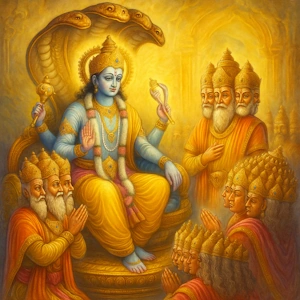
स्वयंभूः –
स्वयमेव भवतीति स्वयंभूः – He doesn’t have a father and mother. He came into existence on His own. Hence, Swayambhu.
भवति स्वेच्छया योऽसौ स्वयंभूः परिकीर्तितः – He takes birth out of His own free will. He takes avatara out of His own free will. All others take birth out of compulsion — compulsion of their own past karma. He doesn’t have karma attached to Him. Hence, His birth is Swayam.
Once, Sri Hari showed His greatness to Brahma — Chaturmukha Brahma, Brahma with four heads to be more precise.
Brahma used to think that he was equal to Sri Hari.
Menaka, the apsaras, once wanted to meet Brahma. He didn’t allow her. She tried a lot, still, he didn’t meet her. This hierarchy, pride and all — they exist even among gods because they are also part of His maya.
Brahma even insulted Menaka in front of others for chasing him.
At the end, Menaka got so frustrated that she cursed Brahma. She said, 'You will never be worshipped by anyone again.' This is another curse because of which Brahma is not worshipped.
Brahma went to Vaikuntha to take up this matter with Sri Hari — about this curse and how to come out of it.
There, Sri Hari respectfully welcomed him — Brahma is Pitamaha — and offered His seat.
Brahma was seated there by Sri Hari’s side.
That time, a guard came in and said another Brahma, from another universe, this one with ten heads, has come to see Sri Hari. He was waiting at the gate.
Sri Hari asked him to be brought in. That Brahma came in and started praising Sri Hari with stutis that our Brahma had not even heard.
After this, another Brahma came in — this one had thousand heads. He also came in and started praising Sri Hari.
Like this, more and more Brahmas started coming in. They all praised Sri Hari with stutis.
Sri Hari told our Chaturmukha Brahma — 'There are as many universes as there are hairs on My body. In each of them, there is a Brahma like you.'
Brahma realized his mistake — of thinking too much about himself.
He apologized to Sri Hari and Sri Hari mercifully gave a solution to Brahma for getting relief from Menaka’s curse.
-
Can even a divine being fall into the trap of ego?
Yes. When even Brahma momentarily thinks himself to be supreme, it shows that the grip of ego can exist anywhere, even among the most elevated. This reminds us that pride, if unchecked, distorts clarity and leads to painful consequences — in relationships, at work, and in spiritual growth. -
Why is comparing ourselves with others spiritually dangerous?
Every being, even the most revered, has a unique place in the divine order. Comparing or competing leads to restlessness and disconnect. Peace comes from doing our role with devotion — whether parent, caregiver, teacher, or seeker — not from feeling better or worse than someone else. -
Is worshipped status or popularity a sign of true spiritual merit?
Not always. Brahma, despite his cosmic role, isn't widely worshipped. True spiritual worth lies in surrender and humility, not public recognition. In family life too, quiet sacrifices may go unseen, but their impact is immense. -
What does this teach about handling insult and humiliation?
Menaka was hurt and retaliated with a curse. Brahma had to seek help to undo it. When hurt, reacting impulsively can complicate matters. In our lives, staying composed and seeking resolution from a higher space often brings lasting healing. -
Why does Sri Hari allow such conflicts to happen at all?
To show even gods can falter and still be corrected. It's not about perfection, it's about learning. We too will err — in parenting, marriage, habits — but turning back with humility always opens the door to grace. -
What is the deeper meaning of multiple Brahmas with more heads?
It breaks the illusion of being the only one or the most important one. Just like someone who earns well in one city may be unknown elsewhere. It reminds us to live with perspective, and not inflate our achievements. -
How does Bhakti protect against the downfall of pride?
Bhakti keeps the focus on the Lord, not on the self. If we’re always thinking of Sri Hari, there’s no room for the ego to swell. Like how daily prayer can humble a person who’s otherwise praised constantly. -
Can spiritual realization happen only through intellect?
No. Brahma had all knowledge, yet needed an experience to see the truth. Similarly, reading scriptures or listening to discourses helps, but surrender, devotion, and humility are what melt the heart and awaken awareness. -
How to cultivate this kind of self-awareness in daily life?
Observe your reactions — to praise, to criticism, to being ignored. If you find yourself needing constant attention, turn inward. Sit in quietness, chant Sri Hari’s name, or reflect on your true place in this vast creation. -
What is the healthiest way to teach children about self-worth?
Let them know they are valued not for being 'better than others', but for their sincerity, kindness, and honesty. Teach them that even those in high positions must bow down to truth and love — just like Brahma had to.





English
Vishnu Sahasranama
Click on any topic to open
7
30
Astrology
Bhagavad Gita
Bhagavatam
Bharat Matha
Devi
Devi Mahatmyam
Ganapathy
Garuda Puranam
Glory of Venkatesha
Hanuman
Kathopanishad
Mahabharatam
Mantra Shastra
Mystique
Practical Wisdom
Purana Stories
Radhe Radhe
Ramayana
Rare Topics
Rigveda Explained
Rituals
Sages and Saints
Shiva
Spiritual books
Sri Suktam
Story of Sri Yantra
Temples
Vedas
Vishnu Sahasranama
Yoga Vasishta
26
17
10
0


