Story of Bakasura and How Sri Krishna Destroyed Him
शंभुः –
शं सुखं भक्तानां भावयतीति शंभुः – He gives happiness and comfort to his devotees. Hence he is Shambhu.
The avataras are taken for the hita, favor, and happiness of all beings.
सर्वलोकेश्वरः साक्षाल्लोकानां हितकाम्यया
and
स हि देवैरुदीर्णस्य रावणस्य वधार्थिभिः
अर्थितो मानुषे लोके जज्ञे विष्णुः सनातनः
When Ravana's atrocities became unbearable, upon being requested by those who wanted Ravana destroyed, he took avatara in the manushya loka, says Ramayana.
Thus contemplating imparting sham to his devotees, hence Sri Hari is Shambhu.
Spiritually oriented people have a tendency to glorify sattva guna. There is nothing wrong with this. But at the same time, we should not ignore that prakriti is trigunatmika. Rajoguna and tamoguna are the other two aspects of the same prakriti, the maya shakti of Sri Hari. You don’t have to hate tamo guna and rajoguna.
You don’t have to be abusive about rajoguna and tamoguna.
When you buy oranges, you don’t really consume their skin. You peel them, remove the skin and discard the skin. You don’t swear at them, you don’t crush them under your feet, you don’t eat them also. It is as simple as you don’t need them anymore, so discard them. They were actually needed till the time they were with the fruit vendor, otherwise, the fleshy part inside would have decayed in no time.
It had a role to play. Rajoguna and tamoguna also play their equally important roles in the universe.
It is only that when you are spiritually progressing, at some point in time, you will need them less, and further down, you won’t need them anymore.
This should be the attitude towards rajoguna and tamoguna.
No need to fear them or hate them. You can simply discard them when you don’t need them anymore.
It will be interesting to see how Sri Hari plays around with these gunas. He shows us how impermanent they are. How mutually interchangeable they are. How our frigid concepts about them are incorrect.
There was a rishi called Jaajali. He was the disciple of Kapila Muni, the avatara of Sri Hari who propounded Sankhya Shastra.
Jaajali was with Kapila Muni at Ganga Sagar, the island where Kapilashrama is located, which is near present-day Kolkata.
Once, Utkala, the son of Hayagreevasura, cast his net to catch fish near the ashrama.
Jaajali told him to stop taking lives near the holy place and go elsewhere.
But Utkala didn’t bother.
He just sat there like a crane near his net, staring at it, looking out for fish to get trapped.
Jaajali became angry and cursed Utkala that he will become a crane.
And thus Bakasura was born as the younger brother of Putana, elder brother of Aghasura.
Utkala begged for pardon. But even Jaajali couldn’t do anything.
He went to his guru, and Kapila Muni told him that he is destined to get relief in the hands of Sri Hari when he takes avatara as Krishna in the Dwapara Yuga.
Jaajali regretted his curse because he wanted to save the fish but ended up creating a monster whose primary food would be fish itself.
Kamsa did a digvijaya yatra and during that defeated Bakasura and Aghasura also.
They became his servants along with Putana.
By this time, the Lord and his people had left Gokula and started living in Vrindavana.
Once, the Lord was grazing calves with gopa boys and suddenly the calves started running here and there, scared.
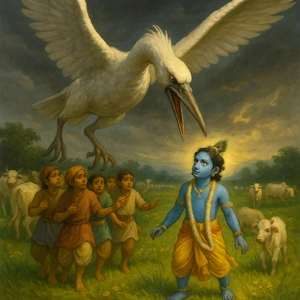
A huge crane, Bakasura, appeared, as big as a mountain, and picked up the Lord with his long sharp beak.
And what could happen afterwards, you can imagine.
In one swift move, the Lord caught hold of the beak of the crane, Bakasura, opened it, pushed the lower beak with his left leg and started lifting the upper beak with his right hand.
He went on doing this till the whole body of the asura was torn into two parts.
And from that body emerged a swan, which started flying up towards Vaikuntha.
Bakasura has been sanctified, absolved of all his sins, and accorded the parama pada.
His kindness, his mercy.
See, tamogunee Utkala, Jaajali a rishi supposed to be sattwik, suddenly turns rajasic, gives curse, regrets later.
And tamogunee Utkala, just by the mercy of Sri Hari — mind you, no tapas, no penances, no effort on his part — he attains Vaikuntha.
Lord is showing us how he is playing around with the gunas, which are absolutely under his control.
-
Why would a violent being receive grace without long penance?
-
Because mercy is Bhagavan’s independent power. He is not a cashier tallying effort; he is the source who can cleanse at once. This doesn’t excuse harm, but it proves his freedom to rescue even at the darkest point.
-
-
If a saint gets angry and harms, what are we supposed to learn from that?
-
That even spiritual people can slip under the pull of rajas and tamas. The lesson is not to worship personalities but to rely on Sri Hari, who alone is steady. For us: pause, breathe, and act only after the first heat has cooled.
-
-
How can the same Lord be gentle to devotees yet fierce to aggressors?
-
Protection and correction are two faces of the same compassion. He shields the innocent and stops the harmful. Justice is love with backbone.
-
-
Are rajas and tamas enemies to be hated?
-
No. They are tools. Use rajas to begin a good task, let sattva steer, and put tamas to rest at night. As devotion grows, you simply outgrow what you no longer need.
-
-
What is a simple daily method to manage my own rajas and tamas?
-
Morning: light movement and japa to channel rajas into service.
-
Midday: short breath breaks to keep sattva on the wheel.
-
Night: screens off, warm food, gratitude round, and sleep to park tamas safely.
-
-
Why does remembrance calm fear faster than reasoning in a crisis?
-
Because devotion anchors the mind to a single, strong refuge. A focused name plus slow exhale cuts the panic loop more quickly than scattered thoughts.
-
-
If the Lord can transform a harmful life in a moment, why keep practice at all?
-
Practice keeps you available to grace. It is how you keep the door unlocked and the lamp lit.
-
-
Isn’t it unfair that some attain quickly while others slog for years?
-
Grace isn’t a queue; it’s a downpour. Sincere turning, even late, can meet the cloudburst. Keep your vessel clean and open.
-
-
How do I turn a burst of anger into a step toward bhakti instead of regret?
-
Own it quickly, apologize, and offer one service immediately. Action toward good neutralizes the residue and returns the mind to the Lord.
-
-
What is the healthiest way to handle disgust toward my own tamasic days?
-
Don’t self-abuse. Do the next small right act, eat light, get sunlight, and chant softly. Tamas thins when you refuse to dramatize it.
-
-
How should a family guide a member who keeps swinging between extremes?
-
Gentle routine wins: shared meals, short evening prayer, lights-out time, and a weekly walk together. Stability outside helps balance inside.
-
-
What do I pray for when I feel unworthy of help?
-
Ask for a clean turn of heart and the strength to act on it. Worthiness grows after you turn, not before.
-
-
How do I serve firmly when someone is harmful, without hatred?
-
Set clear boundaries, prevent damage, and keep the heart free of revenge. Justice can be done without poison in the blood.
-
-
What proves that devotion is working, not just imagined?
-
You bounce back faster, speak cleaner under stress, sleep deeper, and your family feels safer around you.
-
-
How can parents teach this balance to children without scaring them with ‘good vs evil’?
-
Use simple rules: calm voice, kind hands, tidy space, and one prayer line before sleep. Praise effort, not superiority.
-
-
What is a compact crisis protocol inspired by this teaching?
-
Name of the Lord on the exhale, gather and protect dependents, act on the one duty in front of you, and review only after calm returns.
-
-
How do I keep charity from turning into superiority when I feel ‘more sattvic’ than others?
-
Give quietly, credit upward, and rotate dull chores. If your giving needs a spotlight, you’ve shifted away from the Lord to the self.
-
-
What should my heart hold when I see sudden transformation in someone I disliked?
-
Wonder, not suspicion. Celebrate the Lord’s freedom to save. Then ask for the same inner turn wherever you are still stuck.
-





English
Vishnu Sahasranama
Click on any topic to open
7
30
Astrology
Bhagavad Gita
Bhagavatam
Bharat Matha
Devi
Devi Mahatmyam
Ganapathy
Garuda Puranam
Glory of Venkatesha
Hanuman
Kathopanishad
Mahabharatam
Mantra Shastra
Mystique
Practical Wisdom
Purana Stories
Radhe Radhe
Ramayana
Rare Topics
Rigveda Explained
Rituals
Sages and Saints
Shiva
Spiritual books
Sri Suktam
Story of Sri Yantra
Temples
Vedas
Vishnu Sahasranama
Yoga Vasishta
26
17
10
0


