What Is Srivatsa?

श्रीमान् –
सौन्दर्यलावण्यादिभिरतिमनोहरदिव्यरूपः श्रीमान् - after addressing him in his bheeshana roopa as नारसिंहवपु, it is immediately followed by his handsome form as श्रीमान्.
यस्य वक्षसि नित्यं वसति श्रीः सः श्रीमान् – in whose heart Lakshmi resides permanently. Lakshmi is characterized by her impermanence. She would never stay permanently at one place. She is chanchala. The only place where she stays permanently is Vishnu’s chest. So if you want sthiralakshmi, worship Vishnu. If you can make him bless you through his permanent presence with you, then Lakshmi’s permanent presence is assured.
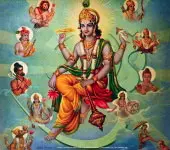
The one marked with Srivatsa is called Shreeman.
What is Srivatsa?
स तु वक्षस्थशुक्लवर्ण दक्षिणावर्त्तलोमावली – a white lock of hair on Vishnu’s chest which curls towards the right is called Srivatsa.
वक्षस्थे महत्त्वलक्षण श्वेत रोमावर्त्तविशेषे – this is one of the signs that distinguishes Bhagawan. This is exactly where Lakshmi resides.
Lakshmi Devi wanted proximity to Bhagawan like how the Gopis of Vrindavana. But this was not possible. After a long tapas she got this boon from Vishnu, that she can occupy his chest permanently. And Srivatsa symbolizes this.
ऋचस्सामानि यजूँषि सा हि श्रीरमृता सताम्
The Veda mantras in the form of Richas, Yajus and Samas are called Shree.
वेदैर्वेद्यः श्रीमान् – one who is known through the Veda mantras is Shreeman.
Even when he is in his ferocious form, Lakshmi is still with him. नारसिंहवपु and Shreeman simultaneously.
Her quality is shuddha satva. Satva guna can come mixed with the other two gunas. Even when mixed, where satva guna is predominant, it is called satva only. When satva is pure, unmixed, it is called shuddha satva. Lakshmi’s nature is shuddha satva. She is dedicated both to Sri Hari and his devotees as well.
She is सर्वसस्यात्मिका – the life force in plants, grains, and vegetables.
When in Vaikuntha she is called Mahalakshmi.
In Swarga she is called Swargalakshmi.
When she is with the kings she is called Rajalakshmi.
And when in houses, with householders, she is called Gruhalakshmi.
Goddess Lakshmi is beauty personified. Wherever you see beauty, know that she is there.
When you see the morning sunlight reflecting from a dewdrop on a blade of grass, know that she is there.
When you see the eyes of a deer, know that she is there.
When you see the mist rising from a beautiful waterfall, know that she is there.
When you see a pond full of lotuses in blossom, know that she is there.
When you see a painting, a sculpture, the enchanting movements of a dancer, know that she is there.
When you see a beautiful ornament, a garment, know that she is there.
Whenever, wherever you see beauty, know that Goddess Lakshmi is there.
She is the fame associated with men of noble deeds.
She is the shine of great kings.
She is trade and commerce in the active marketplace. Whenever you see an active marketplace, a crowded marketplace, know that Goddess Lakshmi is present there.
She is the kindness of the kind-hearted.
And she is the destroyer of evil.
-
Why is Lakshmi called chanchala while Vishnu is steady?
Lakshmi stands for movement, growth, and changing fortunes. Vishnu stands for the unchanging ground of reality. Prosperity becomes stable only when it rests on that steady ground. -
What does Srivatsa on Vishnu’s chest actually mean?
It is the mark that signals Lakshmi’s permanent abode on his chest. It tells you that wealth and beauty become reliable when joined with righteousness and order. -
Why link beauty with the divine at all?
Beauty is the sign of harmony. When parts fit together without conflict, the mind experiences beauty. That harmony points to an underlying intelligence, which tradition calls Bhagavan. -
How can prosperity be spiritual, not just material?
Prosperity is energy that nourishes life. Money without virtue breaks things; money guided by dharma builds families, arts, and learning. The direction of use makes it spiritual or harmful. -
Why does Lakshmi have many forms like Mahalakshmi, Rajalakshmi, Gruhalakshmi?
One essence appears in different roles. The same nourishing force supports heaven, kingdoms, and homes. Context changes the expression, not the core. -
What is the practical message of Srivatsa for daily life?
Anchor goals in values first, then seek gains. When character leads and wealth follows, results last. When wealth leads and values trail behind, results crumble. -
How do I invite ‘sthira Lakshmi’ into my home?
Be truthful, keep promises, share fairly, avoid waste, and honor elders and guests. These actions create order, and order attracts lasting prosperity. -
Why say Lakshmi destroys evil if she is gentle?
Anything that threatens harmony blocks nourishment. Removing that block is compassion in action. Gentleness to the good, firmness to the harmful. -
What does ‘shuddha sattva’ look like in practice?
Clarity without restlessness, kindness without weakness, discipline without harshness. The mind is bright, steady, and helpful. -
Can devotion and effort really go together?
Yes. Devotion sets direction; effort moves the wheel. Prayer without work is wishful thinking; work without prayer loses purpose. Together they align power and meaning. -
Why insist that Vishnu is the only stable refuge for wealth?
Because everything else shifts. Markets, tastes, bodies, and moods change. The ethical order that Vishnu represents does not. Stability comes from standing on what does not shift. -
How should I read sacred symbols like Srivatsa today?
Read them as maps. The symbol tells you: keep beauty and wealth tied to virtue, keep the heart clean, and let your gains serve life. That is how symbols become lived wisdom.





English
Vishnu Sahasranama
Click on any topic to open
7
30
Astrology
Bhagavad Gita
Bhagavatam
Bharat Matha
Devi
Devi Mahatmyam
Ganapathy
Garuda Puranam
Glory of Venkatesha
Hanuman
Kathopanishad
Mahabharatam
Mantra Shastra
Mystique
Practical Wisdom
Purana Stories
Radhe Radhe
Ramayana
Rare Topics
Rigveda Explained
Rituals
Sages and Saints
Shiva
Spiritual books
Sri Suktam
Story of Sri Yantra
Temples
Vedas
Vishnu Sahasranama
Yoga Vasishta
26
17
10
0


