Born Bulletproof
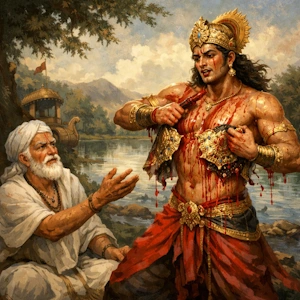
Most of us think of armor as something you put on. A helmet. A vest. Something you wear before battle and remove when you come home.
Karna never had that luxury.
He was born with his armor. The Kavacha covered his chest. The Kundala hung from his ears. But they were not jewelry. They were not equipment. They were part of his body — the same way your skin is part of you.
You could not take them off. Not without taking a piece of him with it.
What Made It Different From Ordinary Protection
Think about it this way.
A bulletproof jacket protects you. But if someone steals it, you are just without a jacket. You are still you.
Karna's Kavacha was not like that. It was fused to him. It grew as he grew. When he was a child, it was small. When he became a warrior, it was powerful. It lived with him. It breathed with him.
This is the key detail the Mahabharata gives us. The armor was alive. It was biological. It was him.
The Day He Gave It Away
Indra, the king of the gods, knew this. He also knew that as long as Karna wore the Kavacha, no weapon could kill him. Not Arjuna's arrows. Not anyone's.
So Indra came in disguise. He dressed as a poor brahmin and asked Karna for a gift.
Karna was famous for one thing above all else — his generosity. He never turned anyone away.
Indra asked for the Kavacha and Kundala.
Karna knew it was a trick. His father Surya had warned him in a dream. He knew this brahmin was Indra. He knew what he was really being asked to give up.
He gave it anyway.
He cut the armor from his own flesh. He removed the earrings with his own hands. He handed them over — bleeding, radiant, and completely at peace with his choice.
That moment is one of the most powerful in the entire Mahabharata.
What Modern Science Sees in This Story
Here is where it gets fascinating.
What Karna had — a protective layer fused to living skin, growing with the body, impossible to separate from the person — scientists today are actually trying to build this.
It is called osseointegration. This is when a medical implant bonds so deeply with your bone that it becomes part of your skeleton. It does not just sit inside you. It joins you. Modern prosthetic limbs now work this way. The boundary between the device and the body slowly disappears.
CRISPR gene editing takes this even further. Scientists can now edit the genes of an embryo before birth. A child could potentially be born with biological traits that protect them — stronger immunity, faster healing, denser bones. Not given to them later. Built in from the very beginning.
Just like Karna.
Adaptive biomaterials are another parallel. These are smart materials that respond to the human body. They adjust. They grow with tissue. They do not stay rigid and foreign — they become familiar, almost organic.
The Mahabharata described all of this thousands of years ago. Not in scientific language. But in story.
The Question That Still Matters
Karna's story is not just about biology. It is about something deeper.
When technology becomes truly part of you — when the line between your body and your tool disappears — what happens when someone takes it away?
That is not a small question. It is one of the biggest questions in modern science and ethics right now.
Today, people have pacemakers that keep their hearts beating. Cochlear implants that let them hear. Neural chips being tested that connect the brain to machines. If someone took those away, it would not just be inconvenient. It would change who that person fundamentally is.
Karna understood this. And he gave up his armor anyway. Not because it did not matter. But because he valued something else more — his word, his generosity, his identity as a giver.
What This Teaches Us
The ancients were not writing science fiction. They were asking real questions about the human body, identity, and sacrifice.
What are you, once your protection becomes part of you?
What does it cost to give up something that is no longer just a thing — but a part of yourself?
And what does it say about a person who gives it up anyway — freely, knowingly, without regret?
Karna's answer was clear.
Being human means more than being protected. It means being willing to be vulnerable for the right reasons.
That is wisdom.
Question 1: In what fundamental way was Karna's armor different from a conventional piece of armor like a vest?
Conventional armor is an external object you wear. Karna's armor was biological, fused to his skin as a part of his body. It grew with him from birth and could not be removed without physically cutting it from his flesh.
Question 2: Why was Indra's request for the armor an act of profound cruelty, even though he disguised it as a simple request for a gift?
Because the armor was part of Karna's living body, Indra was not asking for an object. He was asking Karna to mutilate himself, to carve away a piece of his own being, and to give up the very thing that made him invincible.
Question 3: The text states Karna knew he was being tricked. What does his decision to give the armor away anyway reveal about his character?
It reveals that Karna valued his principles more than his own life. His identity as a person who never refused a request was more important to him than his divine protection. He chose to uphold his word and honor, even knowing it would lead to his vulnerability and eventual death.
Question 4: How does the modern medical concept of osseointegration help us understand the nature of Karna's armor?
Osseointegration is when an implant bonds with bone until it becomes a part of the skeleton. This blurs the line between the body and the device. It serves as a real-world parallel to Karna's armor, which was not just on his body but had become one with it.
Question 5: What is the deeper, mysterious meaning behind the armor being described as ‘alive’ and breathing with him?
This suggests that our inherent gifts and protections are not static things. They are living parts of our identity that shape us, grow with our experiences, and are tied to our life force. To lose them is not just to lose a skill, but to lose a part of who we have become.
Question 6: The story connects to modern gene editing. What ethical dilemma highlighted by Karna's sacrifice becomes relevant with technologies like CRISPR?
If we can edit a person to have built-in biological protections, what does it mean if that person chooses to or is forced to reverse them? The dilemma is about bodily autonomy and identity when the technology is no longer a tool but a fundamental part of a person's biological makeup.
Question 7: What does the story teach about the relationship between a person's greatest strength and their greatest vulnerability?
It teaches that they can often be the same thing. Karna's armor was his greatest strength, making him unbeatable. However, his reputation for generosity, another great strength, was the very thing Indra exploited to take the armor away, turning his strength into his point of greatest vulnerability.
Question 8: How does the text redefine the meaning of being human, using Karna's choice as the primary example?
It suggests that being human is not defined by being strong or perfectly protected. Instead, it is defined by our capacity for sacrifice, our commitment to our values, and our willingness to be vulnerable for a cause we believe in.
Question 9: What is the crucial difference between losing a pacemaker and Karna giving away his armor?
Losing a pacemaker would be a tragic, involuntary event that takes away a person's ability to live. Karna's act was a conscious, voluntary choice. He gave away his protection freely, knowingly, and without regret, which transforms the loss into a powerful statement of his identity.
Question 10: What is the ultimate secret the story reveals about identity versus protection?
The story reveals that who you are is determined not by the armor you wear, whether it is physical or biological, but by the choices you make when that armor is challenged. True identity is forged in moments of sacrifice, not in moments of safety.
Here are some deep insights from the Kavacha-Kundala story:
On Identity
When something grows with you, it stops being a possession. It becomes part of who you are. Karna's armor was not something he owned. It was something he was. This raises a disturbing question — how much of what we call "ourselves" is actually just protection we have built over time?
On Generosity
Karna did not give from his surplus. He gave from his substance. Most of us give what we can afford to lose. Karna gave what he could not afford to lose at all. That is a completely different level of giving.
On Knowing and Still Choosing
He was warned. He knew it was a trap. He gave anyway. This is not naivety. This is conscious sacrifice. There is a huge difference between being deceived and choosing to walk forward with open eyes. Karna chose.
On Vulnerability as Strength
The moment Karna removed his armor, he became mortal. But he also became fully himself — a man defined not by his protection but by his character. His greatest act of strength was making himself weak.
On the Price of Augmentation
Every enhancement has a shadow side. The very thing that made Karna extraordinary also made him a target. Indra did not come for ordinary warriors. He came specifically because Karna was too protected. Power attracts attack. This is as true today as it was then.
On Divine Favoritism and Inequality
Karna was born with something others were not. Not through effort. Not through merit. By birth. And still the world treated him as lesser — called him a charioteer's son, denied him tournaments, questioned his right to compete. His armor could not protect him from social rejection. This is one of the most quietly devastating ironies in the Mahabharata.
On Integrity Over Survival
Karna knew that giving up the Kavacha meant he could die in the war. He gave it anyway because breaking his word felt worse than death. For him, how he lived mattered more than how long he lived. That is a rare kind of courage.
On Manipulation Dressed as Need
Indra came as a beggar. He used the language of poverty and humility to take something priceless from a generous man. This is a timeless pattern. The most sophisticated forms of taking often arrive disguised as asking.
On the Body as a Battlefield
Even before the war began, Karna's body was the site of a transaction. His flesh was negotiated over by gods. This is a powerful metaphor — our bodies are constantly being claimed, shaped, and bargained over by forces larger than ourselves. Religion, culture, medicine, politics. Karna just made it visible.
On Sacrifice Without Reward
Karna got nothing in return that saved him. He was still killed. His sacrifice did not lead to victory or vindication in the conventional sense. And yet the Mahabharata holds him up as one of its greatest figures. This suggests that the value of a noble act is not measured by its outcome.





English
Mahabharatam
Click on any topic to open
7
30
Astrology
Bhagavad Gita
Bhagavatam
Bharat Matha
Devi
Devi Mahatmyam
Ganapathy
Garuda Puranam
Glory of Venkatesha
Hanuman
Kathopanishad
Mahabharatam
Mantra Shastra
Mystique
Practical Wisdom
Purana Stories
Radhe Radhe
Ramayana
Rare Topics
Rigveda Explained
Rituals
Sages and Saints
Shiva
Spiritual books
Sri Suktam
Story of Sri Yantra
Temples
Vedas
Vishnu Sahasranama
Yoga Vasishta
26
17
10
0


