Why Krishna Chose to Die Like a Common Man
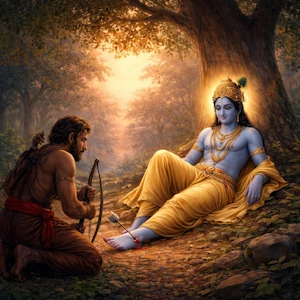
Why did Krishna die like an ordinary man while the Pandavas did their Swargarohana?
On the surface this looks strange. Krishna was God. He knew everything. He could do anything. So why did he die from a hunter's arrow? Alone in a forest. Like a common man.
The answer is simple once you see the full picture.
- First understand the context
Krishna came to Earth with a purpose. That purpose was to restore dharma. The Kurukshetra war was part of that plan. Once the war ended, his work was done. His death was not a tragedy. It was simply the end of his time in a human body.
- Gandhari's curse
After the war, Gandhari had lost all hundred of her sons. In her grief, she cursed Krishna directly. She said his Yadava clan would destroy itself through internal fighting. She said he would die alone in a forest.
Krishna accepted this curse without resistance. He did not argue. He did not block it. He said so be it. That was a deliberate choice.
- Why he accepted the curse
The Yadava clan had become proud and reckless. They were powerful. They had started behaving badly. A sage named Durvasa had already cursed some young Yadavas for mocking him. After Krishna left, an unchecked Yadava empire would have caused serious harm to the world. Their destruction was necessary.
- The hunter and the arrow
A hunter named Jara was in the forest. He saw movement near a tree. He shot an arrow thinking it was a deer. The arrow struck Krishna's foot.
But there is a deeper logic here. In his previous life as Rama, Krishna had killed the monkey king Vali by shooting him from behind a tree. Vali died feeling it was unfair. That karma had to return. Jara was the reborn soul of Vali. The arrow completed a cycle that had been waiting for many lifetimes.
Krishna saw what had happened. He smiled. He absolved the hunter completely. He told him he had done nothing wrong.
- The deeper meaning
Even God, when he takes a human body, follows the laws of that world. He does not escape karma. He does not use divine power to avoid consequences. He lives fully within the rules he has entered.
If Krishna had stopped the arrow with a miracle, it would have broken the integrity of his entire teaching. His whole life was a lesson in righteous action without attachment. He demonstrated that lesson till the very end.
- He did not die the way we understand death
Krishna's soul was never bound to the body. He simply returned to his eternal state. The arrow was the occasion for departure. Not the cause of death.
The Pandavas dropped their bodies on a mountain. Krishna dropped his in a forest. The setting was different. The meaning was the same. Both were conscious exits by souls whose work was complete.
The takeaway
The Mahabharata makes one clear statement through Krishna's death. The rules of the world apply to everyone who enters it. Even God. Karma is real. It completes itself. Krishna did not fight his exit. He accepted it with full awareness. That acceptance is the deepest teaching of his life.
Here are 10 deep Q&A based on the content:
- Why did Krishna accept Gandhari's curse without resistance, even though he had the power to stop it?
Krishna accepted the curse because it aligned with a larger cosmic necessity. The Yadava clan had grown proud and destructive. Their unchecked power would have harmed the world after Krishna's departure. Gandhari's curse became the instrument for an outcome that was already required. Krishna's acceptance was not weakness. It was his mastery of seeing the full picture beyond personal consequence.
- What does Krishna's acceptance of the curse reveal about the nature of divine power?
It reveals that true divine power is not about force or intervention. It is about alignment with cosmic order. Krishna could have deflected the curse. He chose not to. This shows that divinity operating in the world does not impose its will over the natural unfolding of events. Power used with wisdom sometimes looks like surrender.
- Why was the destruction of the Yadava clan necessary, and what does this say about the danger of unchecked strength?
Strength without humility becomes a threat to the world. The Yadavas had power but had lost discipline and respect. After Krishna left, they would have had no restraining force. Their destruction prevented future harm. This teaches that even great lineages can become dangerous when they outlive the wisdom that originally guided them.
- What is the hidden karmic link between Rama, Vali, and the hunter Jara, and why does this matter?
When Rama killed Vali by shooting him from behind a tree, Vali felt it was unjust. That unresolved karma did not disappear. It waited across lifetimes. Jara was Vali reborn. The arrow he shot at Krishna was the completion of that karmic cycle. This reveals that karma is not punishment. It is a debt of energy seeking balance, regardless of how much time passes or how elevated the soul involved.
- Why did Krishna smile when he realized what had happened with the hunter's arrow?
He smiled because he recognized the perfection of the moment. The arrow was not a mistake or a tragedy. It was the exact completion of a cycle he understood fully. His smile was the response of a consciousness that had no fear of death and no resistance to the natural conclusion of his time in the body. It was the smile of total awareness meeting total acceptance.
- If Krishna knew everything, why did he not prevent the events that led to his death?
Because prevention was never the point. Krishna's entire teaching centered on doing one's duty without trying to control outcomes. To have used divine knowledge to escape his own karmic completion would have made his teaching hollow. He lived and died in full integrity with everything he ever taught. Knowing the future and choosing not to interfere was the final and most profound demonstration of that teaching.
- What is the deeper significance of Krishna dying alone in a forest rather than surrounded by devotees or in a grand setting?
It strips away all external importance. No ceremony, no audience, no drama. Just a soul completing its time in a body. This was a teaching in itself. The manner of exit does not define the greatness of the life. Krishna in a quiet forest was no less divine than Krishna on the battlefield of Kurukshetra. The setting being ordinary made the truth more visible.
- How does the idea of God choosing to follow the laws of the world he enters challenge common religious assumptions?
Most people imagine God as someone who operates above the rules, granting exceptions and performing miracles on demand. Krishna's life and death present a different model. When divinity enters the world, it fully inhabits the conditions of that world, including karma, consequence, and mortality. This is not a limitation. It is a form of total respect for the creation. It also means the world and its laws are themselves sacred.
- How is Krishna's death similar in meaning to the Pandavas walking to the mountain, even though the circumstances looked completely different?
Both were conscious exits by souls whose purpose was complete. The Pandavas walked toward the mountain knowing they would fall. Krishna remained in the forest knowing the arrow was the moment of departure. In neither case was death forced upon them from outside. Both were voluntary surrenders of the body once the role had ended. The method differed. The awareness behind it was identical.
- What is the ultimate mystery hidden in the fact that the same consciousness that set the laws of karma was also subject to those laws?
The mystery is this. The creator did not exempt himself from the creation. This means the laws of karma, consequence, and dharma are not external rules imposed on existence. They are the very fabric of existence itself. Even the one who wove the fabric is woven into it when he enters it. This is not a contradiction. It is the deepest possible statement about the integrity and completeness of the cosmic order.
11. The prison doors opened on their own. Guards fell asleep at the right moment. Is this not too convenient?
It is convenient. That is correct.
But understand what kind of text you are reading. The Mahabharata and the Bhagavata Purana are not history books. They are philosophical texts written as stories. The opening doors are not a news report. They are a way of saying something important. They are saying that when something of great cosmic significance arrives, ordinary obstacles cannot stop it.
Every culture does this. Every tradition has stories where nature responds to important moments. It is a storytelling method. Not a factual claim.
12. A voice from the sky made a king kill six children. That sounds invented.
It does sound that way.
But the story is not asking you to believe Kamsa was a rational person. It is showing you what fear does to someone in power. Kamsa is not unique. History is full of rulers who committed violence to protect their position. The prophecy is just the trigger. The real subject is tyranny. That is very real.
13. Krishna is God. Why did he need miracles to survive as a baby? Can God not protect himself?
This is a sharp question.
The text's answer is this. When God takes a human body he accepts that body's limitations. A newborn is physically helpless. He cannot protect himself. The miracles were not Krishna protecting himself. They were the universe protecting a purpose that had not yet been fulfilled.
If you do not accept that Krishna was God, the simpler answer is this. The story needed him to survive. So the storytellers arranged his escape. That is how storytelling works.
Both answers are honest.
14. The same God who parted a river as a baby died from a hunter's random mistake. Does that not contradict itself?
Look at it more carefully.
At birth the mission had not started. The miracles protected something that had not yet happened. At death the mission was complete. There was nothing left to protect. No miracles were needed.
There is also another point here. A story invented only to glorify Krishna would have given him a heroic death in battle. Instead he dies from a hunter's mistake in a forest. Alone. That is not how you write a myth about someone you want to glorify. That kind of unglamorous ending actually gives the story more credibility. Not less.
15. Jara being the reborn soul of Vali is too neat. Every loose end gets tied up perfectly. Real life does not work this way.
You are right. Real life rarely ties up this cleanly.
This is where a believer and a non-believer will read the same text differently.
A believer sees a universe where karma works with precision across lifetimes. Every action returns eventually.
A non-believer sees a skilled author who needed to explain an undignified death and invented a past life connection to give it meaning.
Same story. Two readings. Neither side can prove the other wrong.
16. These texts were written centuries after the events. How can anyone trust them?
This is the strongest question. It deserves a straight answer.
You cannot verify these stories as historical fact. Most scholars treat the Mahabharata as a text that mixes historical memory with mythology, philosophy, and later additions. It was written and revised over many centuries.
But here is the point. The value of these stories does not depend only on whether they are literally true. The Gita's teaching on action without attachment is useful whether Krishna was a real person or not. Yudhishthira refusing to enter heaven without his dog teaches something real about loyalty whether it happened or not.
A story can carry genuine truth without being a factual account. That is what all great literature does.





English
Mahabharatam
Click on any topic to open
7
30
Astrology
Bhagavad Gita
Bhagavatam
Bharat Matha
Devi
Devi Mahatmyam
Ganapathy
Garuda Puranam
Glory of Venkatesha
Hanuman
Kathopanishad
Mahabharatam
Mantra Shastra
Mystique
Practical Wisdom
Purana Stories
Radhe Radhe
Ramayana
Rare Topics
Rigveda Explained
Rituals
Sages and Saints
Shiva
Spiritual books
Sri Suktam
Story of Sri Yantra
Temples
Vedas
Vishnu Sahasranama
Yoga Vasishta
26
17
10
0


