Bhima Reaches Nagaloka
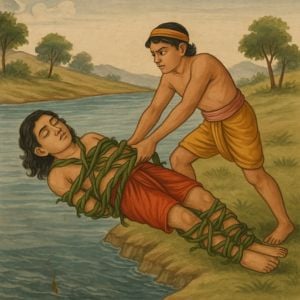
In this gripping 138th chapter of Adi Parva,
deceit wears the mask of festivity.
Duryodhana, burning with envy,
plots to end Bhima's life through poison and treachery—
lacing food with Kalakuta and casting him into a river of hidden spears.
But fate shields the son of Vayu.
Swept into the Naga world,
Bhima not only survives the serpents’ venom
but is embraced as kin by Vasuki himself.
Blessed by ancestral ties and Naga strength,
Bhima drinks the essence of a thousand serpents—
and rises, no longer just a warrior,
but a living storm reborn.
वैशम्पायन उवाच।
ततस्ते मन्त्रयामासुर्दुर्योधनपुरोगमाः।
प्राणवान्विक्रमी चापि शौर्ये च महति स्थितः॥
Then, urged by Duryodhana,
the core of the Kaurava plotters gathered once more.
Their eyes turned again toward Bhima —
the one full of breath, power, and relentless courage,
the immovable force who towered in strength and shone in battle.
They could not defeat him by arms,
nor crush him with poison.
So they schemed again,
weaving darker intentions around the man
who stood as the very wall between their ambition
and the throne of Hastinapura.
स्पर्धते चापि सततमस्मानेव वृकोदरः।
तं तु सुप्तं पुरोद्याने जले शूले क्षिपामहे॥
Bhima—always competing, always overpowering—stood like a living insult to their pride.
His strength was not a moment’s flare; it was relentless, rising with each day.
Duryodhana and his circle, maddened by their repeated failure, now spoke with venom in their breath.
‘He rivals us in everything. Let us not wait for war. Let us strike when he sleeps, unaware and unarmed.
Let us hurl him into the waters upon a bed of spikes—
Let the Ganga, silent and sacred, carry away our shame with his corpse.’
The poison now had taken form. It had become intent.
ततो जलविहारार्थं कारयामास भारत।
प्रमाणकोट्यामुद्देशे स्थलं किंचिदुपेत्य ह॥
And so, O Bharata (addressing Janamejaya), with a smile that hid a serpent’s fang,
Duryodhana set his trap beneath the mask of joy.
He announced a water festival—grand, royal, filled with delight.
A place was chosen on the broad curve of the Ganga,
near the edge of Pramāṇa-koṭi,
where the river ran deceptively deep and the earth beneath knew no loyalty.
A stretch of land, beautiful yet shadowed by unseen danger,
was marked for the gathering.
Joy was proclaimed. But it was death that waited beneath the ripples.
भक्ष्यं भोज्यं च पेयं च चोष्यं लेह्यमथापि च।
उपपादितं नरैस्तत्र कुशलैः सूदकर्मणि॥
Every kind of delight was arranged—
foods to chew, to sip, to lick, to savor.
Fragrant dishes, rich and seductive,
were prepared by expert hands,
their art sharpened not just by skill but by command.
Nothing was lacking—sweet, sour, rich, rare.
The feast was fit for gods,
and yet it was woven by men
who served not the gods, but the will of a prince
who had murder in his heart.
What fed the tongue that day
was crafted to lure, distract, and kill without warning.
न्यवेदयंस्तत्पुरुषा धार्तराष्ट्राय वै तदा।
ततो दुर्योधनस्तत्र पाण्डवानाह दुर्मतिः॥
Once all was set—the feast, the pavilions, the illusion of joy—
Duryodhana’s men reported back:
‘Everything is ready.’
And then, the prince with the corrupted mind,
his face calm but his intent drenched in poison,
invited the Pandavas.
With words polished like gold but forged in fire,
he summoned his cousins to partake in celebration,
offering brotherhood with one hand,
while sharpening betrayal with the other.
The trap was no longer in planning—
it had been opened.
Now only innocence needed to walk in.
गङ्गां चैवानुयास्याम उद्यानवनशोभिताम्।
सहिता भ्रातरः सर्वे जलक्रीडामवाप्नुमः॥
‘Let us all go to the Ganga,’ said Duryodhana,
‘where gardens bloom and the breeze carries joy.
Let us, as brothers, play in her cooling waters.’
His voice was smooth, his smile effortless,
and yet behind that softness lay steel.
He spoke of unity, of laughter, of brotherhood reborn,
but in his heart was a single cry: Let Bhima fall.
The Ganga, ever sacred, was summoned as witness—
not to joy,
but to treachery wrapped in silken words.
एवमस्त्विति तं चापि प्रत्युवाच युधिष्ठिरः।
ते रथैर्नगराकारैर्देशजैश्च गजोत्तमैः॥
‘So be it,’ replied Yudhishthira, calm and composed,
unaware of the poison laced beneath Duryodhana’s invitation.
With trust that still held the remnants of brotherhood,
he accepted the offer without suspicion.
The Pandavas then set out—
in chariots shaped like palaces, drawn by steeds of strength,
and on noble elephants of the finest breed,
their grandeur echoing royal grace.
They journeyed not to war,
but to what they believed was celebration—
bearing dharma in their hearts,
even as adharma prepared its strike in silence.
निर्ययुर्नगराच्छूराः कौरवाः पाण्डवैः सह।
उद्यानवनमासाद्य विसृज्य च महाजनम्॥
The brave princes of Kuru—Kauravas and Pandavas alike—
departed together from the city gates,
a scene that glowed with the illusion of unity.
They reached the forested gardens by the Ganga,
where laughter and greenery wrapped the path ahead.
But once the sacred ground was reached,
the common folk, the crowds, the watchful eyes—
were sent away.
Only the princes remained,
in silence thick with intention.
The play that was to unfold
needed no audience.
Only victims.
And only plotters.
विशन्ति स्म तदा वीराः सिंहा इव गिरेर्गुहाम्।
उद्यानमभिपश्यन्तो भ्रातरः सर्व एव ते॥
Like lions entering the hidden caves of the mountain,
the princes stepped into the great garden—
its groves blooming, waters shimmering,
a paradise veiling the scent of death.
Together they walked—brothers, warriors, kings-in-the-making—
gazing upon the beauty laid before them.
But not all eyes saw the same.
To some, it was a day of leisure.
To others, it was a snare drawn tight.
The forest knew.
It had seen before how peace bends
before the storm of ambition.
उपस्थानगृहैः शुभ्रैर्वलभीभिश्च शोभितम्।
गवाक्षकैस्तथा जालैर्यन्त्रैः सांचारिकैरपि॥
The garden was adorned with grace and grandeur—
brilliant halls for rest, balconies gleaming white,
latticed windows casting patterned shadows,
and moving mechanical wonders to dazzle the eye.
It was a palace in the lap of nature,
crafted not by chance but by cunning design.
Everything invited wonder,
everything whispered luxury.
But beneath the beauty,
a sinister stillness lingered—
as if the very walls waited for someone to fall.
संमार्जितं सौधकारैश्चित्रकारैश्च चित्रितम्।
दीर्घिकाभिश्च पूर्णाभिस्तथा पुष्करिणीषु च॥
The place had been swept and polished to flawlessness,
its walls painted by master artisans with scenes that charmed the eye.
Beautiful pools and long tanks,
clear and brimming, reflected the golden sky—
each one placed with care,
each one crafted to impress.
It was a world woven with opulence,
a theatre set for celebration.
But even the water, serene and shining,
held a silence too perfect—
as if waiting to drown a scream.
जलं तच्छुशुभे च्छन्नं फुल्लैर्जलरुहैस्तथा।
उपच्छन्ना वसुमती तथा पुष्पैर्यथर्तुकैः॥
The waters sparkled, veiled with blooming lotuses.
The earth, too, lay hidden beneath seasonal flowers.
All was fragrant, soft, and inviting—
but behind the beauty,
the land forgot dharma,
for even flowers can cover thorns
when deceit walks wearing garlands.
तत्रोपविष्टास्ते सर्वे पाण्डवाः कौरवाश्च ह।
उपच्छन्नान्बहून्कामांस्ते भुञ्जन्ति ततस्ततः॥
The Pandavas and Kauravas sat together,
feasting beneath shaded groves,
enjoying delicacies that masked the weight of hidden intentions.
Every bite was rich, every setting perfect—
but the sweetness on their tongues
could not conceal
the bitterness growing in one heart,
and the danger slipping quietly toward another.
अथोद्यानवरे तस्मिंस्तथा क्रीडागताश्चते।
परस्परस्य वक्त्रेषु ददुर्भक्ष्यांस्ततस्ततः॥
In that splendid garden,
the princes played like carefree brothers,
feeding each other with laughter and affection.
Hand to mouth, bite by bite—
it was a scene of warmth.
But hidden within one offering
was not love, but death—
a morsel tainted with venom, masked in brotherhood’s gesture.
ततो दुर्योधनः पापस्तद्भक्ष्ये कालकूटकम्।
विषं प्रक्षेपयामास भीमसेनजिघांसया॥
Then Duryodhana, driven by sin,
slipped the deadly Kalakuta poison into Bhima’s food.
His hands moved with calm precision,
his heart burning with the desire to kill.
The act was veiled in play,
but its purpose was pure murder—
to silence strength through the treachery of taste.
स्वयमुत्थाय चैवाथ हृदयेन क्षुरोपमः।
स वाचाऽमृतकल्पश्च भ्रातृवच्च सुहृद्यथा॥
Duryodhana rose himself,
his heart sharp as a razor,
yet his words flowed like nectar.
With the mask of affection,
he spoke like a brother, a friend—
offering poison with a smile.
It was not food he served Bhima,
but death disguised in sweetness and false love.
स्वयं प्रक्षिपते भक्ष्यं बहु भीमस्य पापकृत्।
प्रभक्षितं च भीमेन तं वै दोषमजानता॥
With his own hands,
Duryodhana served Bhima plate after plate,
laced with venom.
Bhima, trusting and unaware,
ate it all without suspicion,
not sensing the shadow beneath the flavor.
What was given as food
was death in disguise—
and Bhima consumed it with a heart still open.
ततो दुर्योधनस्तत्र हृदयेन हसन्निव।
कृतकृत्यमीवात्मानं मन्यते पुरुषाधमः॥
Duryodhana, the lowest among men,
felt triumph rise in his chest.
Though his lips held a controlled smile,
his heart laughed with cruel satisfaction.
He believed the deed was done—
that Bhima would fall,
and his path to power
had finally been cleared through poison and pretense.
ततस्ते सहिताः सर्वे जलक्रीडामकुर्वत।
पाण्डवा धार्तराष्ट्राश्च तदा मुदितमानसाः॥
Then, together, Pandavas and Kauravas entered the waters,
playing joyfully, hearts seemingly light.
Laughter echoed across the river,
splashes masked the undercurrent of betrayal.
Bhima played among them—
poison coursing through him,
unknowing, innocent.
The joy was real for some,
but for others, it was the calm before collapse.
विहारावसथेष्वेव वीरा वासमरोचयन्।
भीमस्तु बलवान्भुक्त्वा व्यायामाभ्यधिकं जले॥
The princes chose to rest in the floating mansions.
Bhima, ever strong, dove back into the waters,
his body charged from food, unaware of the poison within.
He swam, wrestled, and exerted himself beyond measure—
each movement stirring the venom deeper,
while death silently coiled beneath the surface.
वाहयित्वा कुमारांस्ताञ्जलक्रीडागतांस्तदा।
प्रमाणकोट्यां वासार्थी सुष्वापावाप्य तत्स्थलम्॥
After tiring the princes in water games,
Bhima, his energy spent, withdrew alone
to Pramāṇakoṭi for rest.
Reaching the shaded spot,
he lay down peacefully, unaware.
The poison now stirred within him,
awaiting silence and stillness
to strike from inside
what no enemy could conquer from without.
शीतं वातं समासाद्य श्रान्तो मदविमोहितः।
विषेण च परीताङ्गो निश्चेष्टः पाण्डुनन्दनः॥
Exhausted from play, touched by the cool breeze,
Bhima slipped into deep sleep.
But the poison had awakened.
It spread through his limbs like fire wrapped in silence,
freezing his strength from within.
Motionless he lay—
the mighty Pandava,
now still, gripped by venom,
his body sinking into deadly quiet.
ततो बद्ध्वा लतापाशैर्भीमं दुर्योधनः स्वयम्।
शूलान्यप्सु निखायाशु प्रादेशाभ्यन्तराणि च॥
Duryodhana, his heart cold with resolve,
tied Bhima’s unconscious body with creepers.
Then, with cruel haste,
he ordered sharp spears to be driven into the riverbed—
their deadly tips hidden just below the surface,
placed precisely where Bhima would fall.
It was not hatred now—it was murder.
लतापाशैर्दृढं बद्धं स्थलाज्जलमपातयत्।
सशेषत्वान्न संप्राप्तो जले शूलिनि पाण्डवः॥
Tightly bound with creepers,
Bhima was hurled into the water by Duryodhana.
But fate guarded him still—
a cluster of lotus stalks broke his fall.
The spears lay just beneath,
hungry for blood,
but Bhima did not touch them.
Death waited,
but dharma stood in its way.
पपात यत्र तत्रास्य शूलं नासीद्यदृच्छया।
स निःसंज्ञो जलस्यान्तमवाग्वै पाण्डवोऽविशत्।
आक्रामन्नागभवने तदा नागकुमारकान्॥
By sheer divine chance,
Bhima fell where no spear had been planted.
Unconscious, he sank deeper,
drawn into the secret depths of the river.
There, unknowingly,
he crossed into the hidden realm of the Nagas—
startling the serpent princes
as fate quietly opened a door
no one had foreseen.
ततः समेत्य बहुभिस्तदा नागैर्महाविषैः।
अदश्यत भृशं भीमो महादंष्ट्रैर्विपोल्बणैः॥
Surrounded by fierce Nagas,
mighty and venomous, with fangs like daggers and eyes blazing with threat,
Bhima, still unconscious, was bitten repeatedly.
Their poison mixed with the one already burning within him—
a storm of venom surged through his veins,
as if fate itself sought to test his divine endurance.
ततोऽस्य दश्यमानस्य तद्विषं कालकूटकम्।
हतं सर्पविषेणैव स्थावरं जङ्गमेन तु॥
As the serpents bit into Bhima,
their own venom clashed with the Kalakuta within him.
The deadly poison planted by Duryodhana
was destroyed by the fiercer bite of the Nagas—
the still poison within
overpowered by the living fire of serpent-fangs.
Thus, life battled death inside him—and won.
दंष्ट्राश्च दंष्ट्रिणां तेषां मर्मस्वपि निपातिताः।
त्वचं नैवास्य बिभिदुः सारत्वात्पृथुवक्षसः॥
The serpent fangs struck Bhima’s vital points,
but his skin, tough as thunder-forged armor, remained untouched.
Though they bit deep, their fangs could not pierce him.
His chest, broad and dense with divine strength,
resisted even death’s sharpest edge—
proof that he was no ordinary man,
but a storm in flesh.
ततः प्रबुद्धः कौन्तेयः सर्वं संछिद्य बन्धनम्।
पोथयामास तान्सर्पान्केचिद्भीताः प्रदुद्रुवुः॥
Bhima awakened like a storm breaking silence.
Tearing through the creeper-bonds,
he rose in fury.
With his bare hands, he struck down the Nagas—
their hissing drowned by his wrath.
Some fled in terror,
for they had bitten not a man,
but a force no venom could subdue.
हतावशेषा भीमेन सर्वे वासुकिमभ्ययुः।
ऊचुश्च सर्पराजानं वासुकिं वासवोपमम्॥
The surviving Nagas, bloodied and shaken,
rushed to their mighty king, Vasuki—equal to Indra in splendor.
They cried out in fear and awe,
for this was no ordinary intruder.
‘A human has entered,’ they said,
‘but he fights like fire—
none of our venom can touch him.’
अयं नरो वै नागरेन्द्र ह्यप्सु बद्ध्वा प्रवेशितः।
यथा च नो मतिर्वीर विषपीतो भविष्यति॥
‘O King of Nagas,’ they cried,
‘this man was cast into the waters, bound and helpless—
a human, yet untouched by our venom.’
‘We believed him doomed,
but now we fear he is no ordinary being.
Even filled with poison,
he rises—alive, furious, and unconquered.’
निश्चेष्टोऽस्माननुप्राप्तः स च दष्टोऽन्वबुध्यत।
ससंज्ञश्चापि संवृत्तश्छित्त्वा बन्धनमाशु नः॥
‘He reached us motionless,
bitten and believed broken.
But he awoke with terrible force,
regained full sense,
and shattered his bonds like threads.
Before we could retreat,
he struck down many of us.
We bit him as we do all—but he did not fall.
He rose like fire from death.’
पोथयन्तं महाबाहुं त्वं वै तं ज्ञातुमर्हसि।
ततो वासुकिरभ्येत्य नागैरनुगतस्तदा॥
‘O Vasuki, you must know who this mighty warrior is,’
they pleaded,
‘for he strikes with arms like thunder and lays us low.’
Hearing this, Vasuki himself set forth,
accompanied by his serpents,
to see the man who had shattered fear—
a human who fought like a god.
पश्यति स्म महाबाहुं भीमं भीमपराक्रमम्।
आर्यकेण च दृष्टः स पृथाया आर्यकेम च॥
Vasuki beheld Bhima—broad-armed, fierce in form,
a warrior worthy of his name.
At once, he recognized the fire within him.
‘This is the son of Kunti,’ he thought,
‘born of Vayu, fierce as the wind itself.’
For Aryaka, Vasuki’s own kin,
was Bhima’s great-grandfather through Pritha’s line.
तदा दौहित्रदौहित्रः परिष्वक्तः सुपीडितम्।
सुप्रीतश्चाभवत्तस्य वासुकिः स महायशाः॥
Seeing Bhima, his own descendant through Aryaka,
Vasuki embraced him tightly,
his coils gentle yet strong—
not with fear, but with pride.
Joy surged through the serpent king,
for before him stood not just a Pandava,
but his own blood—
glorious, indestructible, and destined for greatness.
Who is Aryaka?
- Aryaka is a Naga king, belonging to the Naga race that dwells beneath the earth and waters.
- He was a close friend and ally of Shurasena, the father of Pritha (Kunti).
- In some traditional tellings, Aryaka is described as being raised or protected by the Nagas or even having Naga lineage through maternal connection, which links the Nagas and the Yadavas.
But more importantly:
The Bhima–Aryaka–Vasuki connection
- Pritha (Kunti) is the mother of Bhima.
- Pritha’s maternal grandfather is Aryaka — making Aryaka Bhima’s great-grandfather from the maternal side.
- Vasuki is related to Aryaka — either as his brother or close kinsman, depending on the version — which makes Vasuki Bhima’s maternal great-granduncle (in simple terms, part of his mother’s extended grandfather’s family).
So when the verse says:
तदा दौहित्रदौहित्रः — “his daughter’s daughter’s son” —
It refers to Bhima, the great-grandson of Aryaka.
Why this matters:
- This is why Vasuki doesn’t attack Bhima even after hearing that he defeated and killed many Nagas.
- Instead, he embraces him with pride, realizing that this fierce warrior is his own bloodline, a descendant of the Nagas through Aryaka.
अब्रवीत्तं च नागेन्द्रः किमस्य क्रियतां प्रियम्।
धनौघो रत्ननिचयो वसु चास्य प्रदीयताम्॥
Vasuki, moved by affection and pride,
turned to his kin and declared—
‘What shall we do to honor him?’
‘Give him riches, jewels, endless treasures.
Let our vaults be opened.’
This was not charity,
but a tribute—
to strength that rose from their own blood
and stood unshaken by poison.
एवमुक्तस्तदा नागो वासुकिं प्रत्यभाषत।
यदि नागेन्द्र तुष्टोऽसि किमस्य धनसंचयैः॥
One wise Naga replied to Vasuki,
‘O King, if your heart is truly pleased,
why offer him mere wealth?
What are gold and jewels to one such as him?
He is no merchant of power—
his gift must be strength itself,
something worthy of a warrior like Bhima.’
रसं पिबेत्कुमारोऽयं त्वयि प्रीते महाबलः।
बलं नागसहस्रस्य यस्मिन्कुण्डे प्रतिष्ठितम्॥
‘Let this prince drink the sacred elixir,’ said the Naga,
‘the one sealed in that pot
which holds the strength of a thousand Nagas.
If you truly honor him, O Vasuki,
grant him this essence—
not gold, but the gift of unmatched power,
worthy of his blood and fate.’
यावत्पिबति बालोऽयं तावदस्मै प्रदीयताम्।
एवमस्त्विति तं नागं वासुकिः प्रत्यभाषत॥
‘Let him drink his fill,’ said the Naga,
‘for as long as he desires,
let the strength be his.’
Vasuki, his heart swelling with approval,
nodded without hesitation:
‘So be it.’
And thus, the gateway to immense Naga strength
was opened before Bhima—
a gift few mortals could even dream.
ततो भीमस्तदा नागैः कृतस्वस्त्ययनः शुचिः।
प्राङ्मुखश्चोपविष्टश्च रसं पिबति पाण्डवः॥
Then Bhima, purified and sanctified by the Nagas,
was seated facing east—
clean in body, focused in spirit.
They performed sacred rites around him,
for what he would consume
was no ordinary drink—
but the distilled might of serpents.
With solemn calm,
Bhima began to drink strength itself.
एकोच्छ्वासात्ततः कुण्डं पिबति स्म महाबलः।
एवमष्टौ स कुण्डानि ह्यपिबत्पाण्डुनन्दनः॥
With a single breath, Bhima emptied one entire pot—
such was his might.
Not once, but eight times he drank,
each vessel holding the strength of a thousand Nagas.
The son of Pandu absorbed it all,
as if his very being was carved to hold
limitless, divine power.
ततस्तु शयने दिव्ये नागदत्ते महाभुजः।
अशेत भीमसेनस्तु यथासुखमरिंदमः॥
Then Bhima, the mighty-armed slayer of foes,
lay upon a divine bed gifted by the Nagas.
Bathed in strength, his body now pulsing with newfound power,
he rested in peace and ease.
For the first time since treachery struck,
Bhima slept not in danger,
but in destiny’s embrace.
Thus ends a chapter where destiny overturns deceit.
What Duryodhana designed as Bhima's end
became instead the rebirth of Bhima’s power.
The Ganga did not drown him,
the serpents could not kill him—
they crowned him with strength instead.
Poison failed, weapons missed,
and in the silent depths of the serpent world,
the Pandava gained what no battlefield could offer—
divine strength sealed in serpent breath.
As Bhima rested, glowing with newfound might,
the gods watched in silence,
for now the balance had shifted—
the one they sought to destroy
had risen beyond their reach.





English
Mahabharatam
Click on any topic to open
7
30
Astrology
Bhagavad Gita
Bhagavatam
Bharat Matha
Devi
Devi Mahatmyam
Ganapathy
Garuda Puranam
Glory of Venkatesha
Hanuman
Kathopanishad
Mahabharatam
Mantra Shastra
Mystique
Practical Wisdom
Purana Stories
Radhe Radhe
Ramayana
Rare Topics
Rigveda Explained
Rituals
Sages and Saints
Shiva
Spiritual books
Sri Suktam
Story of Sri Yantra
Temples
Vedas
Vishnu Sahasranama
Yoga Vasishta
26
17
10
0


