Gaarhasthya Dharma: The Root of All Ashramas
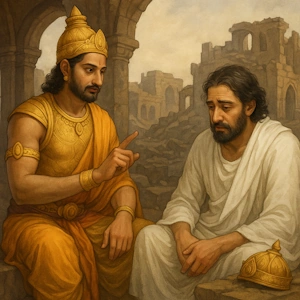
This is the 11th chapter of Shanti Parva in the Mahabharata, set in the solemn aftermath of the Kurukshetra war. Yudhishthira, overwhelmed by grief and dispassion, leans toward renunciation, shunning kingship and desiring the ascetic life. But Arjuna, seeing the kingdom abandoned and dharma in danger, reminds him of the true greatness of the householder's path. Through a powerful ancient dialogue between Indra and forest sages, Arjuna shows that gaarhasthya dharma is not lesser — it is the root of all social and spiritual order. This chapter urges rulers and seekers alike to embrace dharma through responsibility, not retreat.
Verse 1
अर्जुन उवाच।
अत्रैवोदाहरन्तीममितिहासं पुरातनम्।
तापसैः सह संवादं शक्रस्य भरतर्षभ॥
Arjuna speaks with care and reverence.
To convince Yudhishthira, he doesn’t argue — he invokes an ancient tale.
Indra himself, the king of gods, once spoke with ascetic renunciates.
This is no idle parable — it is a mirror from the past, held up to guide the present.
Even gods have weighed renunciation and householder life — let us listen to their truth.
Verse 2
'शक्यं पुनररण्येषु सुखमेतेन जीवितुम्।'
केचिद्गृहान्परित्यज्य वनमभ्यागमन्द्विजाः।
अजातश्मश्रवो मन्दाः कुले जाताः प्रवव्रजुः॥
Some young Brahmins, barely sprouting beards,
born in noble homes but weak in mind,
abandoned their families, believing that forest life alone brings peace.
'It is easier to live in the forest,' they thought.
They left behind duty for silence,
not from wisdom — but from haste clothed as detachment.
Verse 3
धर्मोऽयमिति मन्वानाः समृद्धा धर्मचारिणः।
त्यक्त्वा भ्रातॄन्पितॄंश्चैव तानिन्द्रोऽन्वकृपायत॥
They believed their act was dharma —
leaving kin and comfort for austerity.
Yet the gods watched… and Indra, the protector of order,
was filled not with pride, but compassion.
He saw the flame of righteousness misdirected.
True renunciation does not abandon the living roots of dharma —
brothers, fathers, household bonds.
Verse 4
स तान्बभाषे मघवान्पक्षीभूत्वा हिरण्मयः।
सुदुष्करं मनुष्यैस्तु यत्कृतं विघसाशिभिः॥
Indra took the form of a radiant golden bird
and spoke gently to the renunciates.
'What you have chosen — to live on leftovers, to beg —
is not easy. It is hard, harder than it looks.'
He did not mock them,
but reminded them that even this path
is full of invisible burdens.
Verse 5
पुण्यं भवति कर्मैषां प्रशस्तं चैव जीवितम्।
सिद्धार्थास्ते गतिं मुख्यां प्राप्ताः कर्मपरायणाः॥
Those who truly follow this path with right intent
gain merit, yes —
but only when their life is rooted in karma, not fantasy.
Those who dedicate themselves to purposeful action,
not to ego disguised as renunciation,
attain noble ends.
Right action, not escapism, is what lifts the soul to its destined height.
Verse 6
ऋषय ऊचुः —
अहो बतायं शकुनिर्विघसाशान्प्रशंसति।
अस्मान्नूनमयं शास्ति वयं च विघसाशिनः॥
The renunciates felt stung.
'This bird praises those who eat leftovers?
Is he mocking us?'
Pride flared.
They saw not guidance,
but insult —
and in doing so, revealed that ego can hide even in bark robes.
Verse 7
शकुनिरुवाच —
नाहं युष्मान्प्रशंसामि पङ्कदिग्धान्रजस्वलान्।
उच्छिष्टभोजिनो मन्दानन्ये वै विघसाशिनः॥
The golden bird spoke firmly —
'I do not praise those who roll in filth,
or eat scraps with delusion.
Real leftovers are what remain
after offering to gods, ancestors, and guests —
not what the lazy or impure consume.'
Not all who eat little are pure.
Verse 8
ऋषय ऊचुः —
इदं श्रेयः परमिति वयमेवममंस्महि।
शकुने ब्रूहि यच्छ्रेयो वयं ते श्रद्दधामहे॥
Humbled, the renunciates softened.
'We thought this was the highest good,' they said.
'If there is a truer path, O wise one, teach us.
We are ready to listen — not as critics, but as seekers.'
Verse 9
शकुनिरुवाच —
यदि मां नाभिशङ्कध्वं विभज्यात्मानमात्मना।
ततोऽहं वः प्रवक्ष्यामि याथातथ्यं हितं वचः॥
The bird answered with gravity.
'If you trust me…
if you set aside pride and listen as one Self to another…
then I shall speak the truth.
Not my opinion — but what benefits the soul.'
Verse 10
ऋषय ऊचुः —
शृणुमस्ते वचस्तात पन्थानो विदितास्तव।
नियोगे चैव धर्मात्मन्स्थातुमिच्छाम शाधि नः॥
The renunciates bowed inwardly.
'We are ready.
Show us the path you know —
and we shall walk it,
not by force,
but by faith in your words,
for they shine with dharma.'
Verse 11
चतुष्पदां गौः प्रवरा लोहानां काञ्चनं वरम्।
शब्दानां प्रवरो मन्त्रो ब्राह्मणो द्विपदां वरः॥
Among beasts, the cow is supreme.
Among metals, gold.
Among sounds, the mantra.
Among men, the Brahmana —
not by birth,
but by tapas, truth, and knowledge.
Greatness lies in purpose fulfilled, not form alone.
Verse 12
मन्त्रोऽयं जातकर्मादिर्ब्राह्मणस्य विधीयते।
जीवतोऽपि यथाकालं श्मशाननिधनान्तकः॥
Mantras guide life’s rituals — birth to death.
They light the sacred way for the Brahmana.
Yet even mantras end at the cremation ground.
Forms fade.
But action, grounded in dharma,
leaves echoes beyond the pyre.
Verse 13
कर्माणि वैदिकान्यस्य स्वर्ग्यः पन्थास्त्वनुत्तमः।
अथ सर्वाणि कर्माणि मन्त्रसिद्धानि चक्षते।
आम्नायदृढवादीनि तथा सिद्धिरिहेष्यते॥
The Vedas prescribe karma — sacred, powerful, precise.
Those who follow them with devotion
walk the highest path to heaven.
Mantras succeed through purity of action,
not blind chanting.
When rooted in śraddha and shastra,
they bloom into liberation.
Verse 14
मासार्धमासा ऋतव आदित्यशशितारकम्।
ग्रसन्ते कर्म भूतानि तदिदं कर्मशंसिनाम्॥
Time swallows all.
Days, nights, seasons, planets —
they consume the fruits of karma.
Only the wise, who align their actions with dharma,
move through time,
rather than being eaten by it.
Verse 15
सिद्धिक्षेत्रमिदं पुण्यमयमेवाश्रमो महान्॥
This path — the householder’s path —
is the true field of success.
Holy.
Sacred.
Tested.
It holds the seeds of all other ashramas.
From it, greatness sprouts.
Verse 16
अथ ये कर्म निन्दन्तो मनुष्याः कापथं गताः।
मूढानामर्थहीनानां तेषामेनस्तु विद्यते॥
Those who mock karma,
who scorn the householder’s duty —
walk a dark path.
They appear wise, but are hollow.
Their speech is sharp, but their heart is blind.
Such delusion leads only to downfall.
Verse 17
देववंशान्पितृवंशान्ब्रह्मवंशांश्च शाश्वतान्।
संत्यज्य मूढा वर्तन्ते ततो यान्त्यशुचीन्पथः॥
Fools abandon the lineages of gods, ancestors, and seers —
seeking freedom, they find ruin.
They wander unclean roads,
disconnected from the sacred stream.
No wings grow from roots forsaken.
Verse 18
एतद्वोऽस्तु तपोयुक्तं ददामीत्यृषिचोदितम्।
तस्मात्तदध्यावसतस्तपस्वित्वमिहोच्यते॥
The renunciates accepted the bird’s truth.
He offered them tapas — not escape.
They took it to heart.
And thus, discipline rooted in dharma
became their true asceticism.
Not in withdrawal,
but in right performance.
Verse 19
देववंशान्ब्रह्मवंशान्पितृवंशांश्च शाश्वतान्।
संविभज्य गुरोश्चर्यां तद्वै दुष्करमुच्यते॥
To honor the gods, sages, and ancestors—
to divide one’s efforts between them all—
this is not easy.
It demands devotion, balance, humility.
Only the householder walks this razor's edge daily,
serving all worlds at once.
Verse 20
देवा वै दुष्करं कृत्वा विभूतिं परमां गताः।
तस्माद्गार्हस्थ्यमुद्वोढुं दुष्करं प्रब्रवीमि वः॥
Even the gods attained glory
by performing the hardest tasks.
And what is the hardest?
To uphold gaarhasthya dharma —
the householder’s burden.
It is not lesser, but loftier,
for it bears the weight of all other duties.
Verse 21
तपः श्रेष्ठं प्रजानां हि मूलमेतन्न संशयः।
कुटुम्बविधिनाऽनेन यस्मिन्सर्वं प्रतिष्ठितम्॥
All austerity, all greatness,
springs from the soil of household life.
It is the base of the world-tree.
Without it, no family, no lineage, no dharma survives.
In its structure, the entire society finds balance.
Verse 22
एतद्विदुस्तपो विप्रा द्वन्द्वातीता विमत्सराः।
एतस्माद्वनमध्ये तु लोकेषु तप उच्यते॥
The wise, free from envy and duality,
recognize this householder life as the truest tapas.
Even in the forests,
this is called penance.
Because restraint in the city
is harder than solitude in the woods.
Verse 23
दुराधर्षं पदं चैव गच्छन्ति विघसाशिनः।
सायंप्रातर्विभज्यान्नं स्वकुटुम्बे यथाविधि॥
Those who eat only after sharing
with guests, gods, and family —
are the true vighasashins (eaters of leftovers).
Not weak beggars, but strong givers.
Their path is blessed,
and no one can shake them from dharma.
Verse 24
दत्त्वाऽतिथिभ्यो देवेभ्यः पितृभ्यः स्वजनाय च।
अवशिष्टानि येऽश्नन्ति तानाहुर्विघसाशिनः॥
He who eats last,
after feeding guests, gods, ancestors, family—
is the one praised by the wise.
This is not mere eating —
it is sacrifice made daily.
Verse 25
तस्मात्स्वधर्ममास्थाय सुव्रताः सत्यवादिनः।
लोकस्य गुरवो भूत्वा ते भवन्त्यनुपस्कृताः॥
Such householders,
truthful and vowed to dharma,
become guides to the world.
They rise without seeking rise.
They shine without ornaments.
Their strength lies in living rightly—
not merely talking of rightness.
Verse 26
त्रिदिवं प्राप्य शक्रस्य स्वर्गलोके विमत्सराः।
वसन्ति शाश्वतान्वर्षाञ्जना दुष्करकारिणः॥
And such men, when they leave this world,
dwell in Indra’s swarga. free of envy, full of radiance.
Their seats are permanent,
for they performed what was hardest —
not renouncing the world,
but uplifting it through sacred living.
Verse 27
अर्जुन उवाच —
ततस्ते तद्वचः श्रुत्वा धर्मार्थसहितं हितम्।
उत्सृज्य नास्तिकमतिं गार्हस्थ्यं धर्ममाश्रिताः॥
Arjuna turns to Yudhishthira.
'The renunciates heard and understood.
They cast away their doubts
and embraced householder dharma with reverence.
Not as a fallback — but as the true path.'
Verse 28
तस्मात्त्वमपि सर्वज्ञ धैर्यमालम्ब्य शाश्वतम्।
प्रशाधि पृथिवीं कृत्स्नां हतामित्रां नरोत्तम॥
'So you too, O knower of all,
gather your courage.
Rule this earth with dharma —
for your enemies are vanquished,
and the world waits for your guidance.'
This was not flattery.
It was a brother’s call to duty,
spoken in love and in truth.
This chapter closes with a gentle but firm redirection — from escape to engagement, from despair to duty. Arjuna's words, rooted in ancient wisdom, remind Yudhishthira that true tapasya lies not in fleeing the world, but in sustaining it with dharma. The household life, when lived rightly, uplifts not just the self but the entire society. It is through such disciplined, selfless living that even kings become sages, and rulers become redeemers. Yudhishthira is called not to abandon his throne, but to sanctify it. Thus ends a chapter that crowns gaarhasthya not as bondage, but as the heart of righteousness.





English
Mahabharatam
Click on any topic to open
7
30
Astrology
Bhagavad Gita
Bhagavatam
Bharat Matha
Devi
Devi Mahatmyam
Ganapathy
Garuda Puranam
Glory of Venkatesha
Hanuman
Kathopanishad
Mahabharatam
Mantra Shastra
Mystique
Practical Wisdom
Purana Stories
Radhe Radhe
Ramayana
Rare Topics
Rigveda Explained
Rituals
Sages and Saints
Shiva
Spiritual books
Sri Suktam
Story of Sri Yantra
Temples
Vedas
Vishnu Sahasranama
Yoga Vasishta
26
17
10
0


