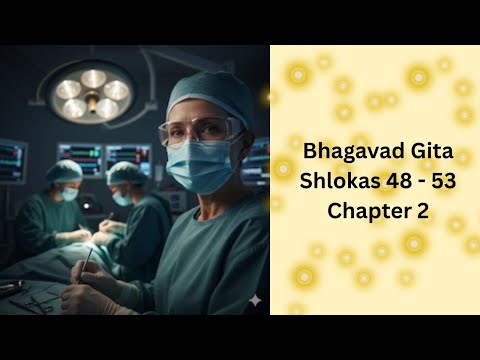
Bhagavad Gita - Shlokas 48 - 53 Chapter 2
योगस्थः कुरु कर्माणि सङ्गं त्यक्त्वा धनञ्जय ।
सिद्ध्यसिद्ध्योः समो भूत्वा समत्वं योग उच्यते ॥ २-४८॥
yogasthaḥ kuru karmāṇi saṅgaṃ tyaktvā dhanañjaya |
siddhyasiddhyoḥ samo bhūtvā samatvaṃ yoga ucyate || 2-48 ||
दूरेण ह्यवरं कर्म बुद्धियोगाद्धनञ्जय ।
बुद्धौ शरणमन्विच्छ कृपणाः फलहेतवः ॥ २-४९॥
dūreṇa hyavaraṃ karma buddhiyogāddhanañjaya |
buddhau śaraṇamanviccha kṛpaṇāḥ phalahetavaḥ || 2-49 ||
बुद्धियुक्तो जहातीह उभे सुकृतदुष्कृते ।
तस्माद्योगाय युज्यस्व योगः कर्मसु कौशलम् ॥ २-५०॥
buddhiyukto jahātīha ubhe sukṛtaduṣkṛte |
tasmādyogāya yujyasva yogaḥ karmasu kauśalam || 2-50 ||
कर्मजं बुद्धियुक्ता हि फलं त्यक्त्वा मनीषिणः ।
जन्मबन्धविनिर्मुक्ताः पदं गच्छन्त्यनामयम् ॥ २-५१॥
karmajaṃ buddhiyuktā hi phalaṃ tyaktvā manīṣiṇaḥ |
janmabandhavinirmuktāḥ padaṃ gacchityanathāmayam || 2-51 ||
यदा ते मोहकलिलं बुद्धिर्व्यतितरिष्यति ।
तदा गन्तासि निर्वेदं श्रोतव्यस्य श्रुतस्य च ॥ २-५२॥
yadā te mohakalilaṃ buddhirvyatitariṣyati |
tadā gantāsi nirvedaṃ śrotavyasya śrutasya ca || 2-52 ||
श्रुतिविप्रतिपन्ना ते यदा स्थास्यति निश्चला ।
समाधावचला बुद्धिस्तदा योगमवाप्स्यसि ॥ २-५३॥
śrutivipratipannā te yadā sthāsyati niścalā |
samādhāvacalā buddhistadā yogamavāpsyasi || 2-53 ||
In our last session, we explored verse 47 of Gita chapter 2, Krishna’s master framework for action: focusing on your effort while relinquishing your attachment to the results. Now, a natural question arises: How do we actually do this? And why is this approach so powerful?
In the next six verses, Krishna provides the answers. He gives us the technique, the rationale, and a glimpse of the extraordinary state of mind it leads to.
Let's begin with verse 48, which gives a new, powerful definition of Yoga.
योगस्थः कुरु कर्माणि…
Krishna says: 'Perform your actions, O Arjuna, while being established in Yoga. Abandon attachment and remain equal in success and failure. This equanimity is called Yoga.'
Here it is. The technique is samatvam—equanimity, even-mindedness. This is the inner posture you must hold while you act. Imagine a senior surgeon in a critical operation at a major hospital like AIIMS Delhi. The situation is tense; a life is on the line. She must be 100% focused, her actions precise. But can she afford to be emotionally overwhelmed by the possibility of success or failure? No. If she's too excited about a potential success, her hands might shake. If she's terrified of failure, her judgment will be clouded by fear. Her peak performance happens when she is perfectly balanced, calm, and steady within—equal to both possibilities. That state of inner balance, right in the heart of intense action, is what Krishna calls Yoga.
Next, in verse 49, Krishna explains why this 'Yoga of the Intellect' is so superior.
दूरेण ह्यवरं कर्म …
He says: 'Action driven by selfish desire is far inferior to action performed with this wisdom of equanimity. Therefore, take refuge in this understanding. Pitiable are those who work only for the fruits of their action.'
The word he uses is kripanaah which means 'misers.' This is a fascinating choice. A miser is someone who hoards wealth and is always anxious about it. Krishna suggests that a person who is constantly chasing results—promotions, bonuses, recognition—is a spiritual miser. They are hoarding experiences and outcomes, living in a state of constant anxiety about gaining and losing them. They can never be truly rich inside. By telling us to take refuge in a steady intellect, he's offering us a path to true inner wealth.
This leads to another famous definition of Yoga in verse 50.
बुद्धियुक्तो जहातीह …
'One who is united with this wisdom frees themselves in this very life from both good and bad deeds. Therefore, strive for this Yoga. Yoga is skill in action.'
योगः कर्मसु कौशलम् … Skill in action. This doesn't just mean technical skill. It means the psychological and spiritual skill to act with your full potential, free from the drag of your ego, your anxieties, and your attachments. It is the skill of acting with a quiet mind. When your mind is quiet, your actions become precise, intuitive, and powerful. You are no longer reacting to your own inner turmoil; you are responding intelligently to the situation at hand. This is the ultimate form of skill.
So what is the final outcome of this practice? Verse 51 tells us.
कर्मजं बुद्धियुक्ता हि …
'The wise, endowed with this equanimity, abandon the fruits of their actions. Freed from the cycle of birth and death, they attain the state that is beyond all suffering.'
This is the ultimate promise. By practicing this inner discipline, one breaks free from the endless emotional rollercoaster of life—the cycle of elation and despair, of hope and disappointment. You attain a state of unshakeable inner peace.
Krishna then anticipates Arjuna's next question: 'This sounds amazing, but when? When does this transformation happen?' Verses 52 and 53 give the answer.
यदा ते मोहकलिलं …
'When your intellect crosses beyond the dense forest of delusion, you will become indifferent to all that has been heard and all that is yet to be heard.'
The 'forest of delusion' मोहकलिलं is a perfect metaphor for our modern world. It's the constant noise of social media, conflicting news reports, endless opinions, and societal pressures telling us what we should want and who we should be. Krishna says that when your mind, through the practice of samatvam, becomes clear and strong, you cut through this jungle of noise. You develop an inner compass. You are no longer swayed by every passing trend or opinion.
And verse number 53 describes the destination.
श्रुतिविप्रतिपन्ना ते …
'When your intellect, which is now tossed about by conflicting teachings, becomes steady and unmoving in the state of self-realization, then you will have attained Yoga.'
Imagine a mind that was once like a turbulent pond, churned up by the winds of desire and fear. Through this practice, it becomes like a deep, calm lake—unmoving, clear, and reflecting the sky perfectly. That unshakeable steadiness of mind is the attainment of Yoga.
So, this section provides a complete path: The practice is equanimity. The rationale is freedom from anxiety. The method is skillful action. And the result is a liberated, unshakeable, and truly peaceful mind.
This journey from action to enlightenment is the core of Karma Yoga.
- Yoga is defined as samatvam—the state of equanimity where you perform actions with full commitment while remaining mentally balanced between success and failure.
- This inner stability is the core technique that enables peak performance, as it frees the mind from the emotional disturbances of hope and fear.
- Action driven by a craving for results is considered inferior because it creates a constant state of anxiety, making one a 'spiritual miser' who is poor in inner peace.
- Yoga is also described as 'skill in action,' referring to the psychological mastery to act with a quiet, focused mind, unhindered by ego or anxiety.
- This form of skillful action allows you to respond to situations with precision and intelligence, rather than reacting to your own inner turmoil.
- The ultimate result of this practice is liberation from the emotional rollercoaster of life and freedom from the cycle of suffering.
- This transformation occurs when your intellect cuts through the 'forest of delusion'—the confusing noise of external opinions and societal pressures—and develops its own inner stability.
- The final attainment of Yoga is an unshakeably steady and clear mind, much like a calm, deep lake, which remains undisturbed by external events.
- What is the core technique for action that this passage introduces?
The central technique is samatvam, or equanimity. This is the practice of maintaining a calm and balanced mind while performing any action, treating the possibilities of success and failure with equal composure. It is not about being passive or indifferent to your work, but about detaching your inner state from the external outcome. This allows you to pour 100% of your focus into the action itself, as exemplified by a surgeon who must be precise and calm under immense pressure, free from the emotional turbulence of potential results. - If I remain equal to success and failure, won't that make me unmotivated to succeed?
This is a common misconception. Equanimity redirects your motivation, it doesn't eliminate it. Your motivation shifts from an anxious craving for a future result to a profound commitment to excellence in the present moment. By letting go of the anxiety about the outcome, you free up immense mental energy. This allows you to focus more intensely and perform more effectively, making success more likely, though you are not emotionally dependent on it. The drive becomes intrinsic—the joy of doing the work well—rather than extrinsic. - Isn't it just human nature to feel happy about success and sad about failure? Is it realistic to try to override this?
The goal is not to suppress or eliminate emotions, but to prevent them from hijacking your intellect and destabilizing your mind. It is a trainable mental discipline, much like an athlete learns to perform under pressure. You learn to observe your feelings of joy or disappointment without letting them dictate your subsequent actions or your core sense of peace. You create a buffer between the external event and your inner state, allowing you to acknowledge the feeling without becoming a slave to it, thus maintaining clarity and control.
- The text says action driven by desire is 'far inferior.' Why is that?
Action driven by selfish desire is considered inferior because it traps you in a cycle of anxiety and emotional dependency. When your happiness is tied exclusively to achieving a specific outcome—like a promotion, bonus, or recognition—you live in a state of constant agitation. You are anxious before the result, ecstatic or devastated after, and then immediately anxious about the next outcome. This makes you a 'spiritual miser,' constantly trying to hoard positive results and fearing their loss, leaving you with no lasting inner wealth or peace. - But isn't the desire for a better life what drives all progress and innovation?
The teaching distinguishes between a clear intention and a clinging attachment. Setting a goal to innovate or improve a situation is powerful and necessary. However, becoming emotionally attached to the exact way that goal unfolds creates suffering. True progress often comes from a place of calm focus and creative freedom, which is hampered by the fear of failure. By focusing on the process with excellence and releasing attachment to the result, you are more adaptable, resilient, and ultimately more innovative. - This philosophy seems impractical in a competitive corporate world where results are the only thing that matters. How can this work?
While the corporate world measures results, this philosophy offers a more effective and sustainable way to achieve them. An individual who practices equanimity is less prone to burnout, makes clearer decisions under pressure, and is not swayed by office politics or market volatility. Their performance is more consistent because it's fueled by a stable inner drive, not by the highs and lows of external validation. Over the long term, this inner stability becomes a formidable professional advantage, leading to better leadership, teamwork, and more reliable outcomes.
- What does it mean that 'Yoga is skill in action'?
This famous phrase, Yogah karmasu kaushalam, redefines skill beyond mere technical proficiency. It refers to the psychological and spiritual skill of acting with a mind that is completely free from the drag of ego, anxiety, and attachment. When your mind is quiet and centered, your actions become more intuitive, precise, and powerful. It is the art of performing your work from a state of inner clarity, allowing you to respond intelligently to the needs of the moment rather than reacting to your own mental static. - So, can someone with no technical ability be 'skillful' just by being calm?
No, the teaching assumes you are already applying your best technical abilities. This 'skill' is an added layer of psychological mastery that enhances your existing talents. Imagine two equally skilled archers. The one who is calm, focused, and unconcerned about the final score will consistently outperform the one who is anxious, whose hands shake with the fear of missing. The psychological skill amplifies the physical one; it does not replace it. True mastery is the fusion of both inner and outer skill. - This sounds like achieving a 'flow state.' Is that what is being described here?
The concept is very similar to the modern psychological concept of a 'flow state,' but with an added spiritual dimension. A flow state is characterized by deep immersion and energized focus, where your sense of self and time fades away. 'Skill in action' encompasses this but also emphasizes the stable equanimity that you carry before, during, and after the action. It's not just about losing yourself in the task, but about maintaining a foundation of unshakeable inner peace regardless of the task's outcome, which is the ultimate aim of the practice. - What is the 'forest of delusion,' and what is its modern-day equivalent?
The 'forest of delusion' is a powerful metaphor for the state of mental confusion caused by an overload of conflicting information, opinions, and desires. Its modern-day equivalent is the constant noise of social media, 24/7 news cycles, advertising, and societal pressures that tell us who to be, what to buy, and how to feel. This endless chatter pulls our intellect in countless directions, making it difficult to find clarity or an inner sense of direction. It is the jungle of external noise that obscures our inner wisdom. - When do I know I have crossed this forest?
You know you have crossed it when your mind is no longer easily swayed by external events or opinions. You develop a strong inner compass and a sense of stability. You can hear a dozen conflicting news reports or receive both praise and criticism without being thrown off your center. Your intellect, once tossed about, becomes steady and self-assured. You become indifferent to the noise not out of arrogance, but because you have found a deeper, more reliable source of wisdom within yourself. - Isn't it dangerous to become 'indifferent' to what is heard? Shouldn't we be open to new information and perspectives?
The 'indifference' spoken of here is not a call for ignorance or closed-mindedness. It is an indifference to the agitating effect of information. The goal is to stop being a victim of every passing trend or alarming headline. A person with a steady intellect can listen to all perspectives with greater objectivity because their identity and peace are not threatened by them. They can process information, learn from it, and act wisely, rather than reacting emotionally to the ceaseless noise.





English
Bhagavad Gita
Click on any topic to open
7
30
Astrology
Bhagavad Gita
Bhagavatam
Bharat Matha
Devi
Devi Mahatmyam
Ganapathy
Garuda Puranam
Glory of Venkatesha
Hanuman
Kathopanishad
Mahabharatam
Mantra Shastra
Mystique
Practical Wisdom
Purana Stories
Radhe Radhe
Ramayana
Rare Topics
Rigveda Explained
Rituals
Sages and Saints
Shiva
Spiritual books
Sri Suktam
Story of Sri Yantra
Temples
Vedas
Vishnu Sahasranama
Yoga Vasishta
26
17
10
0


