Being a Family Man Is Harder Than Being a Monk
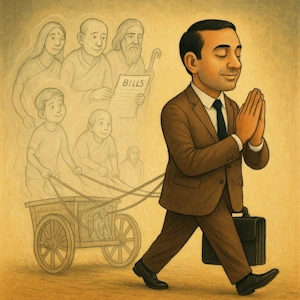
Which is more challenging — being a monk or being a family man?
We have examples of many great ascetics such as Shuka Deva and Shaunaka Maharshi who did not even enter the ashrama of a householder — who chose not to have a family.
Shuka Deva was a born jnani and tyagi. He did not need the training ground that is family life to reach the higher echelons of adhyatma. He already had everything in him. Still, when told by his father, he agreed to propagate the Srimad Bhagavata. He was not devoid of kindness. Out of kindness, he chose to teach the principles of bhakti to the common man. He recognized the importance of elevating the level of the common man.
So in that sense, did he abandon the world? Even though he himself was beyond all the madness and even shackles of the world, he did not abandon the world. He was still there.
Same is the case with Shaunaka Maharshi. He went to Naimisharanya to focus fully on a spiritual life. He had told his father, ‘I don’t want to get married. I want to do tapas, yagas, and listen to the glory of the Almighty more and more.’
But he ended up being instrumental in the spreading of the Puranas across the world. He told Suta, ‘Give me something that can help people in Kaliyuga.’
Did he abandon the world? No. He was very much there.
They all invariably realized the importance of family life.
The importance of being a common man, functioning like a common man.
There are some who think that relinquishing the responsibilities of the world can take you forward, can make you progress spiritually. They think that spirituality and family life are in conflict with each other.
It is not so.
Whenever we talk about divinity — be it Shiva, Vishnu, Devi, or Ganesha — we address them as aadhara of the world, support of the world.
They support the world — the world as it is.
Aadhara is not a physical aadhara.
Aadhara means all that happens in the world, every action in the world — it is because of their support that they all happen.
It is not even that they are happening with their consent or permission — they are all happening because they want them to happen.
That is the meaning of Jagadadhara.
If X is getting married to Y, children are born to them, they build a house, they make a home, they do regular stuff like cook, eat, work, travel, send children to good schools, save money — there is nothing that is non-spiritual about this.
There is nothing anti-spiritual about this.
How will divinity support and allow something that is against divine order, divine wish?
This is the way it has been for millions of years. That is the way of the world.
This is the learning ground. This is the training ground.
Because without a book, you can’t learn.
You can’t stare at blank space and learn anything.
To learn, there has to be something that is real. Something that happens.
Then only you learn:
‘I have done the right thing — I will continue this way.’
‘I have done the wrong thing — I will not do it again.’
‘I could have done it a better way.’
This is how you learn.
Without even doing, how will you learn anything?
Without learning, how will you grow?
You can learn a lot from action — not haphazard action.
A student follows a syllabus, a curriculum.
An athlete follows a training regime.
That’s how they all grow.
So here, for the family man, five daily routines have been prescribed — which he has to insist that he will do every day.
Every time involving his wife.
The husband and wife always have to do these activities together.
Any spiritual activity done by the wife alone or husband alone will not yield any benefit.
Scriptures are clear about this.
If not physically, mentally they have to do it together.
If the husband, on the way to office, has made it a routine to give food to a needy person — a packet of biscuits every day — the wife has to make sure that he doesn’t forget.
She has to make sure that biscuits are available at home.
This is the meaning of doing together — not necessarily going together and doing it.
If the wife is going for a weekend Sahasranama class — the husband has to make sure that he drops her there.
He facilitates it — not necessarily sitting together and learning.
Five daily acts have been prescribed — which are called Pancha Maha Yajnas.
They are Maha Yajnas.
You call Rajasuya a yajna, Vajapeya a yajna — these are called Maha Yajnas.
That itself reveals their greatness and importance.
First one – Worship of divine power. Whatever it is, in your own way.
It may be lighting a lamp, going to a temple, chanting a stotra — recognizing that there is a divine power above everything, which is in command, which is in control.
Second – Learning something every day. Be it worldly knowledge.
Worldly knowledge is part of spiritual knowledge only.
Learn something every day.
Teach something every day.
These days with social media, this has become very easy.
Share some authentic knowledge which can make the life of another person better — the world a better place.
Third – Remember your forefathers.
Do something for them symbolically, if possible ritually.
Ritual makes our belief system strong. That is the purpose of ritual.
In a ritual, physical effort is involved.
You won’t bother to put physical effort unless you have belief in the result.
You will never water a completely dead plant.
Physical action — you will do only if you are convinced.
Ritual can strengthen your beliefs.
Remembering your forefathers every day will cultivate the quality of gratitude in you.
You are here because of them.
Fourth – Feed a person every day — needy or not needy, does not matter.
Feed with the attitude that you are offering this to Agni Bhagwan, who is present in every stomach.
It may be easier to feed someone who is needy.
Fifth – Take care of plants, animals, birds, insects — every day, do something for them.
You can be innovative.
Both these will help you get out of the rigidity of give and take, give and expect something in return.
A beggar whom you are going to feed is not going to give anything in return.
We are so much habituated to expecting return and reward.
Give money — get stuff from the shop.
So cautious we are about the weight of what we get in return for money, quality.
We even count seconds of talk time that the telecom company gives.
So much stress we are taking for these.
Giving without expectation will show you another side of giving —
which gives peace and happiness, rather than stress.
This is why it is said — family life is a good training ground.
If you are in it with awareness, if you are in it with a plan.






English
Practical Wisdom
Click on any topic to open
7
30
Astrology
Bhagavad Gita
Bhagavatam
Bharat Matha
Devi
Devi Mahatmyam
Ganapathy
Garuda Puranam
Glory of Venkatesha
Hanuman
Kathopanishad
Mahabharatam
Mantra Shastra
Mystique
Practical Wisdom
Purana Stories
Radhe Radhe
Ramayana
Rare Topics
Rigveda Explained
Rituals
Sages and Saints
Shiva
Spiritual books
Sri Suktam
Story of Sri Yantra
Temples
Vedas
Vishnu Sahasranama
Yoga Vasishta
26
17
10
0


