Bala and Atibala Mantras - Sriram Ji will unfold their superpower
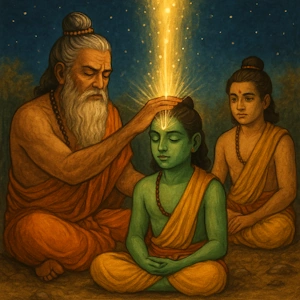
The 22nd sarga of Bala Kanda of Valmiki Ramayana.
Vishwamitra came to Ayodhya to ask Dasharatha to send young Sriram Ji along with him.
Two Rakshasas were obstructing Vishwamitra's yaga.
Vishwamitra wanted Srirama to protect his yaga.
Dasharatha was apprehensive initially.
He was worried about the safety of his sons who was just 12 at that time.
H initially said no to Vishwamitra.
But Sage Vasishta who was also the Rajaguru convinced him that Sriram Ji would be safe with Vishwamitra.
And Dasharatha agreed.
If Rama is going, then Lakshmana also will be with him for sure.
They are inseparable.
Why?
Because Lakshmana is Adishesha, Ananta, who is always with Bhagawan.
Purohitas chanted Swasti suktam wishing safety and success.
Dasharatha and his wives bid farewell to Sriram Ji and Lakshmana.
Vishwamitra walked ahead, Sriram Ji behind him and Lakshmana behind Sriram Ji.
Valmiki says - Sriram Ji and Lakshmana looked like two serpents with 3 hoods each.
They were carrying their bows on their left shoulders and quivers on their right shoulders.
The tips of the bows and the quivers stood alongside their heads and they all together resembled 3 hoods.
It looked as if the Agnilumaras, Skandha and Vinayaka were following Mahadeva.
It was such a brilliant sight.
After walking about one and a half yojanas from the palace, they reached the Sarayu river,
By this time, Rama and Lakshmana were already hungry and thirsty.
Vishawmitra told Rama, take water from the river and do achamanam, purify yourself, I am going to give you something, get ready.
Vishwamitra is about to give him 2 mantras - Bala and Atibala.
Do you know what all powers Rama is going to get with these 2 mantras?
He will never get tired.
He won't be affected by any health issues such as fever.
Rakshasas will not be able to touch him whether he is awake or asleep.
There will be no equal to him in power and strength anywhere in the three worlds.
There will be no equal to him in the 3 worlds.
Remember what Vasishta told?
Vishwamitra is the most powerful warrior in all the 3 worlds.
He has 100 divine weapons with him.
He is empowering Sriram Ji to fulfill the purpose of his avatara starting with these two powerful mantras.
In terms of brilliance, beauty, skills, and determination, Sriram Ji will not have an equal after he starts chanting Bala and Atibala.
He will never be affected by hunger and thirst.
Why is Vishwamitra giving these mantras to Rama?
सर्वलोकस्य गुप्तये - to protect the whole world.
These two mantras are sons of Brahma.
And Rama is fully eligible to receive them, Vishwamitra knows that.
I got them through sever tapas.
Now their manifold capabilities are going to spread out through Rama.
Sriram Ji received the two mantras.
He looked more brilliant than ever after that.
All three spent the night there.
Slept on grass.
Vishwamitra treated them very affectionately.
They also delivered their duties towards him.
- Why does Valmiki compare Rama and Lakshmana to three-hooded serpents while they followed Vishwamitra?
The comparison is both visual and symbolic. Physically, the combination of their heads, the tips of their bows, and their quivers created a silhouette of three peaks or hoods. Symbolically, it hints at their divine nature. Since Lakshmana is an incarnation of Adishesha, the thousand-headed serpent, this imagery serves as a subtle reminder of their celestial identity hidden beneath their human forms. - What is the significance of Vishwamitra initiating Rama into Bala and Atibala specifically on the banks of the Sarayu river?
In Vedic tradition, water acts as a medium for purification and the transmission of spiritual power. By asking Rama to perform achamanam (ceremonial sipping of water), Vishwamitra prepared Rama’s physical vessel to hold the immense energy of the mantras. The location, one and a half yojanas from the palace, represents the transition from the comfort of royalty to the rigor of a tapasvi (ascetic) life. - How do these mantras relate to the primary purpose of the Rama Avatara?
Vishwamitra explicitly states the mantras are for Sarvalokasya Guptaye, meaning the protection of the whole world. While Rama is already the Supreme Being, in his human role, he must acquire the tools necessary to battle forces that transcend human limits. These mantras ensured that physical frailties like hunger, thirst, and fatigue would never hinder his divine mission to uphold Dharma. - Why did Vishwamitra choose to give these mantras to Rama instead of keeping their power solely for his own use?
A true Guru acts as a conduit for divine power. Vishwamitra mentions he acquired these mantras through severe tapas (austerity), but he recognizes that Rama is the perfect recipient (patra). He knew that for the manifold capabilities of these Brahma-born mantras to truly benefit the universe, they needed to be wielded by the embodiment of Dharma himself. - What does the apprehension of King Dasharatha reveal about the nature of parental love versus divine destiny?
Dasharatha’s initial refusal, citing Rama’s age of 12, highlights the human element of Moha or attachment. Even though he was the father of God, his paternal instinct perceived only a vulnerable child. It required the spiritual vision of Sage Vasishta to remind him that Rama’s safety was not dependent on his age, but on the presence of Vishwamitra and Rama’s own inherent divinity. - Why is the presence of Lakshmana considered essential in this journey?
The text emphasizes that they are inseparable. This represents the relationship between the Jivatma (individual soul) and the Paramatma (Supreme Soul), or the Sevaka (servant) and the Swami (Lord). Lakshmana, as Adishesha, provides the foundation and support for the Lord’s activities. His presence ensures that the service to the Guru is complete in every dimension. - What is the "hidden" protection offered by the mantras during sleep?
The mantras provided a unique shield where Rakshasas could not touch Rama even while he was asleep. This suggests that the mantras worked on the subconscious and subtle body levels. It ensured that the Lord’s meditation and rest remained undisturbed by the deceptive and illusory powers (Maya) of the demons. - In what way does this sarga illustrate the ideal relationship between a student and a teacher?
Despite being the Lord of the Universe, Rama follows Vishwamitra. He walks behind the sage, listens intently, performs purification rituals upon command, and serves the sage’s needs. This sets the standard for Vinaya (humility), showing that no matter how great one’s potential, the guidance of a Guru is the key to unlocking it. - Why are the mantras Bala and Atibala referred to as the "daughters of Brahma"?
Calling them the progeny of Brahma signifies that these are primordial energies of creation. They are not merely "words" but living vibrations that carry a portion of the Creator’s power. By receiving them, Rama was effectively being re-linked to the creative and sustaining powers of the universe to counteract the destructive powers of the Rakshasas. - What does the act of sleeping on grass (darbha) signify for the young princes?
Sleeping on the ground on a bed of grass marks the beginning of Rama’s life as a protector of the hermits. It symbolizes the abandonment of material luxury in favor of spiritual purpose. This act of Vairagya (dispassion) reinforces that brilliance and power, as seen in Rama after he received the mantras, are best maintained through a simple and disciplined life.





English
Ramayana
Click on any topic to open
7
30
Astrology
Bhagavad Gita
Bhagavatam
Bharat Matha
Devi
Devi Mahatmyam
Ganapathy
Garuda Puranam
Glory of Venkatesha
Hanuman
Kathopanishad
Mahabharatam
Mantra Shastra
Mystique
Practical Wisdom
Purana Stories
Radhe Radhe
Ramayana
Rare Topics
Rigveda Explained
Rituals
Sages and Saints
Shiva
Spiritual books
Sri Suktam
Story of Sri Yantra
Temples
Vedas
Vishnu Sahasranama
Yoga Vasishta
26
17
10
0


