Asana and Pranayama Explained
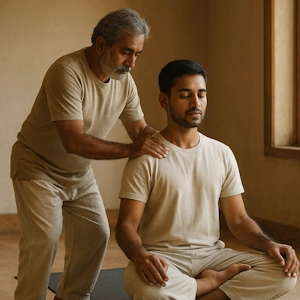
स्थिरसुखमासनम्
Practice of asana, the postures, provides steadiness and comfort to the body.
स्थिरबुद्धिरसंमूढः पूर्वमासनमभ्यसेत् ॥
The asanas should be practiced with a steady mind. Do not do them for the wrong reason. Asanas are to give stability and steadiness to the body, and strength to undertake long hours of dharana, dhyana, and samadhi. A yogi has to sit in meditation for hours together, sometimes days together. Asanas are meant to make the body suitable for that. Do not do asana to remove fat from the belly or fix a back pain. Asana is a preparatory step for what is ahead in ashtanga yoga, and should be performed when one is already steady in yama and niyama.
Only after successfully attaining steadiness of the body through asanas, one should attempt pranayama.
ततो द्वन्द्वानभिघातः
After conquering duality.
तस्मिन सति श्वासप्रश्वासयोर्गतिविच्छेदः प्राणायामः
तस्मिन सति – only after non-duality is attained through asanas. Control of inhalation and exhalation is pranayama.
द्बन्द्वातीतो जयेत्प्राणानभ्यासक्रमयोगतः ॥
अन्तश्चराणां वायूनां बाह्याभ्यन्तररोधनम् ।
प्राणायाम इति प्रोक्तः
Pranayama is not breathing exercise. It is not oxygenation of the blood. It is one of the most risky things ever to do with your body. You are dealing with the nerve currents of the body. Pranayama is not about deep inhalation, retention, and exhalation. By means of them you are trying to control all the internal activities and impulses of the body – pranas are ten in number. Achieving control over them is called pranayama.
Never ever practice pranayama under the guidance of those who hold certificates from one-week and two-week crash courses in pranayama. It can lead to all kinds of physical and mental ailments. Medical science is coming out with more and more evidence to establish that excessive oxygen in the blood is harmful.
In pranayama, the place where it is practised, the timing, and the count are very important.
Gheranda Samhita, an authoritative text in hatha yoga, says:
दूरदेशे तथारण्ये राजधान्यां जनान्तिके
योगारम्भं न कुर्वीत कृतश्चेत् सिद्धिहा भवेत्
Do not practice yoga in a distant place, forest, thickly populated places, or near people. It will not be fruitful.
Pranayama should be practiced in a hut smeared with cow dung and hidden away from people. This is what Gheranda Samhita says.
-
How do I know I am ready for pranayama?
You should already have a steady sitting posture and a calm, disciplined mind. If you cannot sit comfortably and focus for a while, work on that first. -
What does real steadiness in asana look like?
No fidgeting, no forced breathing, and no strain in the face or joints. The body feels grounded and relaxed at the same time. -
Why does motivation matter so much?
If the goal is vanity or quick fixes, the practice becomes shallow and risky. A clear purpose keeps choices disciplined and progress stable. -
Are asanas a substitute for medical treatment or physiotherapy?
No. They support the body for long meditation; aches and clinical issues need proper diagnosis and care. -
What does conquering duality mean in day-to-day practice?
It means you are not yanked around by heat and cold, praise and blame, comfort and discomfort. You remain even and focused. -
Is pranayama just deep breathing?
No. It is the deliberate regulation of the breath to influence the body’s subtle energies and nervous system. -
Why do people warn that breath work can be risky?
Because it changes heart rate, blood gases, and nerve responses. Without guidance, people push ratios or holds that disturb mind and body. -
Why are counts and ratios used at all?
Ratios create predictable effects on attention and energy. They keep the practice measurable and prevent random overdoing. -
Do I need to learn about the ten pranas before starting?
You do not need a thesis. You need humility, a stable seat, clean habits, and a teacher who introduces ideas as your practice matures. -
Why are place and time emphasized so strongly?
Quiet, clean spaces reduce sensory noise and emotional drift. Fixed timing builds rhythm, which trains the nervous system to settle faster. -
Is breath retention compulsory?
Not at the start. Quality inhalation and exhalation under guidance come first; appropriate retention is introduced only when you are truly ready. -
Can a modern fitness-style class still help meditation later?
It can, if it builds stability, ease, and attention rather than performance. Choose sequences that end in stillness, not adrenaline. -
Why insist on a qualified teacher?
A teacher reads your posture, pulse, and mindset in real time, adjusts methods, and prevents harm. Books and videos cannot do that. -
What is a practical sign that I am progressing safely?
You finish practice feeling clear, balanced, and quietly alert. Sleep improves, irritability drops, and your sitting becomes naturally longer.




English
Vishnu Sahasranama
Click on any topic to open
7
30
Astrology
Bhagavad Gita
Bhagavatam
Bharat Matha
Devi
Devi Mahatmyam
Ganapathy
Garuda Puranam
Glory of Venkatesha
Hanuman
Kathopanishad
Mahabharatam
Mantra Shastra
Mystique
Practical Wisdom
Purana Stories
Radhe Radhe
Ramayana
Rare Topics
Rigveda Explained
Rituals
Sages and Saints
Shiva
Spiritual books
Sri Suktam
Story of Sri Yantra
Temples
Vedas
Vishnu Sahasranama
Yoga Vasishta
26
17
10
0


