Ardhanareeshwara: Where Masculine and Feminine Become One Truth
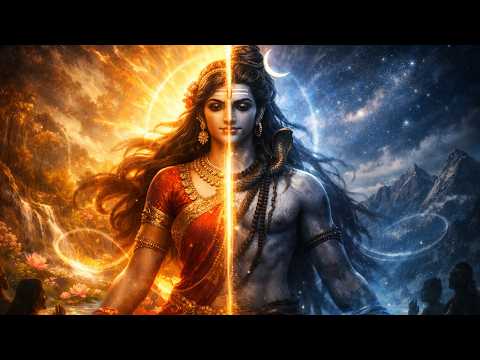
The form of Ardhanareeshwara stands as one of the sharpest metaphysical statements ever conceived. With Shiva occupying the right side and Parvati (Shakti) the left, they form a single, seamless being. This iconographic representation delivers a profound truth: existence is not binary. It is not merely male or female, matter or spirit, or energy or consciousness. It is both. The universe functions through the perpetual tension and cooperation between these two fundamental principles.
The Symbiosis of Stillness and Movement
In the language of the Puranas, Shiva and Parvati are not merely a divine couple; they are a map of reality itself. Their union defines the mechanics of existence:
- Shiva represents consciousness, awareness, and the inner witness. Without Shakti, Shiva is pure stillness—unmoving and detached.
- Shakti represents energy, life, manifestation, and form. Without Shiva, Shakti is pure movement—blind and chaotic.
When these two are brought together, the result is the universe. To remove Parvati is to shut down creation; to remove Shiva is to strip creation of its direction. Ardhanareeshwara teaches us to stop ranking these principles. Neither is superior or dominant; they are the complementary halves of a single truth.
The Puranic Evidence: Energy and Consciousness
The Puranic tradition, specifically within the Shiva Purana and Linga Purana, illustrates this through the story of Sati’s self-immolation. Following her departure, Shiva withdraws into a state of total detachment and silence. Without the presence of Shakti, creation begins to collapse, and the celestial beings cannot function.
Order is only restored when Sati is reborn as Parvati and reunites with Shiva. The philosophical takeaway is straightforward: Energy without Consciousness burns out, and Consciousness without Energy freezes.
Textual Foundations
The Soundaryalahari captures this essential union in a single, powerful verse:
'शिवः शक्त्या युक्तो यदि भवति शक्तः प्रभवितुं न चेदेवन्देवो न खलु कुशलः स्पन्दितुमपि ।'
This translates to: "Shiva becomes able to act only when united with Shakti. Without Shakti, even Shiva is not capable of movement."
Furthermore, the Skanda Purana emphasizes their role as the cosmic parents. Parvati tells Shiva that humanity recognizes him as the father of the worlds and her as the mother. By appearing as Ardhanareeshwara, the ancient seers were signaling for us to stop splitting the world into rigid roles and categories. Creation is born from unity, not separation.
The Path of Union and Non-Duality
Ardhanareeshwara is the visual form of Advaita (non-duality). This does not imply that everything becomes a bland Monolith; rather, it means everything fits so perfectly that separation vanishes. They are:
- Two but one.
- Different but not divided.
- Distinct but not separate.
Integrating the Elements Within
The yogic tradition suggests that every individual possesses both elements:
- The Shiva Element: Strengthened through meditation and awareness.
- The Shakti Element: Strengthened through action and life-force.
True maturity is reached when these two forces run together within an individual without internal conflict.
The Ultimate Lesson
The rishis did not create the image of Ardhanareeshwara for the sake of art or sculpture competitions. They sought to teach the most difficult concept in the simplest form: the unity of opposites.
The message is a direct challenge to our perceptions:
- You cannot worship the masculine while insulting the feminine.
- You cannot celebrate logic while ignoring emotion.
- You cannot chase ambition while ignoring inner clarity.
The world does not run on a single pole, but on the tension between them. Life is born when these two forces acknowledge how incomplete they are alone, and how truly complete they become together.
- Why is Shiva specifically on the right and Parvati on the left in the Ardhanareeshwara form?
The right side is traditionally associated with Purusha, the stationary witness or consciousness, while the left side is associated with Prakriti, the creative force and manifestation. In the human body, the right side is governed by the logical and analytical aspects, whereas the left is the seat of intuition and creativity. Their union in one form shows that these are not separate entities but two functions of the same reality.
- What is the hidden meaning behind Shiva being described as "pure stillness" without Shakti?
Stillness without energy is a state of potentiality that cannot express itself. It is like a silent ocean without a single wave. While it contains everything, it accomplishes nothing. Shakti is the "Spanda" or the cosmic vibration that turns this silent consciousness into a vibrant, living universe.
- How does the story of Sati’s departure explain the necessity of the feminine principle?
When Sati left, Shiva entered a state of total withdrawal. This illustrates that without the feminine principle—which represents engagement, compassion, and involvement—the supreme consciousness becomes indifferent to the world. A world without Shakti is a world where life cannot breathe, and divinity remains locked in an unreachable void.
- Is Ardhanareeshwara a statement about gender equality or something deeper?
While it supports the dignity of both genders, its primary purpose is metaphysical. It suggests that "Male" and "Female" are merely biological reflections of deeper cosmic principles: Consciousness and Energy. It teaches that the universe is a singular fabric woven from two different threads. To rank one over the other is to misunderstand the very nature of existence.
- What occurs when Shakti functions without the guidance of Shiva?
As the text suggests, Shakti without Shiva is "blind and chaotic." This represents raw power or life-force devoid of awareness or purpose. In human terms, it is like ambition without ethics or action without reflection. It leads to destruction because it lacks the "inner witness" to provide direction and balance.
- What does the Soundaryalahari mean by stating Shiva cannot even "stir" without Shakti?
This is a technical metaphysical point. "Stirring" or "Spandana" refers to the first movement of creation. Consciousness by itself is non-dual and unchanging. For it to "become" many things, it requires a power of manifestation. Shakti is that power. Without her, the Divine remains a static concept rather than a living experience.
- How does the concept of "The Cosmic Parenthood" change our view of the world?
By viewing Shiva and Parvati as the universal father and mother, the Skanda Purana removes the idea of a distant, judgmental deity. It suggests that we are born from a state of total union and love. It implies that every aspect of the world—whether solid matter or subtle thought—is a child of this divine harmony.
- How can a person experience the Ardhanareeshwara principle within themselves?
Through the balance of meditation and action. Meditation strengthens the "Shiva element" or the ability to remain a calm witness. Purposeful action strengthens the "Shakti element" or the life-force. When a person can be deeply involved in the world (Shakti) while remaining internally detached (Shiva), they have realized the Ardhanareeshwara state.
- What is the "hidden tension" mentioned in the text?
The tension is not a conflict, but a dynamic pull between two opposites. It is like the tension in the string of a musical instrument; without it, there is no music. The universe exists because Consciousness wants to remain still, while Energy wants to move. Their "agreement" to work together creates the rhythm of life.
- Why is Ardhanareeshwara considered the visual form of Non-Duality (Advaita)?
Advaita is often misunderstood as the denial of the world. However, Ardhanareeshwara shows that non-duality is the perfect integration of variety. It proves that you can have two distinct forms—different in appearance and function—that are yet fundamentally one. It is the celebration of diversity within a singular, divine unity.





English
Shiva
Click on any topic to open
7
30
Astrology
Bhagavad Gita
Bhagavatam
Bharat Matha
Devi
Devi Mahatmyam
Ganapathy
Garuda Puranam
Glory of Venkatesha
Hanuman
Kathopanishad
Mahabharatam
Mantra Shastra
Mystique
Practical Wisdom
Purana Stories
Radhe Radhe
Ramayana
Rare Topics
Rigveda Explained
Rituals
Sages and Saints
Shiva
Spiritual books
Sri Suktam
Story of Sri Yantra
Temples
Vedas
Vishnu Sahasranama
Yoga Vasishta
26
17
10
0


