Annamacharya: The Progenitor of Music and the Shadow of Lord Venkateswara
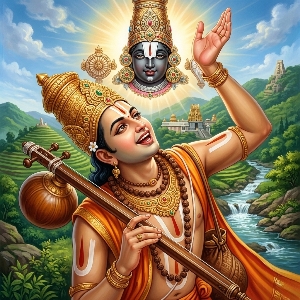
In the annals of Indian devotional literature and the world of Carnatic music, the name Annamacharya represents an entire era. Often regarded as the predecessor to Purandara Dasa (the Pitamaha or Grandfather of Carnatic music), Annamayya was a 15th-century saint-singer. Driven by his boundless devotion to Lord Venkateswara of Tirupati, he composed over 32,000 sankirtanas, showing the world a path to the divine through the power of music.
Birth and Early Life:
Tallapaka Annamacharya was born in 1408 AD in a small village called Tallapaka (modern-day Kadappa district, Andhra Pradesh). Born into a Nandavarika Brahmin family to Narayana Suri and Lakkamma, he showed little interest in worldly affairs even as a child.
Legend has it that at the age of 16, while working in a field, he felt a sudden detachment from mundane life and set out on a pilgrimage toward the Tirumala hills. Exhausted and thirsty on his journey, it is believed that Goddess Alamelu Manga appeared before him and fed him. From that moment on, he never looked back.
Musical Journey and Legacy:
Annamacharya’s compositions are famously known as 'Sankirtanas'. Remarkably, he engraved his songs onto copper plates. These plates remained hidden for centuries in a specialized stone vault within the Tirumala temple known as the 'Sankirtana Bhandagaram'. They were only rediscovered and brought to light in 1922.
His works are primarily categorized into two themes:
- Adhyatma Sankirtanas: These focus on spirituality, philosophy, and the path to liberation (mukti). They reflect on the transience of worldly life and the philosophy of total surrender (sharanagati).
- Sringara Sankirtanas: These describe the divine love (Madhura Bhakti) between Lord Vishnu and Goddess Mahalakshmi.
Famous compositions such as “Brahmam Okkate,” “Nanati Batuku Natakamu,” and “Adigo Alladigo” continue to resonate on music stages across the globe today.
A Social Reformer:
Annamacharya was not just a poet; he was a visionary social reformer. In the 15th century, he boldly spoke out against caste discrimination and social hierarchy.
His iconic song, “Brahmam Okkate”, serves as a spiritual manifesto for equality. It proclaims that all souls are equal before the Divine—that there is no difference between a king and a pauper, or a Vedic scholar and the downtrodden. He was a pioneer in using spirituality to establish social harmony.
The Bond with Tirumala:
Annamayya dedicated his entire life to the service of the Lord of the Seven Hills. He took a vow to compose and offer at least one new song to the Lord every single day.
History notes that Saluva Narasimha Raya, the King of the Vijayanagara Empire, invited Annamayya to his court. However, the saint refused to engage in “Narastuti”, insisting that his voice was reserved solely for “Haristuti”.
Conclusion:
In 1503 AD, after living a full life of approximately 95 years, Annamacharya attained the feet of the Lord. His legacy was carried forward by his son, Peda Tirumalacharya, and his grandson, Chinnanna.
Annamacharya’s songs are more than just musical compositions; they are guides for living. Blending the sweetness of the Telugu language with profound spiritual depth, his creations continue to echo in the hearts of millions of devotees.






English
Rare Topics
Click on any topic to open
7
30
Astrology
Bhagavad Gita
Bhagavatam
Bharat Matha
Devi
Devi Mahatmyam
Ganapathy
Garuda Puranam
Glory of Venkatesha
Hanuman
Kathopanishad
Mahabharatam
Mantra Shastra
Mystique
Practical Wisdom
Purana Stories
Radhe Radhe
Ramayana
Rare Topics
Rigveda Explained
Rituals
Sages and Saints
Shiva
Spiritual books
Sri Suktam
Story of Sri Yantra
Temples
Vedas
Vishnu Sahasranama
Yoga Vasishta
26
17
10
0


