Amrityuh sarvadrik simhah ....
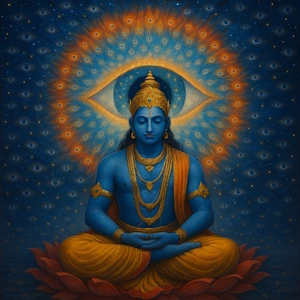
अमृत्युः सर्वदृक् सिंहः सन्धाता सन्धिमान् स्थिरः ।
अजो दुर्मर्षणः शास्ता विश्रुतात्मा सुरारिहा ॥ २२॥
amrityuh sarvadrik sinhah sandhata sandhiman sthirah
ajo durmarshanah shasta vishrutatma surariha
1. अमृत्युः (Amrityuh) – The Deathless One
He is Amrityu — the One who cannot die.
Not because He avoids death.
But because death itself bows before Him.
He is the flame that continues to burn when stars go dark.
He is the witness when ages rise and crumble.
He was before time.
He remains after time.
He is Amrityu — the still center that death cannot touch.
2. सर्वदृक् (Sarvadrik) – The All-Seer
He sees everything.
Not just what you say —
but what you hide,
what you fear,
what you dream in silence,
what your soul has whispered in other lives.
From galaxies spinning to the tear that doesn’t fall —
He sees it all.
He is Sarvadrik — the eye that never blinks,
the vision behind your vision.
3. सिंहः (Sinhaḥ) – The Lion
He is the Lion, but not of the jungle.
He is the lion of Dharma, of Truth, of Terrifying Justice.
He does not growl — He roars,
and falsehood flees.
He stands alone and unafraid in the jungle of fear.
When the soul needs courage, it remembers His name:
Sinha — the majesty that cannot be tamed.
4. सन्धाता (Sandhata) – The Binder of Worlds
He is Sandhata — the one who binds what is broken,
who connects what is scattered.
He stitches the fallen threads of dharma,
He knits hearts that were shattered by pain,
He joins time with timelessness.
He is not just the Creator —
He is the one who heals the cracks.
5. सन्धिमान् (Sandhiman) – The Master of Alliances
He is Sandhiman — the knower of cosmic contracts,
the one who guards divine agreements.
Between fire and water.
Between soul and body.
Between action and consequence.
He keeps all pacts sacred,
ensuring the balance holds.
Even karma moves under His signed covenant.
6. स्थिरः (Sthirah) – The Unshakable
He is Sthira — firm, unwavering, eternally still.
When the world trembles,
when fate screams,
when all forms collapse —
He remains.
He is the rock in the flood,
the silence beneath the storm.
Nothing can move Him,
but everything is moved by Him.
7. अजः (Ajah) – The Unborn
He is Ajah — the One who is never born, yet birth itself flows from Him.
He does not begin.
He does not emerge.
He simply is.
Brahma is born from Him.
Time flows from Him.
But He? He was never not.
He is Ajah — the unborn source of all beginnings.
8. दुर्मर्षणः (Durmarshanah) – The Unassailable
He is Durmarshana — the One who cannot be defeated, cannot be provoked, cannot be resisted.
To oppose Him is to invite your own collapse.
Demons try, kings try, doubts try —
and each one is reduced to ashes.
He is not angry.
He is absolute.
He is Durmarshana — the unshakeable force wrapped in perfect calm.
9. शास्ता (Shasta) – The Supreme Teacher, The Disciplinarian
He is Shasta — the one who teaches by truth,
who corrects without fear,
who gives the bitter medicine of dharma.
He doesn’t flatter.
He doesn’t appease.
He awakens.
When needed, He speaks with a thunderclap.
When needed, with the gentleness of a whisper.
But He always teaches.
10. विश्रुतात्मा (Vishrutatma) – The Universally Celebrated Soul
He is Vishrutatma — the famed soul,
glorified in all the worlds, by gods, sages, and the silence of stars.
His name flows in the Vedas.
His story is sung in temples.
His glory dances in the hearts of children and seers alike.
He is not just known —
He is celebrated across time and space.
11. सुरारिहा (Surariha) – The Slayer of the Gods’ Foes
He is Surariha — the slayer of the enemies of devas.
But not just monsters with horns —
He slays ignorance,
He slays tyranny,
He slays the inner demon that says you are not divine.
Every time the light is threatened,
He rises —
not just to fight — but to finish.
Final Thoughts:
This verse?
It’s a warrior’s prayer and a sage’s song.
It carries the thunder of justice,
the silence of eternity,
the smile of the Unborn.
Amrityu. Sarvadrik. Sinha. Sandhata. Sandhiman. Sthira. Ajah. Durmarshana. Shasta. Vishrutatma. Surariha.
Each name is a shield,
a torch,
a truth.
Each name whispers into your soul —
Stand up. The divine breathes within you.
-
If He is beyond death, how does remembering this truth change our fear of loss?
Chanting any nama from the Vishnu Sahasranama slowly allows the mind to anchor in what cannot be destroyed. Fear softens when the heart hears its own voice declaring that death is not the final authority. This practice steadies families when they face grief, turning despair into courage. -
If nothing can be hidden from His sight, what is the point of pretending in front of others?
Nama japa exposes the futility of masks. Repeating any nama 108 times daily trains the mind to live in honesty, because you are chanting before the All-Seer. Relationships grow stronger when truth replaces pretense. -
What does it mean for courage if He is the lion of dharma, not of the jungle?
Calling upon Him through Sahasranama chanting fills the chest with a quiet fearlessness. Just as the roar scatters falsehood, the rhythm of reciting His names pushes away inner cowardice. This courage helps in family duties, work challenges, and personal trials. -
If He binds what is broken, can reciting His names mend what feels scattered inside us?
Yes. Slow chanting of the full Sahasranama works like stitching — the scattered thoughts begin to align, just as broken ties in relationships find healing. The practice brings coherence, like threads woven into one fabric. -
Why speak of sacred agreements if daily life feels chaotic and unfair?
Because chanting His names reminds us that nothing slips outside His order. Even cause and effect operate under His law. Reciting any nama 11 times before sleep reassures the heart that chaos is only surface noise; deeper balance is intact. -
What strength does one gain by remembering He is unshakable?
In moments of family crisis or illness, the image of the Unshakable one prevents collapse. Chanting a nama 108 times gives the nervous system calmness, like a rock that does not move in flood. The body rests, the breath steadies, and resilience rises.
-
How can you call something deathless when everything we observe in nature decays and ends?
Deathless here means not subject to the cycle of birth and death. Stars, bodies, and minds perish because they are composed parts. The unchanging base from which they arise and into which they dissolve does not perish, so it is called deathless. -
What proof is there that anyone can see everything from galaxies to secret thoughts?
Seeing everything is not about physical eyes. It is the principle that no action, thought, or event exists outside the field of awareness that sustains them. If something exists, it is already contained in that awareness. -
Why use the image of a lion when there is no jungle of dharma to roar in?
The lion is a symbol of unmatched courage and authority. Dharma, or order, faces constant threats from falsehood and fear. The lion image shows that truth has a force that silences pretenders and clears confusion. -
What does it even mean to bind worlds or stitch broken things together?
Binding here means restoring coherence. When dharma breaks, life becomes fragmented and hostile. The sustaining power that reconnects actions, beings, and time into balance is described as the binder. -
Isn't talk of cosmic contracts just storytelling when cause and effect is already explained by science?
Contracts here mean that laws are not random but dependable. Fire burns, water cools, action leads to reaction — these are consistent agreements in the fabric of reality. The claim is that these reliable patterns are safeguarded by a higher order, not chance. -
How can anything be called unshakable when even mountains shift and stars collapse?
Unshakable means not dependent on form or change. Matter collapses because it is temporary structure. The ground reality that allows collapse or stability itself does not shift, so it is rightly called unshakable.





English
Vishnu Sahasranama
Click on any topic to open
7
30
Astrology
Bhagavad Gita
Bhagavatam
Bharat Matha
Devi
Devi Mahatmyam
Ganapathy
Garuda Puranam
Glory of Venkatesha
Hanuman
Kathopanishad
Mahabharatam
Mantra Shastra
Mystique
Practical Wisdom
Purana Stories
Radhe Radhe
Ramayana
Rare Topics
Rigveda Explained
Rituals
Sages and Saints
Shiva
Spiritual books
Sri Suktam
Story of Sri Yantra
Temples
Vedas
Vishnu Sahasranama
Yoga Vasishta
26
17
10
0


