Gururgurutamo Dhama ....
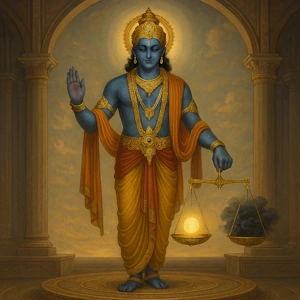
गुरुर्गुरुतमो धाम सत्यः सत्यपराक्रमः ।
निमिषोऽनिमिषः स्रग्वी वाचस्पतिरुदारधीः ॥ २३॥
gurur gurutamo dhaama satyah satyaparaakramah
nimisho’nimishah sragvee vaachaspatir udaaradheeh
1. गुरुः (Guruh) – The Teacher
He is Guru — the bringer of weight, not in mass, but in meaning.
Every truth, every dharma, every secret of the Self —
He delivers it like a seed in the soil of your soul.
His silence teaches.
His presence transforms.
His glance lifts the fog of lifetimes.
He is Guru — the guide who takes you from darkness to light.
2. गुरुतमः (Gurutamah) – The Supreme Teacher
He is not just a guru — He is Gurutama, the guru of all gurus.
Even the great rishis, even the gods —
sit at His feet,
not because they don’t know,
but because He is the source from which even knowledge learns.
He is the ultimate master —
the silent fountain of wisdom where the wise come to drink.
3. धाम (Dhaama) – The Abode, the Radiance
He is Dhaama — the refuge, the brilliance, the source of all light.
Not a physical home — but the sanctuary of the soul.
Where peace lives.
Where fear ends.
Where you return, lifetime after lifetime, seeking the familiar warmth of eternal truth.
He is the shelter behind all shelters.
The light behind all lamps.
4. सत्यः (Satyah) – Truth Himself
He is not truthful — He is Truth.
He is Satyah — the real in all that’s real.
He does not change with time.
He does not bend with opinion.
He does not vanish in illusion.
He stands when illusions fall.
He remains when universes dissolve.
He is the anchor of the soul — steady, silent, certain.
5. सत्यपराक्रमः (Satyaparaakramah) – Whose Valor is Truth Itself
He is Satyaparakrama — the warrior of truth, the strength of honesty.
He fights no battle out of ego.
He swings no sword out of pride.
When He battles, it is truth incarnate rising to tear down falsehood.
His might is not brute — it is righteous.
He is the courage of clarity,
the strength that speaks when silence is cowardice.
6. निमिषः (Nimishah) – He Who Closes His Eyes
He is Nimisha — the one who blinks, who rests,
who allows cycles to end.
In that divine blink, entire yugas disappear.
Worlds fall asleep.
Kalpas take a pause.
His blink is not forgetfulness.
It is grace allowing closure.
Even silence has meaning in His gaze.
7. अनिमिषः (Animishah) – He Who Never Blinks
Yet — He is also Animisha, the unblinking witness.
The eye that never sleeps,
the awareness that never wavers.
He watches over you in the womb.
He sees the moments you forget yourself.
He remembers what even you have erased.
Animisha — the eternal eye that holds the flame of remembrance.
8. स्रग्वी (Sragvee) – The Adorner of Garlands
He is Sragvi — the one who wears divine garlands,
not of just flowers, but of merit, beauty, and sacred acts.
The Vaijayanti mala that graces Him
is not decoration — it is declaration.
It says: He is victory,
He is grace,
He is the blossom of all divine fragrance.
9. वाचस्पतिः (Vaachaspatih) – The Lord of Speech
He is Vaachaspati — the master of speech,
the one from whom all sacred sound emerges.
Vedas are not written — they are heard from Him.
The chants, the mantras, the revelations —
all flow from His tongue like nectar.
He is the first voice,
the original vibration,
the sound that split the silence and birthed the cosmos.
10. उदारधीः (Udaaradheeh) – The One with Vast Intelligence
He is Udaaradhee — whose understanding is limitless,
whose compassion is vast,
whose mind embraces all minds.
He sees not only what is,
but what can be,
and what must be for you to bloom.
He is the intellect that creates with kindness,
and judges with gentleness.
This verse sings of a master, a guru, a silent cosmic monarch
who teaches not with punishment, but with presence.
Who binds not with fear, but with fragrance.
Who rules not with force, but with infinite understanding.
Guru. Gurutama. Dhaama. Satyah. Satyaparakrama. Nimisha. Animisha. Sragvi. Vaachaspati. Udaaradhee.
Each name here is a bead in the garland of truth,
meant to be whispered with awe,
chanted with reverence,
and held close to the soul.
-
How does 'Guru' change the way I carry my day?
Seeing him as 'Guru' puts weight on meaning, not noise. You treat choices as lessons and time as a classroom. Respect grows at home because you listen better. When the mind is scattered, chant any nama from the Vishnu Sahasranama 11 times to steady attention. -
Is 'Guru' anything more than a fancy word for teacher?
Here 'Guru' names the force that turns ignorance into clarity. A teacher gives facts; Guru changes the knower. You measure it by inner shifts: less confusion, cleaner decisions, more integrity. That causal shift is the claim. -
What makes 'Gurutama' different from any brilliant mentor?
'Gurutama' points to the well from which even great mentors draw. It pushes you to humility: stop pretending you are the source. Families soften when ego steps back and learning comes first. -
'Teacher of teachers' sounds untestable. Why take it seriously?
It is a metaphysical claim about the first cause of knowing. Step one: define a highest reference point for truth. Step two: explain derivative teachers as channels, not origins. The result is a coherent map of knowledge, not a lab measurement. -
What happens when I treat truth as someone I can face, not just an idea?
You stop negotiating with lies. Speech straightens, courage rises, and guilt reduces because you are not running from yourself. When choices feel muddy, chant any nama from the Vishnu Sahasranama 11 times at a calm pace. -
How is 'Truth himself' different from facts on a page?
Facts shift with context; 'Satyah' names what stays when contexts fall. The test is collapse-resistance: what remains true when conditions change. Calling that ground 'Satyah' is precise, not poetic padding. -
What does 'valor of truth' look like in real life?
It is the strength to correct a mistake fast, even if it costs face. It cuts gossip, ends double life, and restores trust. That kind of courage lowers stress and helps health and family peace. -
Is 'valor of truth' just moral branding?
No. Truth has force because it aligns with what is. Alignments predict outcomes; falsehoods shatter under testing. That survival under pressure is the 'parakrama'. -
How can 'Dhaama' be a refuge if it is not a place?
It is the inner state where fear has no seat. You can work, parent, and care for elders from that calm center. For many, the full Sahasranama at a slow pace nurtures this steadiness. -
Calling a state an 'abode' feels vague. What makes it real?
An abode is what holds you. If peace returns quickly under stress, the state is stable, not vague. 'Dhaama' names that stability; you verify it by resilience, not by coordinates. -
If he is 'Vaachaspati', how should I treat my words at home and work?
Treat words as sacred currency. Spend them to build trust, not to score points. If the tongue is restless, chant any nama from the Vishnu Sahasranama 108 times with clean pronunciation. -
'Source of all speech' sounds like myth. Explain it plainly.
In this tradition, 'heard' means knowledge is revealed from a primary intelligence, not invented. Step one: posit an original meaning-field. Step two: human speech echoes it in limited forms. The claim is philosophical, not archaeological. -
What does 'Udaaradheeh' expect from my decisions?
Hold big vision with soft hands. Be clear and kind at once, so your choices improve both outcomes and relationships. That balance reduces friction and supports long-term health. -
Is 'vast intelligence' just praise words? How would I know it?
It shows as breadth without cruelty. Step one: map many variables. Step two: choose what preserves order and reduces harm. Results validate the claim. -
Why would the divine ever 'blink'?
'Nimishah' teaches closure. Endings are not failures; they reset cycles so growth can resume. Good sleep, honest downtime, and clean boundaries reflect this rhythm. -
'One blink ends yugas' is extreme. What does it really mean?
It encodes scale. For the infinite, our longest cycles compress to an instant. The point is discontinuity: periods close fully before new order begins. -
What comfort is there in an eye that never blinks?
'Animishah' means you are never unseen. Conscience strengthens, so secret battles feel held rather than lonely. When you feel invisible, chant any nama from the Vishnu Sahasranama 11 times and stand upright. -
Is 'unblinking witness' just surveillance with a halo?
No. It names unwavering awareness within, not an external camera. Step one: recognize the inner judge that does not doze. Step two: align action with it; hypocrisy loses oxygen. -
Why do garlands matter to someone beyond need?
Symbols teach. A garland signals victory, fragrance, and the earned fruits of good action. Celebrating virtue keeps families inspired and children hungry for the right wins. -
Is a garland anything more than decoration?
Yes. In ritual language, forms carry meanings. Medals speak of service; garlands speak of merit and joy. 'Sragvee' states that excellence is not hidden; it is rightfully displayed.





English
Vishnu Sahasranama
Click on any topic to open
7
30
Astrology
Bhagavad Gita
Bhagavatam
Bharat Matha
Devi
Devi Mahatmyam
Ganapathy
Garuda Puranam
Glory of Venkatesha
Hanuman
Kathopanishad
Mahabharatam
Mantra Shastra
Mystique
Practical Wisdom
Purana Stories
Radhe Radhe
Ramayana
Rare Topics
Rigveda Explained
Rituals
Sages and Saints
Shiva
Spiritual books
Sri Suktam
Story of Sri Yantra
Temples
Vedas
Vishnu Sahasranama
Yoga Vasishta
26
17
10
0


