Accept… Or Face Arjuna
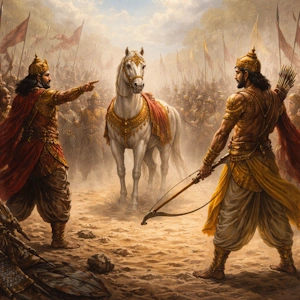
The war had ended.
But its echo had not.
In the palace, everything looked stable. The throne was occupied. The kingdom was functioning. People had begun their lives again.
But inside, Yudhishthira was not at rest.
Victory had come… but at a cost too heavy to ignore.
So the decision was made.
Not for expansion.
Not for display.
But to restore order.
The Ashvamedha would be performed.
A horse was chosen.
Not an ordinary one.
Strong. disciplined. marked by purpose.
It was consecrated through mantra and ritual.
Then it was released.
No chains. No rider.
Only a direction.
Wherever it walked, it carried a silent command.
This land now stands under the authority of dharma.
Accept it… or challenge it.
Behind the horse, at a distance, followed Arjuna.
Not as a conqueror this time.
As a guardian.
His bow was ready.
But his mind was different.
The fire of Kurukshetra had settled.
What remained was clarity.
The journey began.
The horse moved freely.
Across forests.
Across cities.
Across kingdoms that had just recently tasted war.
When rulers saw it, they understood.
This was not a random animal.
This was a test.
Some chose wisely.
They came forward.
They welcomed Arjuna.
They accepted the sovereignty of Yudhishthira.
No battle. No resistance.
Only alignment.
But not all minds bend easily.
There were kings who still held pride.
Kings who believed their strength was enough.
Kings who saw this not as dharma…
But as a challenge to their authority.
They stopped the horse.
They blocked its path.
They called out Arjuna.
And then…
The bow rose again.
But this time, something was different.
No anger.
No personal hatred.
Only response.
Only duty.
The arrows flew.
Precise. controlled. unavoidable.
The battles were swift.
Decisions were clear.
Those who resisted were defeated.
Those who understood were spared.
Between these encounters, words flowed.
Not just weapons.
Questions were asked.
Why this yajna after such destruction?
Why send a horse instead of messengers?
Why test kings again?
And the answers came calmly.
A kingdom cannot stand on broken alignment.
Power must be acknowledged.
Dharma must be accepted willingly.
This is not force.
This is restoration.
As the horse moved forward, something deeper was happening.
The land was not just being claimed.
It was being steadied.
Scattered authority was becoming unified.
Confusion was giving way to structure.
Not through fear.
But through clarity of order.
Arjuna too was changing.
This was no longer the warrior driven by battle cries.
This was a man who had seen the peak of destruction.
And now walked carefully…
Ensuring it never repeats unnecessarily.
His strength was the same.
But its use had become refined.
Kingdom after kingdom responded.
Some with humility.
Some with resistance.
But all were brought to one point.
Accept dharma… or face its enforcement.
The horse continued.
Unstopped.
Unbroken.
Moving forward like time itself.
And Arjuna followed.
Steady. watchful. silent.
The yajna is not finished.
The journey is still unfolding.
The land is still being aligned.
The horse moved ahead.
Calm. Unaware. Unstoppable.
Dust rose behind it as it crossed into another kingdom.
The guards saw it first.
Then the ministers.
And finally… the king.
The court gathered.
Whispers spread quickly.
This is not just a horse.
This is the Ashvamedha horse.
And behind it… Arjuna.
The king sat still.
But inside, his thoughts raced.
If I accept… I submit.
If I resist… I must fight Arjuna.
He knew the name.
Everyone did.
Kurukshetra had made sure of that.
The ministers spoke first.
‘Maharaj, think carefully.’
‘This is not the time for pride.’
‘The world has already seen destruction.’
‘Accepting this is not weakness… it is wisdom.’
But pride has its own voice.
Quiet. persistent. dangerous.
The king stood up.
His decision was made.
‘Stop the horse.’
Soldiers moved forward.
They blocked its path.
The free-moving symbol of dharma…
Was now challenged.
And then Arjuna stepped forward.
No anger.
No harsh words.
Only a calm warning.
‘This horse is not mine.’
‘It belongs to the yajna.’
‘Do not stop what is meant for the welfare of all.’
The king replied firmly.
‘In my land, nothing moves without my will.’
‘If this is a test… I accept it.’
Silence.
For a moment, everything paused.
Two paths stood face to face.
Understanding…
Or conflict.
Arjuna lifted his bow.
Not in rage.
In readiness.
The soldiers charged.
The battlefield formed instantly.
But this was not Kurukshetra.
There was no chaos here.
Every move of Arjuna was controlled.
Every arrow had purpose.
He did not destroy unnecessarily.
He neutralized.
He disarmed.
He broke resistance without losing balance.
The king fought bravely.
There was no cowardice in him.
Only misjudgment.
His attacks were strong.
But they lacked the depth of experience Arjuna carried.
Within moments…
The outcome became clear.
The king’s forces fell back.
His strength was exhausted.
His pride… shaken.
Arjuna stopped.
He did not press further.
He did not humiliate.
He simply lowered his bow.
And then came the real victory.
Not on the battlefield.
In the mind.
The king stepped forward.
This time… without resistance.
‘Now I understand,’ he said.
‘This is not conquest.’
‘This is order.’
‘I accept.’
The horse was released again.
Unstopped.
Unchallenged.
Arjuna moved on.
No celebration.
No attachment.
Just continuation.
This one encounter shows everything.
Not all resistance is evil.
Sometimes it comes from confusion.
Sometimes from ego.
But dharma does not argue endlessly.
It gives a chance.
And if needed… it corrects.
Straight understanding:
Ashwamedha repeatedly shows this pattern — challenge, controlled battle, realization, and acceptance. The real victory is not defeat of the opponent, but removal of wrong understanding.
Here is a clean, practical Ashwamedha like framework you can actually use.
Step 1: Define the ‘Horse’
Be clear about what you want.
Not vague.
Not emotional.
One clear direction.
Example: ‘I will build this project profitably in 6 months.’
If this is weak, everything fails later.
Step 2: Let It Move
Start acting.
Don’t overthink every step.
Put your intention into the real world.
Send the proposal. launch the page. make the call.
Movement reveals truth faster than thinking.
Step 3: Watch Where It Gets Stopped
Notice resistance.
Where do things slow down?
Where do people push back?
Where do you hesitate?
That is your ‘king blocking the horse’.
Don’t ignore it.
Step 4: Give a Clear ‘Warning’
Before reacting, clarify.
Explain. communicate. correct misunderstanding.
In business: clarify expectations
In relationships: speak directly
In self-discipline: remind yourself of the goal
Many problems end here itself.
Step 5: Act Without Emotion
If resistance continues, act.
Firm. precise. controlled.
Not angry. not personal.
Remove the block.
This may mean saying no, enforcing rules, or taking a tough decision.
Step 6: Stop When the Point Is Made
Once the issue is resolved, stop.
Don’t overdo.
Don’t dominate.
Don’t carry ego forward.
This is where most people fail.
Step 7: Extract the Learning
Ask:
What caused this resistance?
Was it ego, lack of clarity, or poor communication?
This prevents repetition.
Step 8: Keep Moving
Don’t get stuck in one win or loss.
Continue forward.
New situations will come.
Handle them the same way.
Step 9: Build Systems, Not Dependence
Don’t solve everything yourself.
Create processes.
Let structure handle repetition.
Like Yudhishthira used the system, not personal presence.
Step 10: Maintain Inner State
This is the real core.
Stay calm.
Stay clear.
Stay detached from reaction.
Your external success depends on internal steadiness.
Straight Use Case
If something is stuck in your life right now:
Define the goal clearly
Take action immediately
Identify the resistance point
Clarify once
Act firmly if needed
Move on without emotional baggage
This is Ashvamedha applied to life.
Q: Why was a horse used instead of an army marching openly?
A: The horse creates a choice, not immediate fear. It invites response. A direct army forces submission. The horse allows kings to reveal their understanding. It separates wisdom from ego without initial violence.
Q: What makes this yajna different from a normal conquest?
A: Conquest seeks control. Ashvamedha seeks alignment. The aim is not to dominate land, but to restore a shared order where rulers willingly accept dharma as the basis of authority.
Q: Why is Arjuna calm in these battles unlike in Kurukshetra?
A: Earlier, he fought under emotional weight. Now, he acts with clarity. The absence of anger shows maturity. Strength remains, but its purpose has shifted from survival to preservation of order.
Q: What is the deeper meaning of kings stopping the horse?
A: It represents resistance of the human ego. Every king is a symbol of inner authority. When the horse is stopped, it shows where pride refuses to align with truth.
Q: Why does Arjuna warn before fighting?
A: Dharma always gives space for understanding. Force is never the first step. The warning is a final opportunity to choose wisdom without suffering.
Q: What is the real victory in these encounters?
A: Not the defeat of armies. The shift in understanding. When the king says I understand, that is the true completion of the encounter.
Q: Why are the battles described as controlled and precise?
A: Because dharma does not act blindly. Every action has measure. Excess destruction would defeat the purpose of restoration. Control is the mark of true power.
Q: What unseen transformation is happening across the land?
A: Fragmented authority is becoming unified. After chaos, systems are being reset. It is not visible like war, but it is deeper. Stability is being rebuilt silently.
Q: Why is the horse described as unstoppable?
A: It represents the flow of time and dharma. Both move forward regardless of resistance. One can align with it or suffer against it, but cannot stop it.
Q: What is the hidden teaching for an individual?
A: Life constantly presents moments like the horse. Situations test whether one aligns with clarity or reacts with ego. Growth happens when resistance turns into understanding.
Now 10 objections and their replies
Objection: This looks like political domination wrapped in ritual.
Reply: Political expansion uses force first. Here, choice is given first. War happens only when understanding is refused. The intention is correction, not exploitation.
Objection: Why not just send messengers instead of risking war?
Reply: Words can be ignored or misinterpreted. The horse creates a direct, visible test. It forces a clear decision. It removes ambiguity.
Objection: This still causes violence, so how is it dharmic?
Reply: Dharma does not avoid action when needed. It avoids unnecessary action. Violence here is restrained, purposeful, and last in sequence.
Objection: Why should other kings accept Yudhishthira’s authority?
Reply: Because after Kurukshetra, he represents the restored center of order. Without a central alignment, chaos would continue. Acceptance ensures stability.
Objection: Isn’t this just pride disguised as righteousness?
Reply: Pride demands submission without reason. Dharma explains, warns, and then acts only when required. The process itself shows the difference.
Objection: Why test kings again after such a destructive war?
Reply: War removed imbalance, but did not guarantee alignment. Ashvamedha ensures that peace is consciously accepted, not just forced by defeat.
Objection: Why is one king allowed to dominate all others?
Reply: It is not about domination. It is about establishing a shared framework of dharma. The king becomes a reference point, not an oppressor.
Objection: This seems like ritual over practical governance.
Reply: The ritual is governance. It creates psychological and political clarity. It binds regions under a shared understanding without constant conflict.
Objection: Why glorify battle at all?
Reply: The focus is not battle, but restraint. The narrative highlights controlled action, minimal harm, and the importance of understanding over destruction.
Objection: Could this not have been done peacefully without any threat?
Reply: Peace without clarity is temporary. When confusion exists, it eventually creates conflict. Ashvamedha resolves that confusion firmly and finally.





English
Mahabharatam
Click on any topic to open
7
30
Astrology
Bhagavad Gita
Bhagavatam
Bharat Matha
Devi
Devi Mahatmyam
Ganapathy
Garuda Puranam
Glory of Venkatesha
Hanuman
Kathopanishad
Mahabharatam
Mantra Shastra
Mystique
Practical Wisdom
Purana Stories
Radhe Radhe
Ramayana
Rare Topics
Rigveda Explained
Rituals
Sages and Saints
Shiva
Spiritual books
Sri Suktam
Story of Sri Yantra
Temples
Vedas
Vishnu Sahasranama
Yoga Vasishta
26
17
10
0


