About Ugrashrava Sauti, the Narrator of Mahabharata
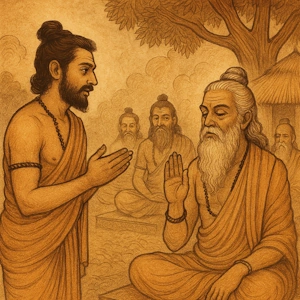
Ugrashrava arrives at Naimisharanya, where the twelve-year-long yaga headed by Shaunaka Maharshi is going on.
Mahabharata calls Ugrashrava the Suta as Pauranika.
There is a meaning to the term Pauranika:
'पुराणं पण्यं जीविका अस्य इति पौराणिकः' —
a person who has made narration of Purana his livelihood.
This is a general meaning.
But here Mahabharata says Ugrashrava Sauti —
Sauti means son of Suta.
There is something more about why Ugrashrava is called Sauti.
Suta is the name of a caste.
There is a long story behind the origin of this caste.
I have explained this in the Bhagavatam discourses.
Anyway, Suta as a caste is son of a Kshatriya man and a Brahmin woman.
They have right to narrate Veda but they don’t have Vedadikara.
However, Shaunaka Maharshi conferred Brahmasana upon Ugrashrava’s father, Romaharshana, due to his merit.
Brahmasana is a position given to a person of high merit.
Even though Romaharshana was Suta by birth, he was conferred the highest position when he arrived at the Yagavedi to narrate Puranas.
This is because, as Shaunaka Maharshi himself says:
'अग्निकुण्डसमुद्भूतसूतनिर्मलमानसः'
Suta had a pure mind. He had no selfish thoughts or intentions in the mind.
While there may be other Sutas who are doing narration of Purana just as a profession, livelihood —
this lineage of Lomaharshana was different.
Due to the high merit of Lomaharshana, Shaunaka Maharshi gave him the highest seat in his Yagavedi.
Then Lord Balarama came to that Yagavedi.
The person who occupies the Brahmasana is not supposed to get up — that is the rule of Yaga.
Balarama took offence.
He killed Lomaharshana with Brahmastra.
But later on realized his mistake.
Later, the Lord transferred all knowledge and qualities of Lomaharshana on to the body of his son, Ugrashrava.
In terms of merit, Ugrashrava became equal to his father — eligible for Brahmasana.
Rishis will not hear Puranas from someone who is inferior to them.
So Shaunaka Maharshi made Lomaharshana to sit in Brahmasana — elevated him, because of his merit, not because they wanted to hear from him — but because he was eligible.
Dhrishtadyumna was another case like this.
He was born from Yagagni and was conferred Kshatriyatva.
Rishis can do this.
So here, to differentiate between the original Suta Lomaharshana and his son Ugrashrava —
Ugrashrava is being addressed as Sauti, son of Suta.
Lomaharshana’s son is also called Laumaharshana.
Here Mahabharata says:
'पौराणिकः पुराणे कृतश्रमः' —
This is Mahabharata's own definition of the term Pauranika,
which means Ugrashrava is not like the conventional narrators for whom it is just a profession.
Sauti has put in a lot of effort into this.
He is well-versed. He knows the secrets of Puranas.
He is the one who has now come to Naimisharanya.
Ugrashrava Sauti asked the rishis,
'What do you want to hear? Listen to?'
Rishis said,
'Yes, we will tell you what we want to listen to.
Of course, we want to listen to the ultimate truth.
But right now, Kulapati Shaunaka Maharshi is not present here.
He is in the Yaga Shala.
Let him come.'
Shaunaka Maharshi is not an ordinary person.
He himself knows quite a lot of stories.
When we use the term 'story', be clear that it is not fiction — these are real incidents of the past.
This is our history — that is why it is called Itihasa.
I am using the term 'story' for simplicity.
Shaunaka Maharshi knows quite a lot of these stories — even about Gandharvas, Nagas, men.
He is well-versed in Vedas and Shastras also.
He is a tapasvi, has all the qualities such as truthfulness in him.
His mind, his organs — they are all under his control.
He observes vratas.
He is respected by everyone.
'Let him come.
Whatever he says, you talk about that.'
Shaunaka Maharshi finished his worship of devas and forefathers,
came to the place where the rishis were assembled and Sauti was present,
and told Sauti to start telling about Bhrigu Vamsha.





English
Mahabharatam
Click on any topic to open
7
30
Astrology
Bhagavad Gita
Bhagavatam
Bharat Matha
Devi
Devi Mahatmyam
Ganapathy
Garuda Puranam
Glory of Venkatesha
Hanuman
Kathopanishad
Mahabharatam
Mantra Shastra
Mystique
Practical Wisdom
Purana Stories
Radhe Radhe
Ramayana
Rare Topics
Rigveda Explained
Rituals
Sages and Saints
Shiva
Spiritual books
Sri Suktam
Story of Sri Yantra
Temples
Vedas
Vishnu Sahasranama
Yoga Vasishta
26
17
10
0


