How Chyavana Maharshi Got His Name
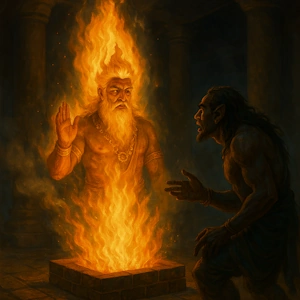
In Mahabharata, the first legend that Ugrashrava Sauti tells Sage Shaunaka and the other rishis at Naimisharanya is that of Chyavana Maharshi — about his birth.
This is very interesting. This is also because Chyavana was Bhrigu Maharshi's son, and Bhrigu vamsha was Shaunaka's own vamsha. When Sauti asked what he would like to hear about, Shaunaka Maharshi said, 'I want to hear about my own vamsha first, Bhrigu vamsha first.'
This is very interesting — how Chyavana Maharshi got his name. Chyavana was the son of Bhrigu Maharshi and Puloma. Puloma was a sadhwi, pativrata. She was pregnant.
At that time, once when Bhrigu Maharshi went out to take bath and Puloma was alone, one rakshasa entered into the ashrama. Rakshasas are mayavis. They can become invisible and go anywhere. When he saw Puloma, he became lustful towards her. That is the nature of rakshasas. Their lust is insatiable. This is why Ravana and the other rakshasas of Lanka abducted women — thousands of them — not just women, apsaras, yaksha strees.
But here there was something more peculiar.
This rakshasa suddenly realized that this Puloma was his own wife.
How is that possible?
When Puloma was a child and when she was crying for something, her father told, 'Hey rakshasa, come take her.' Parents do this to make children stop crying or make them eat. But this rakshasa was present in Puloma's house at that time, invisible. When he heard this, he became happy — 'Ah, I have got her as my wife.'
But later, Puloma's father got her married to Bhrigu Maharshi in the proper Vedic way. He wouldn't have even remembered what he had done. But the rakshasa took it seriously. He became annoyed, frustrated seeing his wife getting married to someone else.
This is a big lesson from Mahabharata. Even casually, jokingly don't say such things — particularly to children. We may not realize what it can lead to. Mothers do this. To make the child eat, they say, 'Police will come and put you in prison.' We may not know — maybe twenty, thirty years later — he may land up in prison for no fault of his.
This is particularly important in the case of noble ladies, committed to their husbands. They have special power. Whatever they say has got special power. Here also, Puloma's father was a noble person. But see where it led to.
The rakshasa said, 'This is my chance.' He said, 'Bhrigu has kept my wife captive here. She became my wife first. Just to avoid me, her father got her married to Bhrigu as an afterthought. Let me take her away right now.' But he needed to confirm. He can't take risk. It is a maharshi — he can curse.
The rakshasa saw Agni in the yagashala. He asked Agni Deva, 'Tell me, isn't this my wife, who was given to me by her father?'
Agni Deva was in a dilemma. What to do now? He can't tell a lie. But if he tells the truth, Bhrigu Maharshi is going to get angry and may curse him. He thought, 'Let me be impartial,' and said, 'Yes, it is the same woman. But later on, her father gave her in marriage to Bhrigu.'
This much was sufficient for the rakshasa. He assumed the form of a wild boar and took Puloma away.
But the child who was in her womb — the father of that child was Bhrigu Maharshi — that child became angry and came out of her womb, on his own.
Chyuti is the word — रोषान्मातुश्च्युतः कुक्षेः — he fell out from his mother's womb, fell down from his mother's womb, on his own.
Chyuti means to fall down.
Because of this chyuti, he became known as Chyavana. And Chyavana was so brilliant and powerful that the rakshasa was burned to ashes.
Now one question here.
What wrong did the rakshasa do? So that he met with this?
Isn't what he did justifiable?
Let's look at that.
Puloma got married twice — one by casual, unintentional blabbering of her father, and the second time through proper Vedic vidhi, with Agni as the witness and chanting appropriate mantras. The first one is just worldly speech. Worldly speech is corrupt. There can be lies in it. The words used in worldly speech are not sacrosanct. The same word can carry different meanings. Meaning is conveyed through the tone, body language — all these are possible in worldly speech.
You can say the same word 'no' as 'no.' In the first one, you are sternly refusing. In the second, you are amenable — given pressure, you will give in.
This is not the case with Veda mantras. They are very specific. You can't alter them. A Veda mantra can never be untrue. Between the two — ordinary speech and Veda mantra — Veda mantra is powerful. Ordinary speech cannot be taken on face value.
And as a matter of fact, there was no intention on the part of Puloma's father to give her away to the rakshasa. So what he did was — he lied. It was just a lie, which later landed Puloma in trouble.
But the rakshasa should have known this — that it was a statement which was untrue. He didn't recognize. He didn't want to recognize it. On the contrary, he tried to take advantage of it.
This was his fault. For which he got punished. Got burned to ashes.
Ordinary speech can be fraught with lies. This is why a person taking deeksha for performing yajna — he is not allowed to engage in worldly speech till the time the yajna is over. Because worldly speech can contain lies, unintentionally also.
Veda is 100% truth.
There is more to this story. We will see them later.





English
Mahabharatam
Click on any topic to open
7
30
Astrology
Bhagavad Gita
Bhagavatam
Bharat Matha
Devi
Devi Mahatmyam
Ganapathy
Garuda Puranam
Glory of Venkatesha
Hanuman
Kathopanishad
Mahabharatam
Mantra Shastra
Mystique
Practical Wisdom
Purana Stories
Radhe Radhe
Ramayana
Rare Topics
Rigveda Explained
Rituals
Sages and Saints
Shiva
Spiritual books
Sri Suktam
Story of Sri Yantra
Temples
Vedas
Vishnu Sahasranama
Yoga Vasishta
26
17
10
0


