A Leather Bag for the Lord of Vaikuntha
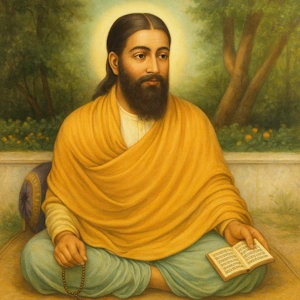
Once in a dusty town where caste was a wall thicker than stone, lived a cobbler named Ravidas Ji. His hut was modest, his hands toughened by years of shaping leather, but his heart — oh, his heart — glowed with a purity that would shame the finest silk-clad priests.
He was a Vaishnava — not by label, but by life. Every morning he rose early, bathed in cold water, calmed his hunger with a simple meal — for he believed that worshipping while hungry only made the mind restless — and then began his puja. His place of worship had no gold, no silver, no sandalwood carvings. Just a worn leather mat, a small water pouch also made of leather, and a soft bag in which he kept his beloved Shaligram — the sacred stone symbol of Vishnu.
To him, leather wasn’t impure. It was what life had handed him. It was his work, his devotion, his prayer. Every stitch he made in a pilgrim’s shoe, every sole he patched for a traveler, was an offering to Hari.
One day, a Brahmin — tall, robed, with a thread across his chest and pride in his spine — walked into Ravidas Ji’s hut to get his shoes repaired.. He looked around and froze. His eyes locked onto the leather vessels, the leather mat, and worst of all — the Shaligram resting in a leather bag.
He scoffed. 'What madness is this? You, a cobbler, dare worship Hari while seated on impure leather? You have enclosed the Lord of Vaikuntha — the one who reclines on Shesha, whom sages strive to see — in a filthy pouch of hide?'
Ravidas Ji folded his hands and said calmly, 'Respected one, can you show me one thing in this world untouched by leather or skin?'
The Brahmin bristled, 'Skin on a body is not the same as hide from an animal!'
But Ravidas Ji continued, unshaken. 'Isn’t the human body covered with skin? And is not the Lord said to dwell within us all — Brahmin, Kshatriya, Vaishya, Shudra? If God lives inside skin, why not in a leather bag?'
The Brahmin’s frown deepened. Ravidas Ji went on, one calm step at a time, like a man who had thought deeply and lived truthfully.
'The drums that echo in temples — do they not sing the Lord’s praise using stretched hide?
The conch you blow in ceremonies — doesn’t it come from the shell of a once-living being?
Milk from a black cow — whose body is covered in leather — is used to bathe idols. Is that not sacred?
The body of a woman giving birth — you call it impure. A newborn and a corpse — you call them polluting.
But the same body, when filled with bhakti, becomes the Lord’s abode.'
The Brahmin, now irritated, snapped, 'You talk in circles. We Brahmins alone are born with the right to worship. We wear the sacred thread. That thread gives us authority! You people are not fit for it.'
Ravidas Ji stood still, eyes glowing. He reached for a blade.
And before the Brahmin could stop him, he tore open his stomach with it — right there — and pulled out his entrails. From within, shining with otherworldly glow, was a sacred thread. Not of cotton. But of truth.
The Brahmin gasped.
Ravidas Ji said, without bitterness, 'Your thread sits on your chest, for others to see. Mine is carved into my being. This is what Hari looks at.'
Now shaken, the Brahmin collapsed at his feet. 'Forgive me,' he whispered. 'You are a saint. A true bhakta. I tested you with pride, and in return, you gave me wisdom.'
Ravidas Ji lifted him up gently and said, 'Even gold is thrown into fire to prove its worth. Even fragrant sandalwood must be rubbed to release its perfume. Even a stone must be chiseled to become a deity. So if you insulted me, it only polished what was already true.'
The Brahmin bowed. 'I came to teach you the calendar, but you’ve taught me the eternal.'
From that day on, Ravidas Ji’s name was no longer just associated with shoes. It was sung as a name of one who carried God not in books or rituals — but in breath, in work, in truth.
The Message
Ravidas Ji didn’t deny caste. He didn’t fight ritual with rebellion. He just asked one question — does the Divine look at outer labels, or inner sincerity?
His tools were leather, yes. But so are the skins of those who speak the Vedas. So are the instruments used in the temple. So is the body in which we seek liberation. The difference lies in how it is used — for ego or for offering.
To Ravidas Ji, even the lowest profession became a sacred act — because it was done with love, with service, and with the name of Hari on his lips.





English
Sages and Saints
Click on any topic to open
7
30
Astrology
Bhagavad Gita
Bhagavatam
Bharat Matha
Devi
Devi Mahatmyam
Ganapathy
Garuda Puranam
Glory of Venkatesha
Hanuman
Kathopanishad
Mahabharatam
Mantra Shastra
Mystique
Practical Wisdom
Purana Stories
Radhe Radhe
Ramayana
Rare Topics
Rigveda Explained
Rituals
Sages and Saints
Shiva
Spiritual books
Sri Suktam
Story of Sri Yantra
Temples
Vedas
Vishnu Sahasranama
Yoga Vasishta
26
17
10
0


