7 Days Left: What Would You Ask?
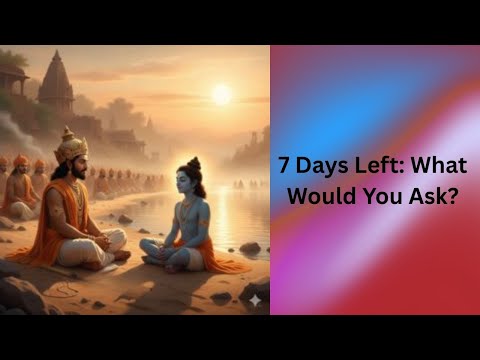
Life is made of questions. From the moment a child speaks, he asks questions. But not all questions are the same. Some questions are small. They are about food, toys, or money. These questions are about the body. But there is a higher type of question. It is about the Truth.
In the Srimad Bhagavatam, King Parikshit shows us the difference. He was the Emperor of the world. He had gold, palaces, and power. But he was cursed to die in seven days. He left everything behind. He went to the bank of the river Ganges. He sat down to fast until death. Great sages gathered around him. The greatest of them was Shukadeva Goswami.
This was a serious moment. The King had only one week left to breathe. Most people in this situation would ask for a cure. They would ask, 'How can I live longer?' or 'How can I save my kingdom?' These are the questions of a person attached to the world. These questions bind us. They make the rope of Maya (illusion) tighter.
But King Parikshit did not ask for life. He asked for the Truth. He asked, 'What is the duty of a dying man? What should he hear? What should he chant? What should he remember?'
Shukadeva Goswami was very pleased. He said this question is Variyan. It is glorious. Why? Because this question is Loka-hitam. It is good for the whole world. When you ask how to get rich, it only helps you (maybe). But when you ask how to find God, the answer helps everyone.
Shukadeva explained the sad state of ordinary people. He called them Grihamedhis. These are people who are jealous of their own home life. They are stuck. They have thousands of things to talk about. They talk about politics, money, and news. They listen to gossip all day. But they never ask about the soul. They are blind to the Atma-tattva (the truth of the self).
The sage explained how these people waste their time. Time is precious. But for the ignorant person, it is wasted. At night, they sleep or seek useless pleasure. In the day, they run after money. They work hard just to feed their family. They act as if they will live forever.
Shukadeva used a strong image here. He spoke of the 'Fallible Soldiers.'
A man thinks his body is strong. He thinks his children, his wife, and his relatives are his army. He thinks, 'If danger comes, my family will save me.' He calls them his Atma-sainya (soldiers of the self).
But this is madness. These soldiers are also dying. Can a dying soldier save a dying king? No. The body will fall. The family will cry. The money will stay in the bank. Nothing can fight death.
The man sees his father die. He sees his grandfather die. He sees death everywhere. Yet, he thinks, 'I will not die.' This is the power of illusion. He sees, but he does not see. He is Pramatta—mad with attachment.
This is why Parikshit’s question was so powerful. It cut through this madness. It was like a sword. He did not want to fix his body; he wanted to free his soul.
Curiosity is when you want to know about the world.
Mumuksha is when you desperately want to be free.
Parikshit had that burning desire. He knew the body was just a shirt. He wanted to know about the person wearing the shirt—the Soul.
Shukadeva told him that the only way to be safe is to remember Lord Hari (Krishna).
One must hear about Him.
One must chant His name.
One must remember Him.
This is the only safety. This is the only truth.
A single moment of true awareness is better than a hundred years of ignorance. King Khatvanga found the truth in a single moment. King Parikshit had seven days. He used them perfectly. He turned his ears away from the noise of the world and opened them to the song of God.
The lesson is simple. We must be careful what we ask for.
If we ask for worldly things, we get worry and fear.
If we ask for the Truth, we get freedom.
The questions we ask define the life we live. King Parikshit asked the best question, and because of him, the world received the light of the Bhagavatam.
- The quality of a person's life is defined by the depth of their inquiries; questions about the eternal self liberate the mind, while questions about temporary survival bind it further to illusion.
- King Parikshit demonstrates supreme wisdom by renouncing his empire and physical safety to seek absolute truth in the face of imminent death.
- A spiritual inquiry is considered universally beneficial because it addresses the root cause of suffering for all beings, unlike mundane questions that serve only individual interests.
- Materialistic individuals distract themselves with thousands of irrelevant topics and gossip to avoid facing the silence and reality of their own souls.
- Time is ruthlessly squandered by the ignorant, who lose their nights to sleep or pleasure and their days to the anxiety of wealth accumulation.
- The reliance on family, body, and wealth as protection against death is a dangerous delusion, as these "soldiers" are themselves mortal and incapable of saving anyone.
- True fearlessness arises only from shifting attention away from the crumbling fortress of the material body to the remembrance and chanting of the Supreme Reality.
What distinguishes a spiritual inquiry from a mundane question?
A mundane question seeks to adjust or improve the conditions of the temporary body, such as asking how to acquire wealth or avoid disease. A spiritual inquiry, however, cuts through these superficial concerns to address the nature of the observer, the soul. While mundane answers provide fleeting comfort, spiritual answers offer a permanent solution to the existential crisis of life and death. The former binds one to the cycle of worry, while the latter liberates the consciousness.
Why is asking about the soul considered more important than asking about survival?
Survival is a losing battle because the body is destined to perish regardless of how well it is maintained. Asking about the soul prepares you for the inevitable transition of death, ensuring you do not die in a state of confusion. If you only know how to maintain the vehicle but do not know the destination, the journey is a failure. Understanding the passenger—the self—ensures that the end of the body does not mean the end of your peace.
Isn't focusing on philosophy while dying impractical compared to seeking medical help?
Medical help can only postpone the inevitable, not prevent it; when death is certain, further struggle for the body is the impractical choice. Philosophy in this context is not abstract theory but a practical navigation tool for the consciousness as it exits the physical frame. Ignoring the reality of death to focus on a few more hours of breath is like painting the walls of a house that is already on fire. True practicality lies in securing the future of the conscious self, which survives the body.
Who is a 'Grihamedhi' and why is their lifestyle considered tragic?
A 'Grihamedhi' is not just a householder, but one whose entire consciousness is tied to the narrow confines of home and family life to the exclusion of spiritual reality. Their tragedy lies in their wilful blindness; they have the capacity to perceive the infinite but choose to obsess over the temporary. They surround themselves with noise and distraction to drown out the call of the soul. Consequently, they remain prisoners of their own attachments, unaware of the freedom that lies just beyond their mental walls.
Is it wrong to be interested in the news and the well-being of the world?
Interest in the world is not wrong, but when it replaces the search for self-knowledge, it becomes a trap. The mind has a limited amount of energy, and scattering it over thousands of external topics leaves no energy for introspection. Knowing the news of the world does not solve the problem of your own mortality or suffering. One should function in the world but keep the core of their attention fixed on the Truth that transcends worldly events.
Calling informed people 'blind' seems arrogant; isn't worldly knowledge necessary for progress?
Worldly knowledge is functional, like reading a map, but spiritual ignorance is like being blind to the cliff edge. A person may be an expert in economics or politics, yet remain completely ignorant of who they are and where they go after death. If a pilot knows how to serve drinks but not how to land the plane, his knowledge is useless in a crisis. Therefore, without the foundational knowledge of the self, all other accumulation of data is merely polished ignorance.
What is the meaning of the 'fallible soldiers' metaphor?
This metaphor illustrates the false sense of security people derive from their family, friends, and assets. We subconsciously view our loved ones and wealth as an army that stands between us and death. However, this army is "fallible" because every soldier in it is also mortal and subject to the same laws of time. Relying on them for ultimate protection is a delusion, as they cannot save themselves, let alone the king who commands them.
Why do we instinctively feel safer when surrounded by family?
This is a biological and psychological instinct designed for physical survival, not metaphysical truth. The presence of a tribe signals safety from predators or starvation, which calms the animal brain. However, the soul’s danger is not a predator but the illusion of identifying with the body. Family can comfort the body, but they cannot prevent the soul from being carried away by time.
Family support is real and tangible; how can you say they offer no help?
Family can offer emotional comfort and physical care, which are valuable in life, but they are powerless against the metaphysical event of death. They can hold your hand, but they cannot stop the breath from leaving or accompany you on the journey that follows. Their help is limited to the physical plane, which you are in the process of leaving. To rely on them for salvation is like a drowning man holding onto another drowning man; the connection is real, but the safety is not.
How does the perception of time change for a seeker of truth?
For a materialist, time is a predator that steals opportunities for pleasure and brings them closer to extinction. For a seeker of truth, time is a currency to be invested in realizing the eternal. A seeker understands that a single moment of full awareness is more valuable than a century of mindless existence. They stop trying to "kill time" with entertainment and start using time to conquer death.
Is it ever too late to start asking these spiritual questions?
It is never too late, because the soul is beyond the constraints of chronological time. Even a single moment of focused reality—like the final hour of a dying man—can grant liberation if the intensity is absolute. The quality of the consciousness matters more than the duration of the practice. Just as a lights switch instantly removes darkness that has existed for years, a flash of true inquiry can dissolve lifetimes of ignorance.
If I have only a short time left, shouldn't I enjoy it instead of fasting and praying?
"Enjoyment" of the senses burns out the very energy needed for the transition of death, leaving the mind weak and distracted. Sensory pleasures are fleeting and often leave a residue of regret or hankering, which binds the soul to the material plane. Fasting and prayer clarify the mind, sharpening the focus so one can leave the body with dignity and direction. Choosing pleasure over clarity at the end is like getting drunk right before you have to walk a tightrope.
Skandha 2, Chapter 1
श्रीशुक उवाच ।
वरीयान् एष ते प्रश्नः कृतो लोकहितं नृप ।
आत्मवित् सम्मतः पुंसां श्रोतव्यादिषु यः परः ॥ १ ॥
Shri Shuka Uvacha.
Variyan esha te prashnah krito lokahitam nripa.
Atmavit sammatah pumsam shrotavyadishu yah parah.
The great sage speaks, and his voice carries the weight of absolute compassion.
O King, this is no ordinary inquiry; it is a thunderbolt of wisdom.
Your question is variyan—it is glorious, superior, and dripping with grace.
You do not ask for yourself alone; you ask for loka-hitam, the ultimate welfare of every suffering soul.
The great atmavits, those who have tasted the essence of the Self, bow their heads to this question.
In a world deafened by useless noise, this is the only subject worth the ear's attention.
It is the supreme sound, the para vibration that shatters the chains of illusion.
To ask about the Lord at the moment of death is to conquer death itself.
श्रोतव्यादीनि राजेन्द्र नृणां सन्ति सहस्रशः ।
अपश्यतां आत्मतत्त्वं गृहेषु गृहमेधिनाम् ॥ २ ॥
Shrotavyadini rajendra nrinam santi sahasrashah.
Apashyatam atmatattvam griheshu grihamedhinam.
But look at the tragedy of the bound souls, O Rajendra.
For those who are blind to the glowing Atma-tattva within, the world is a chaotic market of sounds.
They have thousands of things to hear—an endless, roaring ocean of gossip and news.
They listen to everything except the truth that saves.
These are the grihamedhis—not merely householders, but those who sacrifice their very soul into the fire of household attachment.
They sit in their homes, yet they are homeless, for they have forgotten the eternal abode.
They have eyes, yet they see only the walls of their prison, not the vast sky of the spirit.
Lost in the labyrinth of 'mine' and 'thine', they wander aimlessly, deaf to the call of the Infinite.
निद्रया ह्रियते नक्तं व्यवायेन च वा वयः ।
दिवा चार्थेहया राजन् कुटुंबभरणेन वा ॥ ३ ॥
Nidraya hriyate naktam vyavayena cha va vayah.
Diva charthehaya rajan kutumbabharanena va.
See how the thief called Time steals the treasure of breath, moment by moment.
The night approaches like a dark enchantress, swallowing their consciousness.
Valuable hours are lost in the deep stupor of nidra or wasted in the fever of fleeting passions.
And when the sun rises, does wisdom dawn? No.
The day is devoured by the wolf of greed and anxiety.
They run endlessly after artha—gold that glitters but cannot feed the starving soul.
They carry the heavy burden of family maintenance on their backs, thinking this burden is their identity.
Day and night, the axe falls on the tree of life, yet the tree thinks it is growing.
Life slips through their fingers like dry sand, and they clutch at nothing.
देहापत्यकलत्रादिषु आत्मसैन्येष्वसत्स्वपि ।
तेषां प्रमत्तो निधनं पश्यन्नपि न पश्यति ॥ ४ ॥
Dehapatyakalatradishu atmasainyeshvasatsvapi.
Tesham pramatto nidhanam pashyannapi na pashyati.
Here unfolds the ultimate madness, the great, tragic drama of Maya.
The bound soul, terrified of the end, gathers an army to fight the inevitable.
He looks at his body, his children, his wife, and thinks, 'These are my soldiers. They will save me.'
But alas! These soldiers are asat—they are phantoms, fallible and fleeting shadows.
Can a shadow fight the Lord of Death?
The man is pramatta—intoxicated by the wine of attachment.
He sees his father die, he sees the burning pyres lighting up the riverbank.
He sees death dancing naked before him in every falling leaf.
Yet, in a stupor of delusion, he refuses to believe he too will fall.
He sees, but he remains stone blind.
He trusts the crumbling walls of the body, while the fortress of the Eternal waits unlocked.





English
Bhagavatam
Click on any topic to open
7
30
Astrology
Bhagavad Gita
Bhagavatam
Bharat Matha
Devi
Devi Mahatmyam
Ganapathy
Garuda Puranam
Glory of Venkatesha
Hanuman
Kathopanishad
Mahabharatam
Mantra Shastra
Mystique
Practical Wisdom
Purana Stories
Radhe Radhe
Ramayana
Rare Topics
Rigveda Explained
Rituals
Sages and Saints
Shiva
Spiritual books
Sri Suktam
Story of Sri Yantra
Temples
Vedas
Vishnu Sahasranama
Yoga Vasishta
26
17
10
0


