105 students, 1 success...
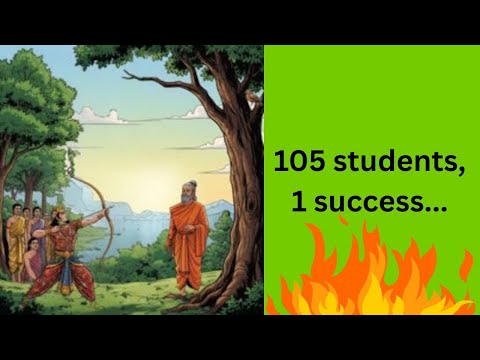
Guru Drona was a great teacher.
He taught the princes of the Kuru clan.
He taught the Pandavas.
He taught the Kauravas.
He also taught princes from other kingdoms.
The princes learned many skills.
They learned how to fight.
They learned how to use weapons.
They learned about swords and spears.
Drona wanted to test them.
He wanted to see who was the best archer.
He planned a difficult test.
Drona called a craftsman.
The craftsman made a wooden bird.
It was an artificial bird.
It looked very real.
Drona took the bird to a training ground.
There was a large tree there.
Drona placed the bird on the tree.
He put it on the very top branch.
The bird was the target.
The princes did not know it was fake.
They thought it was a real bird.
Drona called all his students.
He told them to bring their bows.
He told them to bring their arrows.
The students lined up.
Drona spoke to them loudly.
He pointed to the top of the tree.
He showed them the bird.
He gave them clear instructions.
He said, 'Look at that bird.'
He said, 'You must aim at its head.'
He said, 'Do not shoot yet.'
He said, 'Wait for my command.'
He said, 'I will tell you when to shoot.'
Drona called Yudhishthira first.
Yudhishthira was the eldest Pandava.
He was a very honest boy.
He stepped forward.
He picked up his bow.
He placed an arrow on the string.
He pulled the string back.
He aimed at the bird on the tree.
He stood very still.
Drona looked at him.
Drona asked a question.
He said, 'O Prince, look at the tree top.'
He asked, 'Do you see the bird?'
Yudhishthira answered.
He said, 'Yes, Guruji. I see the bird.'
Drona asked another question.
He asked, 'Do you see the tree?'
Yudhishthira answered honestly.
He said, 'Yes, I see the tree.'
Drona asked again.
He asked, 'Do you see me?'
Yudhishthira said, 'Yes, I see you.'
Drona asked one more time.
He asked, 'Do you see your brothers?'
Yudhishthira said, 'Yes, I see them.'
Drona was not happy.
He told Yudhishthira to stop.
He said, 'Put your bow down.'
He said, 'Step aside.'
He said, 'You cannot hit the target.'
Yudhishthira obeyed his teacher.
He walked away sadly.
Then Drona called Duryodhana.
Duryodhana was the eldest Kaurava.
He was very proud.
He walked to the spot.
He lifted his bow.
He aimed at the bird.
Drona asked him the same questions.
He asked, 'What do you see?'
Duryodhana looked at the target.
He replied quickly.
He said, 'I see the bird.'
He said, 'I see the tree.'
He said, 'I see the leaves.'
He said, 'I see the trunk.'
Drona was not happy.
He told Duryodhana to stop.
He said, 'You cannot hit the target.'
He sent Duryodhana away.
Then Drona called Bhima.
Bhima was very strong.
He came forward.
He aimed his bow.
Drona asked him the question.
Bhima looked at the tree.
He said, 'I see the bird.'
He said, 'I see the big tree.'
He said, 'I see fruits on the tree.'
He said, 'I see everyone here.'
Drona stopped him too.
He told Bhima to go back.
Drona called the other princes.
He called the kings from other lands.
He tested them one by one.
Every student stood there.
Every student aimed their arrow.
Every student answered the question.
They all said the same thing.
They saw the bird.
They saw the tree.
They saw the garden.
They saw the teacher.
Drona scolded them all.
He said they did not have focus.
He sent them all away.
Finally, Drona looked at Arjuna.
Arjuna was the third Pandava.
He was Drona’s favorite student.
Drona smiled at him.
He called Arjuna forward.
He said, 'Now it is your turn.'
He said, 'You must hit the target.'
He said, 'Look at the bird.'
He said, 'Get ready.'
Arjuna walked to the mark.
He picked up his bow.
He pulled the string tight.
His bow made a circle shape.
He stood like a statue.
He aimed at the bird.
He waited for the Guru's words.
Drona waited for a moment.
Then he asked Arjuna.
He asked, 'O Arjuna, do you see the bird?'
He asked, 'Do you see the tree?'
He asked, 'Do you see me?'
Arjuna kept looking at the target.
He did not look at Drona.
He answered clearly.
He said, 'I see the bird.'
He said, 'I do not see the tree.'
He said, 'I do not see you.'
Drona was happy.
But he wanted to be sure.
He asked Arjuna again.
He said, 'If you see the bird, tell me.'
He asked, 'Describe the bird.'
Arjuna answered immediately.
He said, 'I see the head of the bird.'
He said, 'I do not see the body.'
He said, 'I see only the head.'
Drona was very pleased.
His hair stood up with joy.
He knew Arjuna was ready.
He gave the command.
He shouted, 'Shoot!'
Arjuna did not wait.
He released the arrow instantly.
The arrow flew very fast.
It was very sharp.
It hit the wooden bird.
It cut off the bird's head.
The head fell to the ground.
The test was over.
Arjuna had passed.
Drona walked up to Arjuna.
He hugged him tight.
He was very proud.
He knew Arjuna was the best warrior.
The other princes watched in silence.
They learned a lesson about focus.
What was the fundamental criteria Drona used to pass or fail his students?
Drona did not judge the students based on their stance, the strength of their draw, or the quality of their bows. The sole metric for success was the exclusivity of their vision. A student passed only if they could eliminate every external variable from their consciousness, including the presence of the master himself. Drona sought a mind that could contract its awareness to a singular point. If the student saw the context surrounding the target, they were deemed unfit to release the arrow.
Why is seeing the tree or the teacher considered a failure in this context?
In the ordinary world, seeing the context is wisdom; in the moment of action, it is a leakage of energy. When the mind holds the image of the tree or the teacher, a portion of mental processing power is diverted away from the target. This division creates a gap between the will and the action, introducing the possibility of error. To strike with absolute precision, the mind must have no other content than the target itself. The presence of the 'other' is the death of focus.
Isn't situational awareness crucial for a warrior? Why train them to have tunnel vision?
Situational awareness is vital for strategy and defense, but execution requires a different mental state. When the decision to strike is made, the warrior must switch from a wide-angle lens to a laser focus. If a surgeon worries about the hospital walls while cutting, the hand trembles; similarly, an archer cannot hit a moving mark while processing the landscape. Drona is not teaching them to be blind to the world permanently, but to possess the faculty of shutting out the world at will. This is the training of the switch, not the permanent state of the eye.
How did Yudhishthira’s truthful nature contribute to his failure in this test?
Yudhishthira, the icon of Dharma, answered Drona with absolute honesty, admitting he saw the tree, the brothers, and the bird. His failure lies in the fact that his mind is naturally inclusive and expansive, taking in the relationships and the environment. While this makes him a just king who sees all sides, it prevents him from being the ultimate archer who sees only one point. His virtue of truthfulness revealed his lack of 'Ekagrata' or one-pointedness. He could not compartmentalize his reality to exclude the 'whole.'
Why does the text emphasize that the bird was artificial?
The artificiality of the bird removes the variable of the creature's movement, placing the burden of difficulty entirely on the student's mind. If the bird were real, a missed shot could be blamed on the bird taking flight or twitching. By using a static, wooden object, Drona ensures that the only variable changing is the focus of the archer. It turns the exercise from a hunt into a laboratory experiment of psychology. The target is constant; only the mind fluctuates.
If Yudhishthira saw everything, doesn't that mean he had better eyesight than Arjuna?
Superior optics should not be confused with superior processing. The test was not an eye exam to check who could see the most details; it was a volition exam to check who could suppress the unessential. Yudhishthira’s eyes functioned perfectly as optical instruments, gathering all available light and data. However, his mind failed to filter that data down to the critical imperative. Arjuna passed not because his eyes were sharper, but because his mind acted as a relentless gatekeeper, refusing entry to irrelevant visual data.
What is the significance of Arjuna seeing only the head and not the body?
This distinction represents the graduation from general focus to absolute penetration. Seeing the bird is good, but the bird is still a composite object with wings, feet, and a tail. By seeing only the head, Arjuna demonstrates that he has dissected the target down to the precise point of impact. It symbolizes a mind that does not settle for the general vicinity of a goal but locks onto the specific locus of success. The narrowing of vision from 'bird' to 'head' indicates a deepening of the trance state required for the perfect shot.
Did Arjuna disrespect the Guru by saying he did not see him?
On the contrary, Arjuna offered the highest form of respect by obeying the Guru's intention rather than his physical presence. Drona’s command was to focus on the target; looking at Drona would have been an act of disobedience to that command. True devotion in this context is the total surrender to the task assigned by the master. By 'deleting' the Guru from his vision, Arjuna fulfilled the Guru’s teaching. He honored the instruction by ignoring the instructor.
Is it actually physically possible to stop seeing what is in front of your open eyes?
Physiologically, the photons from the tree and the teacher still strike the retina, but the brain has the power to ignore them completely. This is a phenomenon known as 'inattentional blindness,' where the brain filters out massive amounts of stimuli to focus on a high-priority task. We experience this when we are so engrossed in a book that we don't hear our name called. Arjuna’s state is a highly controlled, voluntary induction of this psychological mechanism. He is not physically blind; he is neurologically selective.
तांस्तु सर्वान्समानीय सर्वविद्यास्त्रशिक्षितान्।
द्रोणः प्रहरणज्ञाने जिज्ञासुः पुरुषर्षभः।।
कृत्रिमं भासमारोप्य वृक्षाग्रे शिल्पिभिः कृतम्।
अविज्ञातं कुमाराणां लक्ष्यभूतमुपादिशत्।।
Tanstu sarvansamaniya sarvavidyastrashikshitan.
Dronah praharanajnane jijnasuh purusharshabhah.
Kritrimam bhasamaropya vrikshagre shilpibhih kritam.
Avijnatam kumaranam lakshyabhutamupadishat.
Behold the gathering of the young lions.
The princes stand, their minds sharpened by scripture and their arms hardened by weaponry.
But knowledge remains burden until tested by fire.
Acharya Drona, the bull among men, seeks to measure the depth of their souls.
High upon the tree, he places a bird—not of flesh and blood, but of artifice.
It is an illusion, a piece of Maya, crafted by artisans.
The students do not know it is false; to them, the target is absolute reality.
The Master prepares the stage for the greatest lesson of the mind.
द्रोण उवाच।
शीघ्रं भवन्तः सर्वेऽपि धनूंष्यादाय सर्वशः।
भासमेतं समुद्दिश्य तिष्ठध्वं सन्धितेषवः।।
मद्वाक्यसमकालं तु शिरोऽस्य विनिपात्यताम्।
एकैकशो नियोक्ष्यामि तथा कुरुत पुत्रकाः।।
Drona uvacha.
Shighram bhavantah sarve’pi dhanunshyadaya sarvashah.
Bhasametam samuddishya tishthadhvam sandhiteshavah.
Madvakyasamakalam tu shiro’sya vinipatyatam.
Ekaikasho niyokshyami tatha kuruta putrakah.
The Guru’s voice rolls like thunder across the training ground.
'Take up your bows! Now!'
He commands them to fix their arrows upon the bird, but to hold the fury within.
This is the discipline of Kala—waiting for the precise cosmic moment.
'When my word falls, the head must fall.'
He calls them Putrakah—sons.
But this love is rigorous; it demands the sacrifice of distraction.
One by one, the souls must step forward to face the abyss of the target.
वैशंपायन उवाच।
ततो युधिष्ठिरं पूर्वमुवाचाङ्गिरसां वरः।
संधत्स्व बाणं दुर्धर्ष मद्वाक्यान्ते विमुञ्चतम्।।
ततो युधिष्ठिरः पूर्वं धनुर्गृह्य परन्तपः।
तस्थौ भासं समुद्दिश्य गुरुवाक्यप्रचोदितः।।
Vaishampayana uvacha.
Tato Yudhishthiram purvamuvachangirasam varah.
Sandhatsva banam durdharsha madvakyante vimunchatam.
Tato Yudhishthirah purvam dhanurgrihya parantapah.
Tasthau bhasam samuddishya guruvakyaprachoditah.
First, he summons Dharma himself.
Yudhishthira, the eldest, steps forward at the command of the best of Angirasas.
'Aim the arrow, O invincible one, but release only when I speak.'
Yudhishthira obeys instantly, for obedience is his nature.
He stands, bow in hand, a picture of righteousness.
His posture is correct, his duty is clear.
But external obedience is not inner vision.
The test is not of the hand, but of the eye.
ततो विततधन्वानं द्रोणस्तं कुरुनन्दनम्।
स मुहूर्तादुवाचेदं वचनं भरतर्षभ।।
पश्यसि त्वं द्रुमाग्रस्थं भासं नरवरात्मज।
पश्यामीत्येवमाचार्यं प्रत्युवाच युधिष्ठिरः।।
Tato vitatadhanvanam dronastam kurunandanam.
Sa muhurtaduvachedam vachanam bharatarshabha.
Pashyasi tvam drumagrastham bhasam naravaratmaja.
Pashyamityevamacharyam pratyuvacha Yudhishthirah.
As the string is pulled taut, the Guru intervenes.
He does not look at the arrow; he peers into the mind of the student.
'Do you see the bird sitting on the tree tip, O son of kings?'
Yudhishthira answers with the innocence of Truth.
'I see it.'
He speaks the simple fact.
But in the realm of high yoga, simple sight is not enough.
To see the object is easy; to see only the object is the struggle.
स मुहूर्तादिव पुनर्द्रोणस्तं प्रत्यभाषत।
अथ वृक्षमिमं मां वा भ्रातॄन्वाऽपि प्रपश्यसि।।
तमुवाच स कौन्तेयः पश्याम्येनं वनस्पतिम्।
भवन्तं च तथा भ्रातॄन्भासं चेति पुनःपुनः।।
Sa muhurtadiva punardronastam pratyabhashata.
Atha vrikshamimam mam va bhratrinva’pi prapashyasi.
Tamuvacha sa Kaunteyah pashyamyenam vanaspatim.
Bhavantam cha tatha bhratrinbhasam cheti punahpunah.
The test deepens.
Drona asks, 'Do you see the tree? Do you see me? Do you see your brothers?'
Here is the trap of the senses.
Yudhishthira, the truthful soul, confesses his fragmented attention.
'I see the great tree. I see you, my Guru. I see my brothers. And I see the bird.'
He sees the Prapancha—the entire manifested world.
His mind is expansive, inclusive, and therefore, scattered.
He sees relationships, hierarchy, and nature.
But the warrior must become a laser, not a lamp.
तमुवाचापसर्पेति द्रोणोऽप्रीतमना इव।
नैतच्छक्यं त्वया वेद्धुं लक्ष्यमित्येव कुत्सयन्।।
ततो दुर्योधनादींस्तान्धार्तराष्ट्रान्महायशाः।
तेनैव क्रमयोगेन जिज्ञासुः पर्यपृच्छत।।
अन्यांश्च शिष्यान्भीमादीन्राज्ञश्चैवान्यदेशजान्।
यदा च सर्वे तत्सर्वं पश्याम इति कुत्सिताः।।
Tamuvachapasarpeti drono’pritamana iva.
Naitacchakyam tvaya veddhum lakshyamityeva kutsayan.
Tato Duryodhanadinstandhartarashtranmahayashah.
Tenaiva kramayogena jijnasuh paryapricchata.
Anyanshcha shishyanbhimadinrajnashchaivanyadeshajan.
Yada cha sarve tatsarvam pashyama iti kutsitah.
The verdict is harsh and swift.
'Step aside! Go!'
With a scolding tone, the Guru shatters the moment.
'This target cannot be hit by you.'
It is a rejection of the distracted mind.
Then comes Duryodhana, full of pride. Then Bhima, full of strength.
Kings from other lands, princes of high birth—all step forward.
All fail.
They all say, 'We see everything.'
They are awake to the surroundings but asleep to the Lakshya (goal).
The atmosphere grows heavy with the failure of royalty.
वैशंपायन उवाच।
ततो धनञ्जयं द्रोणः स्मयमानोऽभ्यभाषत।
त्वयेदानीं प्रहर्तव्यमेतल्लक्ष्यं विलोक्यताम्।।
मद्वाक्यसमकालं ते मोक्तव्योऽत्र भवेच्छरः।
वितत्य कार्मुकं पुत्र तिष्ठ तावन्मुहूर्तकम्।।
Vaishampayana uvacha.
Tato Dhananjayam Dronah smayamano’bhyabhashata.
Tvayedanim prahartavyametallakshyam vilokyatam.
Madvakyasamakalam te moktavyo’tra bhaveccharah.
Vitatya karmukam putra tishtha tavanmuhurtakam.
Now, the sun rises.
Drona turns to Arjuna, and a smile plays upon the Guru's lips.
This is Dhananjaya—the Conqueror of Wealth, the master of the senses.
'Now, it is for you to strike. Behold the target.'
The tone changes from command to invitation.
'Stretch the bow, my son, and wait for the moment.'
The air itself seems to hold its breath.
The connection between Guru and Shishya becomes electric.
एवमुक्तः सव्यसाची मण्डलीकृतकार्मुकः।
तस्थौ भासं समुद्दिश्य गुरुवाक्यप्रचोदितः।।
मुहूर्तादिव तं द्रोणस्तथैव समभाषत।
पश्यस्येनं स्थितं भासं द्रुमं मामपि चार्जुन।।
Evamuktah Savyasachi mandalikritakarmukah.
Tasthau bhasam samuddishya guruvakyaprachoditah.
Muhurtadiva tam Dronastathaiva samabhashata.
Pashyasyenam sthitam bhasam drumam mamapi charjuna.
Arjuna, the Savyasachi—he who can shoot with left or right hand—draws the bow.
The bow bends into a perfect circle, a Mandala of destruction.
He stands rock-still.
After a moment, Drona asks the fatal question again.
'Do you see the bird? Do you see the tree? Do you see me?'
The trap is laid once more.
Will Arjuna fall into the web of the world?
पश्याम्येकं भासमिति द्रोणं पार्थोऽभ्यभाषत।
न तु वृक्षं भवन्तं वा पश्यामीति च भारत।।
ततः प्रीतमना द्रोणो मुहूर्तादिव तं पुनः।
प्रत्यभाषत दुर्धर्षः पाण्डवानां महारथम्।।
Pashyamyekam bhasamiti dronam partho’bhyabhashata.
Na tu vriksham bhavantam va pashyamiti cha bharata.
Tatah pritamana drono muhurtadiva tam punah.
Pratyabhashata durdharshah pandavanam maharatham.
The answer cuts through the air like a blade.
'I see only the bird.'
Arjuna's voice is the voice of absolute concentration.
'I do not see the tree. I do not see you.'
He denies the existence of the Guru to honor the Guru's teaching.
He denies the world to conquer the world.
Drona’s heart swells with delight.
This is Ekagrata—one-pointedness.
But the test is not over; the Guru demands a finer edge.
भासं पश्यसि यद्येनं तथा ब्रूहि पुनर्वचः।
शिरः पश्यामि भासस्य न गात्रमिति सोऽब्रवीत्।।
अर्जुनेनैवमुक्तस्तु द्रोणो हृष्टतनूरुहः।
मुञ्चस्वेत्यब्रवीत्पार्थं स मुमोचाविचारयन्।।
Bhasam pashyasi yadyenam tatha bruhi punarvachah.
Shirah pashyami bhasasya na gatramiti so’bravit.
Arjunenaivamuktastu drono hrishtatanuruhah.
Munchasvetyabravitpartham sa mumochavicharayan.
'If you see the bird, describe it!' Drona challenges.
Arjuna replies, 'I see the head of the bird. I do not see the body.'
The vision has narrowed to a singular point of existence.
The bird is gone; only the target remains.
Drona’s hair stands on end in ecstasy.
This is the disciple he has waited for!
'Shoot!'
The command is given.
Without a thought, without a tremor, the arrow is released.
It is not an action; it is a happening.
ततस्तस्य नगस्थस्य क्षुरेण निशितेन च।
शिर उत्कृत्य तरसा पातयामास पाण्डवः।।
तस्मिन्कर्मणि संसिद्धे पर्यष्वजत पाण्डवम्।
मेने च द्रुपदं सङ्ख्ये सानुबन्धं पराजितम्।।
Tatastasya nagasthasya kshurena nishitena cha.
Shira utkritya tarasa patayamasa pandavah.
Tasminkarmani samsiddhe paryashvajata pandavam.
Mene cha Drupadam sankhye sanubandham parajitam.
The arrow, sharp as a razor, severs the head instantly.
The illusion falls. The Truth stands vindicated.
In that moment of perfection, Drona embraces Arjuna.
It is not just a hug; it is an initiation.
In Arjuna's focus, Drona sees his own vengeance.
He knows now that Drupada is already defeated.
The arrow that hit the bird today will strike the pride of kings tomorrow.
The warrior is born.





English
Mahabharatam
Click on any topic to open
7
30
Astrology
Bhagavad Gita
Bhagavatam
Bharat Matha
Devi
Devi Mahatmyam
Ganapathy
Garuda Puranam
Glory of Venkatesha
Hanuman
Kathopanishad
Mahabharatam
Mantra Shastra
Mystique
Practical Wisdom
Purana Stories
Radhe Radhe
Ramayana
Rare Topics
Rigveda Explained
Rituals
Sages and Saints
Shiva
Spiritual books
Sri Suktam
Story of Sri Yantra
Temples
Vedas
Vishnu Sahasranama
Yoga Vasishta
26
17
10
0


