Yuyutsu: The Lone Kaurava Who Chose Dharma
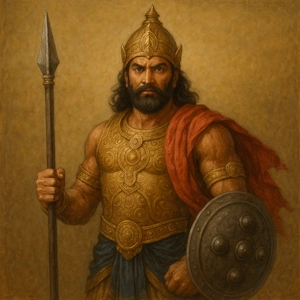
Yuyutsu, a significant yet often overlooked figure in the Hindu epic Mahabharata, stands as a testament to the idea that righteousness transcends lineage. Though a son of the Kuru king Dhritarashtra, he is not counted among the infamous 100 Kaurava brothers. His story is a compelling narrative of moral courage and the difficult choice to stand for dharma, even against his own family.
A Unique Birth and Upbringing
Yuyutsu was the son of Dhritarashtra and a Vaishya woman. His birth came about as Dhritarashtra, anxious for an heir during Gandhari's prolonged pregnancy, had a child with her handmaiden. This made Yuyutsu a half-brother to Duryodhana and the other ninety-nine Kauravas and their sister Dushala. Born on the same day as Duryodhana, Yuyutsu was raised in the royal palace but was often neglected and sidelined by his half-brothers. This early alienation may have contributed to his affinity for the Pandavas. In the Mahabharata, he is also referred to by other names such as Dhartarastra, Dhrtarastraja, Dhrtarastraputra, Karana, Kauravya, and Vaisyaputra.
A Conscience in the Kaurava Camp
From a young age, Yuyutsu was disturbed by the unrighteous and malicious schemes of his half-brothers, particularly Duryodhana. He and Vikarna, another of Dhritarashtra's sons, were known to abhor the conspiracies and evil deeds of the Kauravas, such as the disrobing of Draupadi. However, while Vikarna remained loyal to his family and perished in the war, Yuyutsu chose the path of righteousness.
One of Yuyutsu's most crucial acts of integrity was saving Bhima's life. He informed the Pandavas of Duryodhana's sinister plot to kill Bhima by poisoning his food, allowing them to take precautions. This act of warning the Pandavas about Duryodhana's treacherous plans was a significant turning point, showcasing his allegiance to justice over familial ties.
The Fateful Decision and the Kurukshetra War
On the eve of the great Kurukshetra War, Yudhishthira, the eldest Pandava, made a public announcement that anyone who wished to switch sides could do so before the commencement of the battle. It was at this moment that Yuyutsu made the momentous decision to defect from the Kaurava army and join the Pandavas. This choice solidified his position as a moral warrior who prioritized dharma above all else.
As a warrior on the side of the Pandavas, Yuyutsu proved to be an eminent and honest fighter. He was considered an 'Atirathi,' capable of fighting thousands of warriors simultaneously. During the war, he had several notable encounters:
- He fought with Subahu and managed to cut off his hands.
- He confronted the mighty elephant of Bhagadatta.
- He was defeated in a fight with Uluka.
- He severely rebuked the Kauravas who rejoiced over the death of the valiant Bhagadatta, demonstrating his unwavering moral compass even in the heat of battle.
Aftermath of the War and Later Life
Yuyutsu was one of the few warriors to survive the devastating Kurukshetra War and the only son of Dhritarashtra to do so. In the aftermath, he played a significant role in the new era of Hastinapura. At the suggestion of Yudhishthira, Yuyutsu attended to and served his grieving father, Dhritarashtra.
When the Pandavas decided to renounce the world and embark on their final journey, the Mahaprasthana, they entrusted the supervision of the kingdom to Yuyutsu. He was appointed as the guardian and regent to the young King Parikshit, the grandson of Arjuna. This appointment was a testament to the trust and high regard the Pandavas held for his righteousness and administrative capabilities.
The life of Yuyutsu, the lone Kaurava who sided with the Pandavas in the Mahabharata, offers several profound lessons on integrity, courage, and the nature of righteousness. Though a lesser-known figure, his story serves as a powerful moral compass within the epic.
Here are some of the key lessons to be learned from Yuyutsu's life:
- Dharma Transcends Blood and Loyalty
The most significant lesson from Yuyutsu's life is that righteousness (Dharma) is superior to familial bonds and blind loyalty. Despite being a son of Dhritarashtra, he recognized the injustices and unrighteous acts committed by his Kaurava brothers, particularly Duryodhana. He chose to stand for what was right, even if it meant opposing his own family. This is exemplified by his decision to defect to the Pandava side just before the Kurukshetra War began, an act of great moral courage. - The Power of Individual Conscience
Yuyutsu represents the voice of individual conscience in the face of immense societal and familial pressure. From a young age, he was disturbed by the evil deeds of his half-brothers, such as the plot to poison Bhima and the humiliation of Draupadi. He did not allow his lineage to dictate his moral choices, demonstrating the importance of listening to one's own inner sense of right and wrong. - Courage to Stand Against Injustice
It takes immense courage to stand up against injustice, especially when it is perpetrated by one's own kin. Yuyutsu, along with his half-brother Vikarna, openly condemned the disrobing of Draupadi in the Kaurava court. While Vikarna ultimately fought and died for his family out of loyalty, Yuyutsu took the more difficult step of actively fighting against them. This highlights that true courage lies not just in protest, but in acting on one's convictions. - Authenticity and Integrity Lead to True Honor
Yuyutsu's actions were not driven by personal gain or ambition but by a genuine belief in upholding Dharma. In the end, he was the only son of Dhritarashtra to survive the war, a testament to the idea that those who stand for righteousness are ultimately protected. His survival and subsequent role as a trusted guardian of the kingdom under the Pandavas underscore that true honor comes from integrity, not from siding with the powerful. - The Possibility of Redemption
Yuyutsu's story also shows that it is possible to change and atone for being associated with wrongdoing. By choosing the path of dharma, he distanced himself from the adharma of his brothers and carved a new destiny for himself. His life serves as a reminder that one's true character is defined by their choices and actions, not their birth. - Loyalty to Principles over People
Yuyutsu's loyalty was to the principles of justice and righteousness, rather than to his family. This teaches a valuable lesson about where our ultimate allegiance should lie. In a world with conflicting loyalties, his life encourages us to prioritize what is morally right.
In essence, Yuyutsu's life is a beacon of moral clarity in the complex narrative of the Mahabharata. He exemplifies that true strength lies in moral courage and that standing up for what is right is the highest duty, irrespective of the personal cost





English
Mahabharatam
Click on any topic to open
7
30
Astrology
Bhagavad Gita
Bhagavatam
Bharat Matha
Devi
Devi Mahatmyam
Ganapathy
Garuda Puranam
Glory of Venkatesha
Hanuman
Kathopanishad
Mahabharatam
Mantra Shastra
Mystique
Practical Wisdom
Purana Stories
Radhe Radhe
Ramayana
Rare Topics
Rigveda Explained
Rituals
Sages and Saints
Shiva
Spiritual books
Sri Suktam
Story of Sri Yantra
Temples
Vedas
Vishnu Sahasranama
Yoga Vasishta
26
17
10
0


