Yaska – The Vedic Scholar of Etymology and Semantics
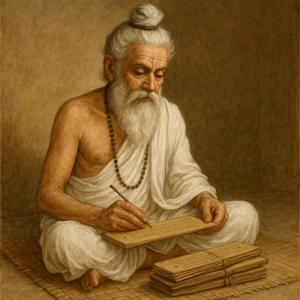
Overview
Yaska was an ancient Indian grammarian and linguist who flourished sometime between the 7th and 5th centuries BCE. He pre‑dated the famous grammarian Panini and is traditionally regarded as the author of the Nighantu—a collection of difficult or ambiguous Vedic words—and the Nirukta, a treatise explaining the etymologies and meanings of those words. These two works, together with his discussions on parts of speech and semantics, make Yaska a foundational figure for Indian linguistics and one of the earliest scholars of etymology in world history.
The Vedic ritual and oral tradition placed tremendous importance on preserving the wording of hymns. Over time, their meanings became obscure, and scholars compiled lists of difficult words and proposed interpretations. Yaska belonged to this tradition but went beyond it: he systematised the earlier glossaries (the Nighantus, created a methodology for deriving meanings, and wrote Nirukta - he first known work to treat etymology as an independent science. He believed that understanding the roots (dhatu) and proper meanings of words was essential for correctly interpreting Vedic hymns.
Dating and historical context
Determining Yaska’s exact dates is difficult. Traditional accounts place him a few centuries before Panini; modern scholars estimate he lived between the 7th and 5th centuries BCE. Indian traditions often emphasise the relative chronology of thinkers rather than precise biographical dates. In classical sources, Panini quotes Yaska, implying that Yaska is older. Modern scholars such as Kapil Kapoor argue that Yaska may have lived even earlier—possibly around the 9th century BCE, but the evidence is uncertain.
Yaska within the Vedic scholarly milieu
The Vedas form the earliest layer of Indian literature. They were transmitted orally, and their archaic language gradually became difficult for later audiences. To preserve the rituals and their meaning, a class of scholars called Vedangins developed six 'limbs' (vedangas) of Vedic study: shiksha (phonetics), kalpa (ritual), vyakarana (grammar), nirukta (etymology), chandas (metre) and jyotisha (astronomy). Yaska’s Nirukta is the classical text for the limb of etymology. Three of these six vedangas—shiksha, vyakarana and nirukta - are directly related to the science of language, reflecting the centrality of linguistic analysis in the Vedic tradition.
Works
1 The Nighantu – proto‑thesaurus of Vedic words
The Nighantu is the earliest Indian glossary of rare Vedic words. It is attributed to Yaska or to predecessors whose materials he collected. According to the Nirukta and later commentaries, the Nighantu is arranged in five chapters:
|
Chapter (Kanda) |
Purpose |
Characteristics |
Evidence |
|
Naighantuka (three chapters) |
Lists synonyms for common semantic fields |
The first chapter contains words for physical objects (earth, water, dawn, day, night); the second deals with human anatomy and qualities (arms, fingers, wealth, anger); the third lists abstract qualities (heaviness, lightness). Together these sections contain about 1,341 words. |
|
|
Naigama |
Contains homonyms and words with multiple meanings |
Includes around 278 words and illustrates how a single form can have several senses depending on context. |
|
|
Daivata |
Lists names of deities and sacrificial terms |
Contains roughly 151 words and organises deities by earth, mid‑region and heaven. |
The Nighantu does not include all Vedic words. It focuses on words that were ambiguous, obsolete or difficult, and it lists them once in the exact form found in the Vedas. Scholars such as Sarup (1927) and Kapil Kapoor regard the Nighantu as the earliest attempt at lexicography in India.
2 The Nirukta – science of etymology
Yaska’s Nirukta (12 chapters) is a commentary on the Nighantu and the first systematic treatise on etymology, philology, and semantics. It provides rules for deriving the meanings of Vedic words from their roots and demonstrates their usage with examples. Key features include:
- Structure and scope: The first chapter (and part of chapter 2) outlines Yaska’s theoretical approach. Chapters 2–12 contain the etymological explanations. Yaska treats etymology as a science and insists it should be studied for its own sake. The treatise follows a painstakingly elaborate process: for each entry Yaska identifies the word, derives its dhatu (verbal root), gives the root’s meaning and then explains how the derived word acquires its specific sense. He cites appropriate Vedic hymns, provides social and philosophical context, and offers alternative explanations when a word is controversial.
- Theoretical principles: Yaska states that understanding the context (rishi, deity and metre) is vital for interpreting a Vedic word. He warns against isolating words from the larger hymn. Yaska recognises dialectal and regional differences in speech and posits that linguistic analysis must account for variations. In the opening chapters of the Nirukta, Yaska expounds principles such as primacy of meaning, parts of speech, the verb–root principle, causes of language variation and the principles of nirvacana (etymological analysis).
- Dhatu (root) theory: Yaska asserts that every word has a root and that etymology helps reveal meaning. He proposes three rules for tracing roots: (1) use phonological laws to link a word to its root; (2) when phonological connections are unclear, derive the root from a similarity of form; and (3) always consider the context, because words cannot be analysed in isolation. He cautions against arbitrary derivations and emphasises correct semantic interpretation.
- Parts of speech: In an early classification system, Yaska divides words into four categories—nama (nouns), akhyata (verbs), upasarga (pre-verbs or prefixes) and nipat (indeclinable particles). He describes a noun as having sattva (being) and a verb as exhibiting bhava (becoming). The Nirukta explores each category:
- Nama (noun): Yaska famously asserts that nouns are derived from verbs. This claim sparked debate with grammarians like Gargya, who argued that every profession would share a name if nouns came solely from verbs. Yaska responds that objects are named for one specific action.
- Akhyata (verb): Yaska defines verbs as having bhava (becoming) as their core notion and lists six modifications: genesis, existence, alteration, growth, decay and destruction. He distinguishes sadhya verbs (actions in progress) from siddha nouns (completed states).
- Upasarga (prefixes): He describes upasargas (prepositions) as particles that modify the meanings of nouns and verbs. While some grammarians doubted that upasargas have independent meaning, Yaska asserts they do and lists 20 upasargas such as aa, abhi, prati, ati, su, nir, dur, ni, ava and ut.
- Nipat (particles): Yaska classifies particles (for example ha, iva, nu, sma, khalu) into comparative, conjunctive and expletive uses, providing examples from Vedic literature.
- Debate over onomatopoeia and word origins: Yaska belongs to the nairukta school, which holds that words derive from roots. He acknowledges that a few words, mostly bird names, originate from onomatopoeia (anukarana), but he downplays its role in the origin of language. Yaska quotes Audambarayana, who denies onomatopoeia altogether, and rejects Panini’s and Plato’s emphasis on sound imitation; he maintains that root derivation is primary.
Significance of Nirukta
Yaska’s Nirukta played several critical roles:
- First scientific attempt at Vedic interpretation: Scholars note that Yaska’s treatise is the first known scientific attempt to interpret the Vedas. It systematises the earlier Nighantu lists, applies rules for deriving meanings and makes etymology a rigorous discipline.
- Guard against misinterpretation: The College Hive summary illustrates how misreading Vedic words can produce nonsensical translations, such as a Dutch philosopher translating gau as 'cow' instead of 'earth.' Nirukta’s function is to guide interpretation and prevent such errors by clarifying the intended meanings. It serves as a thesaurus of synonyms to facilitate accurate reading.
- Understanding obscure and homonymous terms: By explaining synonyms (Naighantuka), homonyms (Naigama) and deity names (Daivata), Yaska allows Vedic scholars to grasp the diverse semantics of the hymns. The structure of Nighantu and the commentary of Nirukta highlight the importance of context and nuance.
- Influence on later linguistics: The classification of parts of speech and the root theory influenced later grammarians, philosophers and linguists. Panini refers to Yaska; Katyayana and Patanjali discuss and sometimes criticise his views. Debate between Yaska’s atomistic view that words (pada) are primary carriers of meaning and later grammarians’ holistic view that sentences are primary lasted for centuries. Yaska also asserts that most nouns derive from verbs, a position that remained contested.
Philosophical views
Primacy of speech and meaning
Yaska sees articulate speech (vac) as the primary mode of human expression. He was aware of dialectal and regional variations but nonetheless gave spoken words primacy over other modes. He believed that understanding a word’s meaning and its root is fundamental to knowledge and that ignorance of etymology leads to misinterpretation.
Debate on the eternity of words
Yaska participates in the Indian philosophical debate on whether words are eternal. Later grammarians like Panini and Katyayana argued that words (shabda) are eternal and exist independently of their utterance. Yaska, influenced by Audambarayana, holds the opposite view that words are transitory—they exist only when pronounced. He nonetheless recognises that proper articulation is crucial and emphasises the four stages of speech (vac): para, pasyanti, madhyama and vaikhari (physically spoken words).
The verb–root controversy
Yaska’s assertion that nouns are derived from verbs triggered long debates. The Nirukta defends this view, partly following an older thinker Sakatayana. Yaska argues that verbs denote processes (bhava) while nouns denote states (sattva), and that the actions give rise to names. Opponents like Gargya objected that if all nouns came from verbs, everyone performing the same action should have the same name. Yaska counters by saying objects are named after one principal action and thus retain distinct identities.
Role of context and systematic study
Yaska emphasises that Vedic mantras cannot be understood in isolation. To interpret a hymn properly one must consider (1) the seer (rsi), (2) the deity to whom the mantra is dedicated, and (3) the metre (chanda). He also insists that the six vedangas provide the necessary disciplines for this study. This integrated approach ensures that semantics, grammar, phonetics and ritual knowledge work together.
Influence and legacy
- Foundational role in lexicography: By compiling the Nighantu and analysing it in the Nirukta, Yaska laid the foundation for lexicography in India. Later dictionaries such as Amarakosha and commentaries build on his methods. Scholars consider the Nighantu the earliest work in lexicography.
- Precursor to semantics and philology: The depth of Yaska’s analysis marks the beginning of systematic semantics and philology in India. His treatment of etymology influences both Eastern and Western traditions and is cited as the first science of etymology.
- Impact on later philosophers: The debates Yaska initiated—about the primacy of words or sentences, the derivation of nouns from verbs, and the transitory vs. eternal nature of words—were taken up by Nyaya, Mimamsa, Buddhist scholars and later grammarians. These discussions shaped Indian linguistic and philosophical thought for over a millennium.
- Cultural significance: In subsequent Hindu thought, Yaska’s dictionary became the safeguard for interpreting Upanishads and other sacred texts. His classification of parts of speech is referenced in grammatical texts and contributes to knowledge of Sanskrit structure. The Mahabharata and other epics credit him with illuminating linguistic and philosophical ideas.
Conclusion
Yaska stands at the earliest dawn of linguistic science. In response to the difficulties of interpreting archaic Vedic hymns, he compiled the Nighantu and authored the Nirukta, creating the first systematic science of etymology and semantics. His insistence on connecting words to their roots, his classification of parts of speech, and his rules for interpreting words within their context laid the groundwork for later grammar and lexicography.
Beyond technical linguistics, Yaska engaged with philosophical questions about the nature of words, their origin, their permanence and the relationship between speech and meaning. His works influenced Panini and became a touchstone for Vedic exegesis. Modern scholarship recognises Yaska not only as an etymologist but also as a philosopher who sought to harmonise semantic analysis with ritual, myth and cosmology. His contributions remain central to understanding the evolution of linguistic thought in India and the world.






English
Rare Topics
Click on any topic to open
7
30
Astrology
Bhagavad Gita
Bhagavatam
Bharat Matha
Devi
Devi Mahatmyam
Ganapathy
Garuda Puranam
Glory of Venkatesha
Hanuman
Kathopanishad
Mahabharatam
Mantra Shastra
Mystique
Practical Wisdom
Purana Stories
Radhe Radhe
Ramayana
Rare Topics
Rigveda Explained
Rituals
Sages and Saints
Shiva
Spiritual books
Sri Suktam
Story of Sri Yantra
Temples
Vedas
Vishnu Sahasranama
Yoga Vasishta
26
17
10
0


