Women in the Vedic Era: Scholars, Warriors, and Thinkers
Start with the core question
Most people assume that women in ancient India had limited access to education. The Vedic era tells a completely different story. In the early Vedic period, women had the same right to education as men. This was not an exception. It was the standard.
Understand the purpose of education
First understand the context. Ancient Indian education was not about getting a job or learning a skill. The goal was self-realization. People studied to understand themselves, the universe, and the ultimate truth. This goal applied equally to men and women. Society did not see any biological reason to keep women away from this pursuit.
The initiation ceremony
Here is what this means in practice. Boys in the Vedic period went through a formal ceremony called upanayana. This was a sacred rite that officially admitted a student to serious study, including the Vedas. Girls had the same right. They too underwent this ceremony. They too were given the authority to study Vedic texts and recite sacred mantras. This single fact tells you a great deal about how society viewed women at that time.
Two types of female students
Now look at the deeper point. Women students were divided into two groups.
The first group was called brahmavadinis. These women chose not to marry. They devoted their entire lives to study, theology, and the pursuit of spiritual knowledge.
The second group was called sadyavadhus. These women studied until they reached a mature age for marriage. They completed their full course of education before entering domestic life.
Both paths were respected. Both were considered complete and honourable.
Student life and discipline
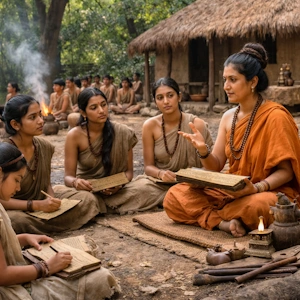
Girl students lived and studied under the same strict conditions as boy students. Many lived in the homes of their teachers. They wore simple garments made of bark or deerskin. They kept their hair in the traditional way of a student. Some studied at home under their fathers or brothers. Others travelled to hermitages or stayed in boarding houses built specifically for female students.
What they studied
The curriculum was wide and serious. Women studied all four Vedas. They studied grammar, astronomy, the science of rituals, mathematics, and philosophy. They also studied fine arts such as singing, dancing, and music. There is another important detail here. Women also received military training. Vedic records mention warrior women like Mudgalani, who drove her husband's chariot into battle, and Vishpala, a female soldier who received a prosthetic iron leg after being wounded in war.
Scholars, philosophers, and teachers
This system produced remarkable women. The Rig-Veda alone contains hymns written by at least twenty-seven female sages. One of them, Vach, wrote a hymn expressing her complete identification with the universe and the Absolute. In the later period, women like Maitreyi and Gargi became leading voices in philosophy. Gargi publicly questioned the greatest philosopher of her time, Yajnavalkya, on the nature of ultimate reality. She did not do this quietly. She did it in a royal court.
Women also became teachers themselves. The Sanskrit language created specific words for female teachers who taught independently. They were not just wives of male teachers. They were teachers in their own right.
The takeaway
The Vedic era shows that the idea of women as intellectually secondary is not ancient. It is a later development. In the earliest period of Indian civilization, women studied the same texts, followed the same disciplines, asked the same deep questions, and taught the same knowledge as men. That is the actual starting point of Indian intellectual history.
QUESTIONS AND ANSWERS
Q1. Why does the Vedic approach to women's education matter today?
It matters because it breaks a false assumption. Many people today believe that equality for women is a modern Western idea. The Vedic period shows that a civilization thousands of years ago had already built equality into its core structure. This was not a reform or a movement. It was simply how society was organized. That fact alone forces us to rethink where we get our ideas about progress and civilization.
Q2. What is the deeper meaning behind both men and women having the same initiation ceremony?
The upanayana ceremony was not just a school admission. It was a declaration that the student was ready to seek ultimate truth. When society gave this ceremony equally to girls and boys, it was saying something profound. It was saying that the search for truth has no gender. The universe does not reveal itself only to men. Any sincere seeker, regardless of gender, has equal access to the deepest knowledge. That is a remarkably advanced philosophical position.
Q3. What does the existence of brahmavadinis tell us about how Vedic society viewed marriage?
It tells us that marriage was a choice, not a compulsion. Society had created a fully respected path for women who chose knowledge over domestic life. These women were not seen as failures or outcasts. They were honored scholars and sages. This means Vedic society separated a woman's worth from her marital status entirely. Her value came from her pursuit of knowledge and truth, not from being someone's wife.
Q4. What is the hidden significance of Gargi questioning Yajnavalkya in a royal court?
Most people focus on the fact that she questioned him. But the deeper point is that nobody stopped her. She was a woman standing in a royal assembly, publicly challenging the most celebrated philosopher of her time on the nature of ultimate reality. The court did not dismiss her. Yajnavalkya engaged with her seriously. This means the culture had normalized women as intellectual equals to the point where such a scene was not considered unusual or inappropriate. That normalization is the real story.
Q5. Why is Vishpala's story particularly significant?
Vishpala was a female soldier who lost her leg in battle and was fitted with an iron prosthetic leg so she could return to the fight. This story is significant on two levels. First, it tells us women were active combatants, not just supporters in war. Second, it tells us that society invested in restoring a woman soldier to full capacity. Nobody said her fighting days were over. They built her a new leg and sent her back. That level of commitment to a female warrior is extraordinary by any standard in human history.
Q6. What does the fact that Sanskrit developed specific words for female teachers tell us?
Language reflects reality. When a society creates a new word, it is because a new reality exists that needs to be named. The fact that Sanskrit had to create specific terms for women who taught independently means there were enough such women to require a dedicated word. These were not rare exceptions. They were a recognized and common enough category that the language had to formally acknowledge them. Words are social records.
Q7. What is the deeper philosophical principle behind teaching women both lower and higher knowledge?
Lower knowledge covered subjects like grammar, astronomy, mathematics, and the arts. Higher knowledge was the pursuit of Brahman, the ultimate reality. Teaching women both meant society believed women were capable of the full range of human intellectual achievement. They were not limited to practical skills. They were considered fit to ask the deepest questions about existence itself. This reflects a view of women not just as functional members of society but as complete spiritual beings on the same journey as men.
Q8. What does the military training of women reveal about Vedic society's understanding of strength?
In most ancient civilizations, physical strength and combat were exclusively male domains. The Vedic inclusion of women in military training suggests the society understood strength differently. Strength was a quality of the prepared individual, not a biological privilege of one gender. This also means women were seen as capable of protecting themselves, their families, and their civilization. They were not defined as those who needed protection. They were also among those who provided it.
Q9. What is the secret that Vach's hymn carries for modern readers?
Vach composed a hymn in which she declared her complete identity with the Absolute universe. She was not writing about the universe from the outside. She was saying she herself was the universe. This is one of the highest states of spiritual realization any human being can express. The fact that this realization was achieved and recorded by a woman in the earliest layers of human literature is a profound secret that most people have never encountered. It quietly destroys the idea that spiritual greatness was a male achievement.
Q10. Why did this system decline, and what does that decline teach us?
The Vedic system of equal education did not collapse because it failed. It was gradually replaced as social structures shifted over centuries, as invasions changed cultural priorities, and as rigid interpretations of social roles hardened. The lesson here is important. A great principle does not survive automatically. It survives only if a civilization consciously protects and practises it. The decline of women's equality in later periods of Indian history was not a return to something natural. It was a departure from something originally natural.
OBJECTIONS AND REPLIES
Objection 1. These are just ancient texts. There is no proof any of this actually happened in real life.
Reply. The same logic would erase all of ancient history. We know about Greek philosophers, Roman rulers, and ancient wars through texts. We do not dismiss those as fiction. The Vedic texts are among the oldest and most carefully preserved records in human history. The hymns of women like Gargi and Vach exist in the actual Rig-Veda. Their words are there. The grammarian Panini documented female teacher titles in his grammar. These are not myths. They are recorded facts.
Objection 2. Women may have composed a few hymns but that does not mean they had equal status overall.
Reply. The point is not just about composing hymns. The evidence covers initiation ceremonies, full Vedic study, military service, philosophical debate in royal courts, and professional teaching. This is not one isolated example. It is a consistent pattern across multiple domains of life. When a pattern is that wide, it reflects a social reality, not a lucky exception.
Objection 3. The number of women scholars was probably very small compared to men.
Reply. This is likely true in absolute numbers. But the same is true for male scholars. Not every man became a philosopher or warrior either. The question is not how many women reached the highest levels. The question is whether the path was open to them. The evidence shows clearly that the path was open, the ceremony was available, the curriculum was the same, and the profession of teaching was accessible. Opportunity matters more than outcome statistics.
Objection 4. These women were probably from elite families only. Ordinary women had no such privileges.
Reply. This is a fair observation but it applies equally to men. Higher education in any ancient civilization was largely limited to those with access to teachers and resources. The point is not that every woman in the Vedic era was a philosopher. The point is that being a woman was not itself the barrier. Gargi and Maitreyi are not celebrated because they overcame gender discrimination. They are celebrated because they achieved great things. Their gender is not presented as an obstacle in the texts.
Objection 5. The idea that women fought in wars sounds exaggerated or symbolic.
Reply. The story of Vishpala is specific. She is named. She lost her leg in battle. She was given an iron prosthetic. She returned to fight. Mudgalani drove a war chariot into combat. These are not vague references to courage. They are specific accounts of specific women doing specific things in battle. Symbolic writing does not give this level of precise detail.
Objection 6. Modern India does not reflect any of this so perhaps it was never the real culture.
Reply. Modern India reflects centuries of change, including periods of invasion, colonial rule, and shifting social codes. What a culture looks like today is not proof of what it looked like three thousand years ago. Germany today does not look like ancient Rome. Egypt today does not look like the civilization that built the pyramids. A culture can move far from its own origins. That is exactly what happened. The Vedic period was the origin. Later periods were the departure.
Objection 7. Religions and ancient societies always idealized their past. This could be the same thing.
Reply. Idealization tends to be vague and general. It says things like women were respected or women were honored. The Vedic evidence is specific. It names individual women, records their exact words, documents their philosophical arguments, and captures grammarians creating new vocabulary to describe their professional roles. Specific details are the opposite of idealization. They are documentation.
Objection 8. Even if women were educated, they were probably still under male control at home.
Reply. The existence of brahmavadinis directly answers this objection. These were women who never married and spent their entire lives as independent scholars. They were not under any husband's control. They were not under any father's control after their studentship. They lived, studied, and taught as autonomous individuals. If the system were built on female subordination, this category of women could not have existed or been respected.
Objection 9. This is just Hindu nationalism using history to make a political point.
Reply. The facts of the Vedic period exist independently of any political use made of them. A fact does not become false because someone uses it for a particular purpose. The texts are real. The hymns exist. The philosophers existed. Studying them honestly is not politics. It is history. Anyone from any background who looks at the primary sources will find the same evidence.
Objection 10. If Vedic women were so free and equal, why did patriarchy develop in India at all?
Reply. Freedom and equality are not self-maintaining. They require active social commitment to survive across generations. When external pressures such as invasions, economic shifts, and rigid social stratification increased over centuries, social structures changed. Women's roles narrowed. This happened in Greece too, and in many other civilizations that had earlier periods of greater female participation. The development of patriarchy in India was a historical process, not an inevitable destiny. The Vedic period proves that clearly.





English
Bharat Matha
Click on any topic to open
7
30
Astrology
Bhagavad Gita
Bhagavatam
Bharat Matha
Devi
Devi Mahatmyam
Ganapathy
Garuda Puranam
Glory of Venkatesha
Hanuman
Kathopanishad
Mahabharatam
Mantra Shastra
Mystique
Practical Wisdom
Purana Stories
Radhe Radhe
Ramayana
Rare Topics
Rigveda Explained
Rituals
Sages and Saints
Shiva
Spiritual books
Sri Suktam
Story of Sri Yantra
Temples
Vedas
Vishnu Sahasranama
Yoga Vasishta
26
17
10
0


