Why You Don’t Own Your Child
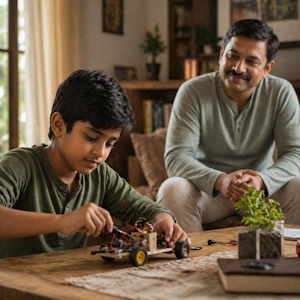
This is one of the biggest misunderstandings in parenting.
Parents think children belong to them.
They say my child.
My son.
My daughter.
The language itself creates ownership.
But Dharma does not support this idea.
Children are not property.
They are not extensions of your ego.
They are not projects you design.
They are beings passing through your care.
Now understand this clearly.
You are not the creator of the child.
You are a medium.
The body comes through you.
The life does not come from you.
That life has its own continuity.
Its own past.
Its own tendencies.
Its own direction.
You are not starting that story.
You are entering it at a point.
This changes everything.
Now see the difference.
Ownership tries to control.
Lineage tries to guide.
Ownership says this child must become what I want.
Lineage says this child must be supported to become what they are meant to become.
Ownership imposes identity.
Lineage protects development.
Now understand the role of a parent in Dharma.
You are responsible.
But you are not in control of everything.
Responsibility means providing structure.
Values.
Discipline.
Exposure to Dharma.
Not designing outcomes.
Now see where modern parenting goes wrong.
Parents attach their own unfulfilled desires to the child.
What they could not become,
they want the child to become.
This creates pressure.
Not growth.
Because the child is not aligned with that projection.
This is not guidance.
This is transfer of burden.
Now see another mistake.
Over-identification.
When the child succeeds,
the parent feels they succeeded.
When the child fails,
the parent feels they failed.
This creates emotional instability.
Because you are tying your identity
to something you do not fully control.
Dharma removes this confusion.
It separates role from identity.
You play the role of a parent.
But you do not become the child.
Now understand something deeper.
Attachment is natural.
But attachment must be guided by clarity.
Without clarity,
attachment becomes control.
With clarity,
attachment becomes care.
Now see how this plays out practically.
A parent who thinks in ownership
tries to control every decision.
What the child studies.
What the child likes.
What the child becomes.
This creates resistance.
Or dependency.
Both are unhealthy.
A parent who understands lineage
focuses on foundation.
Right values.
Right habits.
Right exposure.
Then allows the child to grow within that framework.
This creates strength.
Not rebellion.
Not weakness.
Now understand the final point.
Letting go does not mean neglect.
It means correct positioning.
You guide.
You support.
You correct when needed.
But you do not own.
Because ownership creates pressure.
Responsibility creates growth.
Now see the shift.
From control to guidance.
From projection to understanding.
From ego to Dharma.
That is the difference.
And once you see this,
parenting stops being a struggle.
It becomes a role performed with clarity.
Question: If parents are not the owners of the child, what exactly is their role
Answer: The role is stewardship, where the parent provides structure, values, and protection while allowing the child’s inherent nature to unfold without forced direction
Question: What is the hidden danger of thinking my child
Answer: It subtly shifts the relationship from care to control, where the child becomes a means to fulfill the parent’s identity rather than an individual with their own path
Question: Why does Dharma separate lineage from ownership
Answer: Because lineage acknowledges continuity of life across generations, while ownership creates illusion of control over something that has its own independent journey
Question: What happens internally when parents project their desires onto the child
Answer: The child experiences pressure and misalignment, while the parent unknowingly transfers unresolved ambitions, creating strain instead of natural growth
Question: What is the deeper meaning of guiding without controlling
Answer: It means setting a strong foundation of discipline and values while allowing the child’s nature to express itself within that framework without interference
Objection: If parents do not control the child, the child may go in the wrong direction
Reply: Lack of control does not mean lack of guidance, and strong values combined with clarity create better direction than forced control
Objection: Parents sacrifice a lot, so they have the right to decide the child’s future
Reply: Effort creates responsibility, not ownership, and the purpose of that effort is to support growth, not impose identity
Objection: Children are too immature to choose their own path
Reply: They need guidance and correction, but not complete control, because controlled growth limits their ability to develop judgment
Objection: Without pressure, children may not achieve success
Reply: Pressure may create short-term performance, but clarity and inner stability create long-term strength and consistency
Objection: This idea sounds ideal but not practical in real life
Reply: It becomes practical when applied gradually, where parents shift from controlling outcomes to strengthening the foundation on which outcomes naturally build





Children's Section
Parenting
Click on any topic to open
7
30
Astrology
Bhagavad Gita
Bhagavatam
Bharat Matha
Devi
Devi Mahatmyam
Ganapathy
Garuda Puranam
Glory of Venkatesha
Hanuman
Kathopanishad
Mahabharatam
Mantra Shastra
Mystique
Practical Wisdom
Purana Stories
Radhe Radhe
Ramayana
Rare Topics
Rigveda Explained
Rituals
Sages and Saints
Shiva
Spiritual books
Sri Suktam
Story of Sri Yantra
Temples
Vedas
Vishnu Sahasranama
Yoga Vasishta
26
17
10
0


