Why Vrindavan Is Called Krishna’s Yogapitha
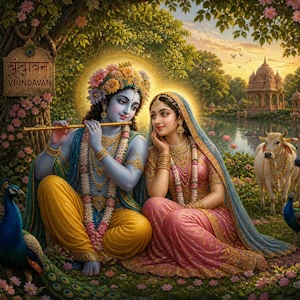
Vrindavan is not just a place on the map.
It is not only a town.
It is not only a pilgrimage center.
It is not only a memory of Krishna’s childhood.
Vrindavan is described in our tradition as a living spiritual field.
A place where Bhagavan’s presence is not treated as a past event.
It is treated as a continuous reality.
That is why devotees do not look at Vrindavan like an ordinary location.
They approach it with reverence.
Because Vrindavan is connected with Krishna’s most intimate lilas.
His childhood play.
His flute.
His cows.
His friends.
His love for the gopis.
His protection of the simple-hearted people of Vraja.
His sweetness.
His nearness.
His accessibility.
In many sacred traditions, Bhagavan is approached as ruler, judge, creator, protector, or destroyer.
But in Vrindavan, Bhagavan is approached as beloved.
As child.
As friend.
As the one who can be loved without distance.
This is the special power of Vrindavan.
It removes fear.
It softens the heart.
It brings Bhagavan close.
Vrindavan Is A Yogapitha
Vrindavan is called a Yogapitha.
This means it is a central seat of divine presence.
A place where the connection between Bhagavan and the devotee becomes extremely intense.
The word 'yoga' here does not simply mean physical posture or exercise.
It means union.
Connection.
Meeting.
Joining.
The soul meeting Bhagavan.
The heart turning toward Bhagavan.
The restless mind becoming absorbed in Bhagavan.
So Vrindavan is called Yogapitha because it is the seat where this divine meeting happens.
In ordinary life, the mind runs in many directions.
Money.
Family.
Fear.
Reputation.
Desire.
Anxiety.
Comparison.
But Vrindavan pulls the mind in one direction.
Toward Krishna.
That is why even the dust of Vrindavan is praised.
Even the trees are respected.
Even the Yamuna is worshipped.
Even the cows, paths, groves, and kundas are seen as sacred.
Because they are not viewed as separate objects.
They are part of Krishna’s field.
Part of his lila.
Part of his presence.
Divine Activities Are Always Happening
The deepest idea is this.
Krishna’s lilas are not treated as dead history.
They are not like an old story that happened once and ended.
In the devotional vision, Bhagavan’s divine activities are eternal.
They are always present in the spiritual plane.
The earthly Vrindavan gives us access to that divine Vrindavan.
This is why saints weep in Vrindavan.
This is why devotees chant there with a different feeling.
This is why even a simple walk in Vrindavan becomes a form of meditation.
Because the devotee feels:
Krishna walked here.
Krishna played here.
Krishna protected his devotees here.
Krishna revealed the sweetness of Bhagavan here.
But the feeling goes deeper.
The devotee does not say only, 'Krishna was here.'
The devotee feels, 'Krishna is here.'
That is the heart of Vrindavan.
Why Vrindavan Is Different From Other Sacred Places
Every tirtha has power.
Kashi gives liberation-oriented wisdom.
Ayodhya carries the maryada of Rama.
Dwaraka carries Krishna’s royal majesty.
Kurukshetra carries the fire of dharma and decision.
But Vrindavan carries madhurya.
Sweetness.
Intimacy.
Tenderness.
Here Krishna is not seated far away on a throne.
He runs through the forest.
He plays the flute.
He eats with his friends.
He steals butter.
He responds to love.
He allows himself to be bound by Yashoda.
This is the greatness of Vrindavan.
Bhagavan, who holds the universe, becomes reachable through love.
The infinite becomes intimate.
The supreme becomes personal.
The cosmic becomes close.
That is why Vrindavan is not only a place to visit.
It is a state into which the heart must enter.
The Real Vrindavan Must Awaken Within
A person can physically go to Vrindavan and still remain outside it.
If the mind is full of gossip, ego, greed, complaint, and distraction, then even in Vrindavan, the person remains far away.
At the same time, a devotee sitting anywhere can remember Krishna with sincerity and touch the inner Vrindavan.
This does not reduce the greatness of the physical Vrindavan.
It shows how sacred it is.
The outer Vrindavan is the doorway.
The inner Vrindavan is the awakening.
When the heart becomes soft.
When the mind turns toward Krishna.
When love becomes more important than ego.
When remembrance becomes natural.
When Bhagavan is not treated as a distant concept but as living presence.
Then Vrindavan begins inside.
That is the real purpose of going there.
Not tourism.
Transformation.
Straight Understanding
Vrindavan is not an ordinary geographical place.
It is a sacred spiritual center.
It is called Yogapitha because it is the seat of divine union between Bhagavan and the devotee.
Krishna’s lilas are understood as eternal, not merely historical.
The physical Vrindavan opens the heart toward the eternal Vrindavan.
The real test is not whether you visited Vrindavan.
The real test is whether Vrindavan entered you.
1. Why is Vrindavan called a spiritual plane?
Because Vrindavan is not seen as ordinary land.
It is Krishna’s lila-bhumi.
His divine play is connected with every grove, path, tree, and riverbank.
A tourist sees a town.
A devotee sees a living sacred field.
That is the difference.
2. What does Yogapitha mean?
Yogapitha means the central seat of divine presence.
In Vrindavan, the heart meets Krishna through love.
Not through fear.
Not through distance.
Through sweetness.
Through remembrance.
Through bhakti.
That is why Vrindavan is called a Yogapitha.
3. Can Vrindavan be experienced from anywhere?
Yes.
When the mind turns to Krishna with love, inner Vrindavan begins.
But this does not reduce the greatness of physical Vrindavan.
The real Vrindavan outside awakens Vrindavan inside.
That is the purpose of pilgrimage.
Objection
Is this just imagination?
People love Krishna.
So they imagine Vrindavan as divine.
Reply
No.
Vrindavan is not made sacred by imagination.
It is sacred because Krishna’s lilas happened there.
Saints realized Krishna there.
Devotees worshipped there for centuries.
Shastra, bhakti, and experience all meet there.
That is why Vrindavan is a sacred center.
Not just a sentimental place.





English
Radhe Radhe
Click on any topic to open
7
30
Astrology
Bhagavad Gita
Bhagavatam
Bharat Matha
Devi
Devi Mahatmyam
Ganapathy
Garuda Puranam
Glory of Venkatesha
Hanuman
Kathopanishad
Mahabharatam
Mantra Shastra
Mystique
Practical Wisdom
Purana Stories
Radhe Radhe
Ramayana
Rare Topics
Rigveda Explained
Rituals
Sages and Saints
Shiva
Spiritual books
Sri Suktam
Story of Sri Yantra
Temples
Vedas
Vishnu Sahasranama
Yoga Vasishta
26
17
10
0


