Why there are ten Mahavidyas?
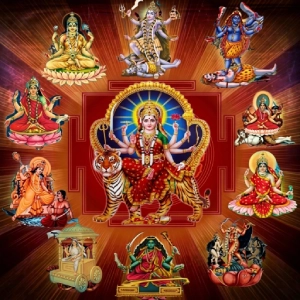
The introduction of the Kalikarpura Stotra highlights the importance of the number ten in the Mahavidyas. Zero in mathematics has no value by itself. But when combined with any number, it increases the value tenfold. zero symbolizes completeness and infinity.
Similarly, the formless Brahmamayi Adishakti, when linked with her trigunatmika (satwa, rajas,tamas) nature, engages in the creation, preservation, and destruction of the universe. She fulfills all the desires of her devotees. Therefore, the manifestation of Adishakti into the ten Mahavidyas is like attaching zero after a number, symbolizing the tenfold emergence of the Mahavidyas.
This concept underlines the complete and infinite aspects of the divine feminine. The ten Mahavidyas represent different forms of Adishakti, each fulfilling a unique aspect of the universe and addressing the desires of her devotees. Through this symbolic process, Adishakti’s connection with the trigunatmika nature illustrates how the ten Mahavidyas emerge as powerful, distinct forms, embodying the full spectrum of divine energy and presence.
- How does the mathematical concept of zero explain the transformation of the formless Adishakti into the ten Mahavidyas?
Zero represents Shunya, which is both absolute void and infinite potential. By itself, the formless cosmic consciousness, or Nirguna Brahman, remains unmanifest and still. However, just as zero attached to a digit multiplies its value tenfold without changing the intrinsic nature of the original number, Adishakti projects her power into the material realm. The number ten signifies that she has moved from a state of pure potentiality into full, multi-dimensional expression. She does not lose her absolute, formless essence; instead, she expands her presence tenfold to completely cover every directional, psychological, and cosmic dimension of existence. - What is the hidden connection between the Trigunatmika nature and the specific number of ten Mahavidyas?
The Trigunatmika nature consists of the three primal forces: Satva (purity/equilibrium), Rajas (passion/activity), and Tamas (inertia/darkness). When these three gunas interact with the three primary cosmic functions of creation, preservation, and destruction, they generate nine distinct combinations of cosmic energy. The tenth dimension is the transcendent source itself, which holds and witnesses all nine combinations. Therefore, the ten Mahavidyas represent the total mathematical permutation of nature interacting with cosmic function, ensuring that no aspect of reality—whether light, dark, active, or still—is left outside the divine matrix. - Why is the manifestation of the Mahavidyas compared to an increase in value rather than a division or fragmentation of the original goddess?
In many theological systems, creation is viewed as a descent or a fragmentation of the divine into lower forms. The Kalikarpura Stotra reverses this by using the analogy of adding a zero. This indicates that manifestation is an amplification, not a dilution. When Adishakti becomes the ten Mahavidyas, she does not divide her power into ten smaller parts. Each Mahavidya is a full expression of the infinite. It is a mystery of divine mathematics where infinity multiplied or added to itself remains completely infinite, yet becomes more accessible to the devotee. - What is the overlooked psychological mystery behind the fierce and unconventional forms among the ten Mahavidyas?
People often wonder why forms like Chinnamasta, who holds her own severed head, or Dhumavati, the widow goddess associated with decay, are included in a system of divine greatness. The secret lies in the concept of completeness symbolized by the zero. True infinity must include what human conditioning rejects. By embodying shadows, destruction, recycling, and radical transcendence, the Mahavidyas teach that the divine presence is equally vibrant in terror, sorrow, and endings as it is in beauty and beginnings. They break human judgment to reveal that everything is sacred. - How does the principle of fulfilling all desires connect to the infinite aspect of the Mahavidyas?
Human desires are diverse, ranging from material survival and emotional comfort to destruction of enemies and ultimate spiritual liberation. A limited deity can only grant limited boons. Because the Mahavidyas represent the tenfold multiplication of infinite energy, they cover the entire spectrum of human consciousness. Each goddess acts as a specialized portal for a specific frequency of desire, ensuring that whether a seeker approaches with a worldly need or a thirst for absolute truth, the infinite mother has a corresponding form perfectly aligned to fulfill and eventually elevate that desire. - What is the hidden cosmological significance of the number ten in the context of space and time?
In Vedic cosmology, space is divided into ten directions: the four cardinal points, the four intermediate points, the zenith above, and the nadir below. By manifesting as ten distinct forms, Adishakti effectively seals the entire cosmos. There is no corner of existence, no direction in space, and no fraction of time where she is absent. The hidden aspect here is that the Mahavidyas are not just historical mythological figures; they are the literal grid of space and time holding the universe together. - How does the relationship between the formless Brahman and the Trigunatmika nature challenge the idea that material reality is an illusion?
Many philosophical paths dismiss the material world as a mere illusion to be discarded. However, this philosophy demonstrates that the Trigunatmika nature is the very vehicle through which the formless Adishakti chooses to express her ultimate greatness. The material world, driven by the three gunas, is the canvas upon which the infinite zero paints its value. This implies that the universe is not an illusion to escape, but a purposeful, powerful expansion of divine energy meant to be experienced, understood, and integrated. - What is the mystery of the sequence of the ten Mahavidyas, starting with Kali?
The sequence represents the evolution and involution of the universe. Kali is the primordial darkness, the absolute zero before creation begins, representing time in its unmanifest state. As the sequence progresses through forms of light, beauty, destruction, and speech, it maps out how the universe populates itself with form and name. The final forms bring the seeker back to the recognition of the unmanifest. The hidden truth is that the sequence is a cyclic loop, mirroring how zero begins a sequence, defines its growth, and receives it back at the end of the cosmic cycle. - How can a practitioner apply the principle of the formless becoming manifest to their own spiritual development?
The human soul is a micro-reflection of Adishakti. In our deepest essence, we are formless, still, and full of silent potential, like a standalone zero. The lesson of the Mahavidyas is that we should not fear engaging with the world of action, emotion, and duty. By linking our inner stillness with the gunas or qualities of life, we can allow our own potential to manifest creatively and powerfully. We learn to see our distinct talents and life phases not as limitations, but as unique, distinct forms of a single, infinite inner energy. - What is the ultimate secret realization hidden within the comparison of Adishakti to infinity?
The ultimate secret is the dissolution of duality between the worshiper and the worshiped. If Adishakti is truly infinite and leaves nothing outside of her tenfold expansion, then the devotee, the act of worship, the desires, and the path itself are also expressions of her energy. The realization of the Mahavidyas is the understanding that one is not separate from the divine mother. Just as a zero realizes its power only when it unites with a number, the individual ego realizes its infinite nature only when it consciously aligns itself with the cosmic, all-encompassing presence of Adishakti.





English
Devi
Click on any topic to open
7
30
Astrology
Bhagavad Gita
Bhagavatam
Bharat Matha
Devi
Devi Mahatmyam
Ganapathy
Garuda Puranam
Glory of Venkatesha
Hanuman
Kathopanishad
Mahabharatam
Mantra Shastra
Mystique
Practical Wisdom
Purana Stories
Radhe Radhe
Ramayana
Rare Topics
Rigveda Explained
Rituals
Sages and Saints
Shiva
Spiritual books
Sri Suktam
Story of Sri Yantra
Temples
Vedas
Vishnu Sahasranama
Yoga Vasishta
26
17
10
0


