Why the Mind Can Make or Break the Body
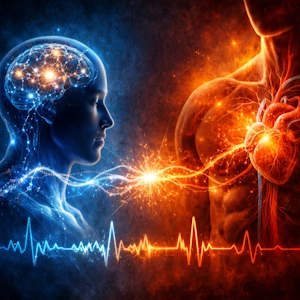
These verses come from the classical Ayurvedic tradition.
They reflect teachings found in Charaka Samhita and Sushruta Samhita.
These texts go beyond treatment and focus on complete living.
Ayurveda views the human being as a union of body, mind, and inner self.
Health is seen as balance across all these layers.
Disease arises when this balance is disturbed.
These verses explain how daily conduct shapes health.
They connect thoughts, actions, and physical condition.
They also show the role of discipline and right living.
The aim is not only to remove illness.
The aim is to build a stable and harmonious life.
सत्त्वमात्मा शरीरं च त्रयमेतत् त्रिदण्डवत्।
लोकस्तिष्ठति संयोगात् तत्र सर्वं प्रतिष्ठितम्॥
This verse describes the basic structure of human existence.
The body, mind, and soul stand like three supports.
Life depends on their coming together.
The world functions through this union.
The body gives form and action.
The mind gives thought and response.
The soul gives life and awareness.
Each plays its own role clearly.
If one weakens, balance is lost.
The whole system becomes unstable.
Health cannot exist in separation.
All three must remain aligned.
A person is never just the body alone.
Ignoring the mind or soul creates imbalance.
Care must reach all three levels.
Stability in life comes from inner alignment.
When all three stand firm, life stands steady.
शरीरं सत्त्वसंज्ञं च व्याधीनामाश्रयो मतः।
तथा सुखानां योगस्तु सुखानां कारणं समः॥
This line explains where disease and health arise.
The body and mind both hold the roots of illness.
They also hold the source of happiness.
Disease is not limited to the body.
The mind also becomes disturbed.
Both must be considered together.
Harmony between them creates comfort.
Disturbance between them creates suffering.
Balance becomes the key factor.
Mental stress affects the body directly.
Physical pain disturbs the mind quickly.
They constantly influence each other.
A calm mind supports healing.
A stable body supports clarity.
Both must move in balance.
Health grows from inner coordination.
Where harmony exists, suffering reduces naturally.
समदोषः समाग्निश्च समधातुमलक्रियः।
प्रसन्नात्मेन्द्रियमनाः स्वस्थ इत्यभिधीयते॥
The teaching here defines true health clearly.
Balance in body systems is required.
Digestion must function properly.
Tissues must remain steady.
Waste removal must also work correctly.
Nothing should be blocked or excessive.
Internal processes must stay smooth.
Health is not only physical.
The mind must remain calm.
The senses must stay under control.
The inner state must feel light and clear.
Joy must arise naturally within.
Peace becomes a visible sign.
Mental disturbance creates imbalance.
Negative thinking affects body functions.
The system loses its natural rhythm.
Complete health includes inner happiness.
When body and mind stay balanced, health becomes complete.
सुखार्थाः सर्वभूतानां मताः सर्वाः प्रवृत्तयः।
सुखं च न विना धर्मात् तस्माद् धर्मपरो भवेत्॥
Why does every being act in life?
All actions aim toward happiness.
This is the common drive.
True happiness does not come alone.
It depends on right living.
Dharma becomes essential here.
Actions without dharma give short pleasure.
They do not sustain peace.
They create hidden disturbance.
Right action builds inner stability.
The mind stays clear and light.
Guilt does not arise.
Living with dharma protects the person.
It supports both mind and body.
It keeps life steady.
Happiness follows right conduct naturally.
Without dharma, peace cannot stay.
दुराचारो हि पुरुषो लोके भवति निन्दितः।
दुःखभागी च सततं व्याधितोऽल्पायुरेव च॥
After this, the teaching warns about wrong conduct.
Bad behavior brings criticism from others.
Respect is slowly lost.
Such a person lives in discomfort.
Suffering becomes constant.
Disease appears frequently.
Wrong habits damage the body.
They disturb natural balance.
Health begins to decline.
Mental unrest increases daily.
Anger and greed take control.
The system remains disturbed.
Life energy weakens over time.
Longevity gets reduced naturally.
The body cannot sustain such strain.
Right conduct protects life.
Wrong conduct weakens it steadily.
न सीदन्नपि धर्मेण मनोऽधर्मे निवेशयेत्।
अधार्मिकाणां पापानामाशु पश्यन् विपर्ययम्॥
The teaching here points to inner discipline.
The mind must not turn toward wrong action.
This rule stays firm always.
Difficulty may arise while doing right.
Still, the path should not change.
Patience becomes necessary.
Wrong paths may look easier.
They may give quick results.
But they do not last.
Observe those who follow adharma.
Their fall comes quickly.
Their stability breaks.
Temporary success creates illusion.
It hides future consequences.
Clarity must be maintained.
Endurance builds real strength.
Choosing right action builds lasting stability.
सर्वलक्षणहीनोऽपि यः सदाचारवान् नरः।
श्रद्दधानोऽनसूयश्च शतं वर्षाणि जीवति॥
This verse highlights the power of good conduct.
A person may lack many qualities.
Still, character can uplift them.
Right behavior holds great strength.
It supports long life directly.
It protects inner balance.
Faith plays an important role.
It keeps the mind steady.
It removes inner doubt.
Jealousy weakens the system.
It disturbs mental peace.
It reduces inner strength.
A clean mind supports the body.
Kind actions create stability.
Gentleness preserves energy.
External traits are not decisive.
Inner character decides the outcome.
A pure way of living supports long life.
Steady conduct becomes the real foundation.
These verses bring the teaching to a clear close.
Health is not a random outcome.
It is shaped by how one lives each day.
The body, mind, and inner self must stay aligned.
Right conduct supports this alignment naturally.
Wrong choices slowly disturb this balance.
True well being comes from steady habits.
It comes from clarity in thought and action.
It comes from living with discipline.
These teachings guide a person toward stability.
They show a simple path to lasting strength.






English
Mystique
Click on any topic to open
7
30
Astrology
Bhagavad Gita
Bhagavatam
Bharat Matha
Devi
Devi Mahatmyam
Ganapathy
Garuda Puranam
Glory of Venkatesha
Hanuman
Kathopanishad
Mahabharatam
Mantra Shastra
Mystique
Practical Wisdom
Purana Stories
Radhe Radhe
Ramayana
Rare Topics
Rigveda Explained
Rituals
Sages and Saints
Shiva
Spiritual books
Sri Suktam
Story of Sri Yantra
Temples
Vedas
Vishnu Sahasranama
Yoga Vasishta
26
17
10
0


