Why the Family Observes Impurity After Someone's Demise
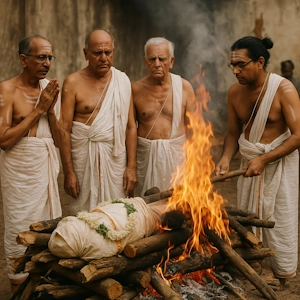
This is a bit deep concept.
You may have to listen to this a few times to understand it fully.
But if you understand this, your complete perspective can change about everything.
This is about generations.
The thread that runs through generations.
Because of which, period of impurity is observed at birth and death,
and shraadha is performed for forefathers.
This will also explain what exactly is pitru runa.
We will have to start with Ayurveda.
The physical body is made up of seven dhatus or seven tissues.
When we take food, the useful part of it becomes the primary tissue of the body called rasa.
Then rasa refines into blood,
blood further refines into flesh,
flesh further refines into fat,
fat further refines into bone,
bone further refines into marrow,
marrow further refines into semen.
You may come across a different sequence also starting with bone.
This is because they are not exactly top-down processes. They happen simultaneously.
These seven tissues are present in every cell of the body in different proportions.
That means a marrow cell will have maximum of marrow dhatu and less of the other six.
But the most refined dhatu of the body is semen.
That is why it has got the power and potential to procreate.
The very purpose of the tissue semen in the body is to procreate.
And according to the Vedas,
a progeny is born not from just the reproductive organ.
A progeny is born from the whole body — angad angad.
The semen carries the essence of the whole body.
What is the role of the ovum?
Ovum is the field in which the seed is sown, upon which it grows.
The content of semen is soma.
You can directly connect the color of semen and color of the moon.
At any given point of time, the semen or shukra in a male's body has got 84 parts.
I am not talking about the fluid called semen.
I am talking about the dhatu called shukra, which is present in every cell.
The fluid semen is just a derivative of this dhatu called semen.
Out of these 84 parts, 28 are what he has acquired through food, as explained before.
The soma tatwa in his shukra — 28 out of 84 parts — are self-acquired through food within the first sixteen years of his life.
The remaining 56 parts are inherited from his predecessors — his forefathers.
He inherits 21 parts from his father.
You should keep in mind that his whole body has developed out of a single sperm cell of his father.
That single sperm cell contains these 56 parts of soma:
-
21 parts from the father
-
15 from grandfather
-
10 from great-grandfather
-
6 from his father
-
3 from his father
-
1 from his father
These are the six generations before him.
Including him, there are seven generations.
That means his body contains the essence of all those six before him — in that proportion.
Since his body developed out of a single sperm cell which had the soma kalas in these proportions,
his body contains:
-
21 out of 84 from his father
-
15 from his grandfather
-
Like that, 1 out of 84 from the sixth forefather before him
28 parts are self-acquired.
Now he wants to beget a progeny.
When he fertilizes his wife's ovum,
in that single sperm cell which will fertilize that ovum,
he will pass on:
-
21 out of 28 of his self-acquired soma kalas, retaining seven with him
-
15 out of the 21 parts inherited from his father, retaining six with him
-
10 out of the 15 parts of the kalas he inherited from his grandfather, retaining five with him
-
6 parts out of 10 inherited from his great-grandfather, retaining four with him
-
3 out of the six parts he inherited from great-grandfather's father, retaining three with him
-
1 out of the three parts inherited from the great-grandfather's grandfather, retaining two parts with him
At this point, the connection with the forefather who is the sixth generation above is cut.
There is a rule about this passing on of soma kalas:
You cannot pass on everything — you always have to retain some and pass on some.
From the sixth generation forefather above, he has inherited only 1 kala, 1 part — so that he cannot pass on.
When a son is born, the connection with the forefather who is six generations above is cut off.
Now we will see how much he has passed on to his son:
21 of his own + 15 + 10 + 6 + 3 + 1 = 56 parts.
Now the remaining 28, the son has to self-acquire through food.
How much is he retaining with him?
7 + 6 + 5 + 4 + 3 + 2 + 1 = 28 parts.
Out of the total of 84, he has passed on 56 to his son and retains 28 with him.
This thread will again run down six generations in the same way.
So you can say:
21 out of 84 parts of your body is your father.
15 out of 84 parts of your body is your grandfather's.
Like that, for the previous generations also.
Only 28 out of 84 parts is your own.
So when the grandfather dies,
15 out of 84 parts of your body inherited from him also suffers the impurity of separation.
When you are born, you have acquired 56 parts from your earlier generations — this is a debt.
How do you get rid of that debt?
By passing them on to your son.
This is repayment of pitru runa.
And those 21 parts that you still retain,
they go back and dissolve into the forefathers at the time of your demise — completely repaying what you have got from them.
Now do you understand why shraadha should be done?
Because your forefathers still live through your own body.
There is another reason for doing shraadha, which I have explained before.





English
Rituals
Click on any topic to open
7
30
Astrology
Bhagavad Gita
Bhagavatam
Bharat Matha
Devi
Devi Mahatmyam
Ganapathy
Garuda Puranam
Glory of Venkatesha
Hanuman
Kathopanishad
Mahabharatam
Mantra Shastra
Mystique
Practical Wisdom
Purana Stories
Radhe Radhe
Ramayana
Rare Topics
Rigveda Explained
Rituals
Sages and Saints
Shiva
Spiritual books
Sri Suktam
Story of Sri Yantra
Temples
Vedas
Vishnu Sahasranama
Yoga Vasishta
26
17
10
0


