Why Special Procedure Is Followed in Yajnas
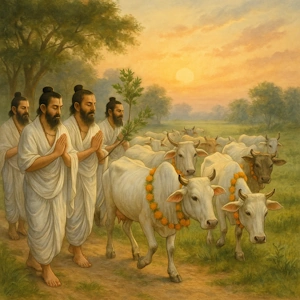
The first anuvaka of Krishna Yajurveda or the first set of mantras in Shukla Yajurveda — we have already seen the meaning in detail.
The context is:
For the yaga that is to take place on the next day, Indra has to be offered curd.
For this, cows should be milked in the evening.
They are being sent away for grazing.
The calves are separated from the cows so that they don’t drink away all the milk.
Here we saw several steps.
The branch of the palasha tree with which the calves are to be driven away — that is addressed with mantra.
The calves are addressed with mantras saying that they are Vayu Deva himself.
The cows are told to go graze and produce milk for the noblest of karmas that is going to take place.
For this, Lord Savita should give them prerana.
The cows are also praised with several terms — urajasvatee, payasvatee, prajaavatee.
Prayer is also done for their safety as they proceed for grazing.
Even on a daily basis, these cows must be going for grazing.
Are all these steps done even then?
No.
This is only when it is meant for yajna, which will take place tomorrow.
These are all samskaras.
What happens in a yajna?
Something is offered to Devata.
Here, Indra — next day, curd will be offered to him.
Indra, as a Devata, is part of Parameshwara, Paramatma, Parabrahma.
So you are not milking the cows for making coffee or tea for someone.
The usage when you are going to make coffee is worldly.
Here, it is going to be used in yajna — hence, it is divine.
How do you distinguish between the two?
By keeping separate norms.
How do you distinguish between a minister and a common man?
A minister will have police around him.
You can’t just go and talk to him like that.
You have to take an appointment.
Someone will check whether it is essential or not.
This is how you distinguish between the common and the special.
Here, the procedure of sending them for grazing is special, and also there are mantras involved — making it more divine.
These are called samskaras.
Making something samskrita — special, more refined, more purified.
We also do this.
If there is an important guest, we are more careful about what we serve them.
Even in the case of children, we are like that.
Here, in yajna, the guests are Gods — divinities.
So we follow a special procedure even for stuff as routine as grazing, milking, driving the calves away with a stick.
In Gokula, whenever the gopikas were expecting Lord Krishna — that he would come and have butter, milk —
they used to take special care of the cows.
They used to give them the best of grass —
and even special sweets for the cows.
If Krishna was expected tomorrow, they would do all these today.
They would worship the cows and calves today.
Adorn them with special clothes and ornaments — with bhakti.
It is not a regular day.
It is not regular milking.
Tomorrow Krishna is going to come.
The milk should be of special quality.
The butter should be of special quality.
Not only physical quality — it should contain the essence of bhakti.
So that he can feel it — he can recognize it.
For that, they worshipped the cows and calves with bhakti —
so that bhakti goes into that milk, into that butter.
This is what is being done in yajnas also.
The various samskaras of materials used — even vessels are addressed with mantras, praised with mantras.
The bhava and the power of mantras — both are important.
The respect for cows on a normal day is different.
This is special.
Driving away cows with a normal stick on a normal day is different.
Here, this is special — with both bhava and mantras also.
And a lot of learning also goes behind it.
If the branch is defective — what happens?
If it is without leaves — what happens?
With a dry tip — what happens?
So even when getting that branch, tearing it from a tree — there is a whole lot of thought process going on
within the adhvaryu — the priest who is doing it.
These are what would make the procedure and results special —
the context, the knowledge, the bhava, the mantras, and of course, the divine will.





English
Vedas
Click on any topic to open
7
30
Astrology
Bhagavad Gita
Bhagavatam
Bharat Matha
Devi
Devi Mahatmyam
Ganapathy
Garuda Puranam
Glory of Venkatesha
Hanuman
Kathopanishad
Mahabharatam
Mantra Shastra
Mystique
Practical Wisdom
Purana Stories
Radhe Radhe
Ramayana
Rare Topics
Rigveda Explained
Rituals
Sages and Saints
Shiva
Spiritual books
Sri Suktam
Story of Sri Yantra
Temples
Vedas
Vishnu Sahasranama
Yoga Vasishta
26
17
10
0


