Why Is Ganesh Visarjan More Celebrated Than His Arrival?
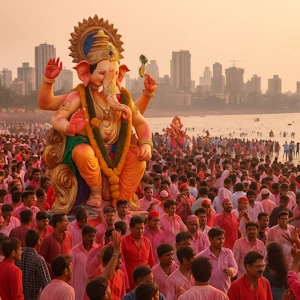
Ganesha Chaturthi or Vinayaka Chaturthi of Bhadrapada Masa is very important.
It is on this day that the ten-day-long Ganesha festival starts. Parthiva Ganesha Pujanam starts on this day.
Parthiva means idol made of prithvi, clay. So, the name itself implies that the idol should be made of clay. It is not a concept brought by nature lovers. It is originally meant that way only.
Commercialisation of everything, including religion and spirituality, has brought in so many changes.
Ganesha festival has particular significance in Maharashtra.
Ganesha Chaturthi or Parthiva Ganesha Pujan used to be a private household celebration.
In the year 1893, the nationalist leader, great Lokmanya Bal Gangadhar Tilak, turned it into a community festival, a social festival.
There is also evidence that Ganesha festival was originally started by Chhatrapati Shivaji Maharaj to promote patriotism and culture. Even if that is the case, Lokmanya Tilak was instrumental in its revival.
Why Ganesha? Because then, Lord Ganesha was every man's god. When the caste system was prevalent and strong, Lord Ganesha was worshiped by all. All strata of the society — upper caste, lower caste, rich, poor, scholar, common man, leader, follower — they all liked and worshiped Lord Ganesha alike.
So, celebrating Ganesha festival was a good method to bridge the gap between them.
The Lord is brought home on the day of Chaturthi and worshiped for ten days. He goes back on Ananta Chaturdashi.
The idol is carried to the sea or a nearby water source and immersed. This is called visarjan.
So, there are two things here — sarjan and visarjan.
Sarjan is when the idol and the whole set-up is created — during Chaturthi.
Then vi-sarjan — its elimination after ten days.
These days, as a matter of convenience, the ten-day festival is often cut short to a lesser number of days.
There is something very puzzling about Ganesha festival.
People celebrate sending away of the Lord more than bringing Him home.
During visarjan, there will be drum beats, singing, dancing, colours — not so much when the Lord comes home.
It is like the priest comes and performs prana pratishtha, like a typical puja, wherein everybody is well-behaved, silent — but singing and dancing at the time of visarjan.
You will be surprised to see this.
People have come out with so many explanations for this.
They are singing and dancing because He will come back again next year. They are showing that — we are so happy to have served You. Come back again fast. Good display of emotion — agreed.
Some cynics also say — they are happy because after a few days of restricted living, back to normal life.
These can’t be the reason.
Originally, if you see, the scriptures don’t talk about any such celebration at the time of visarjan.
But then, who are behind this?
Chhatrapati Shivaji Maharaj, Bal Gangadhar Tilak — great visionaries.
What are they trying to convey, teach?
Let’s see.
Sarjan and visarjan — creation, sustenance, and elimination.
This is what happens to everything.
Lord Ganesha is telling us. He is giving us this knowledge.
Anything that is created — it has to go after some time.
Whatever Brahma creates, Vishnu protects for some time, and then Shiva comes and eliminates.
This is inevitable.
Whatever you see around you — they are not permanent. They will go. They will have to go.
House, vehicle — everything.
Buy a new car — the government will not allow you to run it after 15 years or 20 years, whatever. So, don’t get attached to it.
A building, a house has a life — thirty years, fifty years. After that, you will have to demolish.
So, Lord Ganesha is teaching us — everything, including my own idol, will have to go at some point of time.
Celebrate this knowledge that you have acquired. Celebrate this freedom from attachment that you have acquired.
Ganesha Atharva Sheersha is one of the most heard mantras during Ganesha festival.
When the Lord is with us for these few days, as a living presence at home or in the neighbourhood, He teaches so many things — so many things — provided you are ready to listen.
त्वमेव प्रत्यक्षं तत्त्वमसि
Tat — that — the truth, the ultimate truth, the supreme truth — is You, Lord Ganesha.
The Vedantic principle of तत्त्वमसि — that whatever truth you are searching for is You yourself, I myself.
This entire creation is divinity itself. Every man is divine. Every woman is divine. Every plant is divine. Every animal is divine. Every mountain is divine. Every river is divine.
There is nothing other than divinity anywhere.
And Lord Ganesha’s very form conveys this principle to us. That man himself is God. God is not different from man.
This the Lord teaches us.
He says — even when this idol of mine is gone, I will still be with you — all around you, in every being around you.
When you will realize — त्वमेव सर्वं खल्विदं ब्रह्मासि — सर्वं खल्विदं ब्रह्म
Aren’t all these supreme truth itself?
This is why our Vedas tell us — worship plants, worship rivers, worship Mother Earth. These are who divinities are. Worship sun, worship clouds.
Our saints say — Nara Seva Narayana Seva.
This is what the Lord teaches us during His stay with us.
He teaches that even when you immerse my idol in water — I am not going anywhere. I am still with you.
And this idol is just following a principle of nature — whatever is created is eliminated after some time.
But this knowledge that the Lord gives us — is permanent.
Lord says —
Celebrate this knowledge that you have acquired.
Celebrate this freedom that you have acquired having learned.
Sing, dance to the beats of drums, throw colours around.
I am not going anywhere. I am always with you.





English
Rare Topics
Click on any topic to open
7
30
Astrology
Bhagavad Gita
Bhagavatam
Bharat Matha
Devi
Devi Mahatmyam
Ganapathy
Garuda Puranam
Glory of Venkatesha
Hanuman
Kathopanishad
Mahabharatam
Mantra Shastra
Mystique
Practical Wisdom
Purana Stories
Radhe Radhe
Ramayana
Rare Topics
Rigveda Explained
Rituals
Sages and Saints
Shiva
Spiritual books
Sri Suktam
Story of Sri Yantra
Temples
Vedas
Vishnu Sahasranama
Yoga Vasishta
26
17
10
0


