Why Earth is Called Prithvi
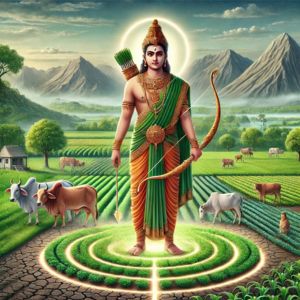
King Prithu ruled the earth well. Due to his righteous rule, the earth prospered. Cows gave milk. The happy sages performed a great sacrifice. At the end of the sacrifice, two groups called 'Sutas' and 'Magadhas' emerged. The sages instructed them to sing the praises of Prithu. But they asked, 'Prithu is very young. He has just started ruling. He has not yet done any great deeds. How can we praise him?'
The sages granted them the power to see the future. Immediately, the Sutas and Magadhas sang the future glories of Prithu. These songs spread in all directions. Meanwhile, some people came to Prithu from a distant land. They said, 'O King! Your fame is spreading everywhere. But we are suffering. Nothing grows on earth. Due to lack of fertility, cows do not give milk. What should we do?'
Hearing this, Prithu became very angry. He took his bow and set out to split the earth. The earth, frightened, took the form of a cow and ran. She roamed everywhere but found no place to hide. Finally, she stood before Prithu and pleaded, 'O King! Killing me, a female, will bring you no benefit. Only sin will remain. Instead, make the earth even. Push the mountains aside. Agriculture on flat land will bring you the needed wealth.'
Prithu listened to her. He pushed the mountains aside and made the land flat. Agriculture flourished. The earth prospered. The name 'Prithvi' for the earth comes from King Prithu, who made the land suitable for living beings.
Learnings -
- Just Rulers: A fair ruler ensures prosperity and happiness for all.
- Future Vision: True leaders are known for both present actions and future potential.
- Determined Action: Determined efforts, like Prithu's, overcome tough challenges.
- Compassion Over Violence: Understanding and wisdom lead to better outcomes than violence.
- Respect for Nature: The earth is a living entity, deserving respect and protection.
- Importance of Agriculture: Agriculture is the foundation of prosperity, sustaining all life.
- The story begins by stating that under Prithu's righteous rule the earth prospered and cows gave milk, yet later, people from a distant land complain of barrenness and dry cows. What deeper principle of leadership does this contradiction highlight?
This contradiction highlights the difference between localized success and universal responsibility. A true leader's duty extends beyond their immediate surroundings. Prithu's initial success was limited to his direct domain, but the arrival of the distant sufferers taught him that a sovereign's duty is incomplete until prosperity reaches the most marginalized and distant parts of his realm. - Why did the sages grant the Sutas and Magadhas the power to sing of Prithu's future glories rather than waiting for him to achieve them?
Praising future glories acts as a powerful psychological tool for leadership. It establishes a grand vision and a high moral standard that the young king must strive to fulfill. Instead of relying on past laurels, it binds the ruler to a self-fulfilling prophecy of greatness, ensuring his continuous commitment to the welfare of his people. - When faced with the earth's barrenness, Prithu's first instinct was to take up his bow to split the earth. What does this initial reaction symbolize about human nature and problem-solving?
Prithu's instinct to use weapons symbolizes the human tendency to use force, aggression, and exploitation to extract resources from nature when faced with scarcity. It represents a primitive, conqueror mindset that views nature as an adversary to be defeated rather than a partner to be understood and nurtured. - The earth transformed into a cow rather than a fierce beast to flee from Prithu. What is the hidden significance of this specific form?
The cow is a universal symbol of selfless nourishment, motherhood, and innocence. By taking this form, the earth subtly reminded Prithu of her true nature as a provider, not an enemy. It shifted the dynamic from a warrior fighting an opponent to a guardian who must protect and care for a life-giving mother, steering him from violence toward stewardship. - The earth reasons with Prithu, warning that killing her would bring sin and no benefit. What profound ecological principle is hidden in her plea?
Her plea embodies the principle of sustainable development and the disastrous consequences of ecological destruction. Killing the earth represents the total depletion of natural resources, which ultimately destroys humanity itself. The earth teaches that humanity cannot survive by destroying its host; true wealth comes from working in harmony with nature's laws. - Prithu is credited with pushing mountains aside to make the land flat for agriculture. What does this act represent in the broader context of human civilization?
Pushing mountains aside is a metaphor for the dawn of human civilization, engineering, and organized agriculture. It represents the transition from nomadic hunter-gatherer societies, which were at the mercy of wild, uneven terrains, to settled agrarian societies. It is the taming of chaotic landscapes to create structured, life-sustaining environments. - How does the resolution between Prithu and the earth redefine the concept of a powerful ruler?
Traditionally, a ruler's power is measured by his ability to conquer and destroy his enemies. However, this story redefines true power as the capacity to listen, adapt, and show compassion. Prithu's greatness is cemented not when he raises his bow, but when he lowers it, choosing wisdom and constructive labor over destructive dominance. - The earth came to be known as Prithvi, derived from King Prithu. What deeper relationship between humanity and the planet does this naming signify?
Naming the earth after a human king signifies a bond of guardianship and familial responsibility. In ancient traditions, the earth is seen as the daughter of Prithu because he nurtured and organized her, just as a parent does for a child. It implies that humanity is not just a guest on earth, but an active caretaker responsible for her well-being and fertility. - The sages organized the sacrifice and directed the Sutas and Magadhas, yet they did not solve the earth's barrenness themselves. What does this suggest about the division of duties in a well-functioning society?
It illustrates the ancient division between spiritual guidance and executive action. The sages provided moral direction, foresight, and spiritual foundation, but they left the physical execution and governance to the ruler. It emphasizes that while wisdom and vision are essential, tangible worldly problems require the determined, hands-on action of a capable leader. - Looking at the entire narrative, what is the ultimate hidden message about how continuous prosperity is achieved?
The hidden message is that prosperity is not a static state granted by righteousness alone, but a continuous cycle of effort, innovation, and ecological balance. Initial prosperity was not enough to sustain everyone. It was expanded only when the king actively reformed the land through agriculture and established a sustainable relationship with the earth. Prosperity demands constant, mindful collaboration between human effort and natural resources.





English
Purana Stories
Click on any topic to open
7
30
Astrology
Bhagavad Gita
Bhagavatam
Bharat Matha
Devi
Devi Mahatmyam
Ganapathy
Garuda Puranam
Glory of Venkatesha
Hanuman
Kathopanishad
Mahabharatam
Mantra Shastra
Mystique
Practical Wisdom
Purana Stories
Radhe Radhe
Ramayana
Rare Topics
Rigveda Explained
Rituals
Sages and Saints
Shiva
Spiritual books
Sri Suktam
Story of Sri Yantra
Temples
Vedas
Vishnu Sahasranama
Yoga Vasishta
26
17
10
0


