Why Do We Offer Milk to the Shiva Lingam?
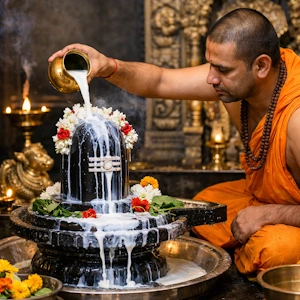
This is one of the most visually striking rituals in Sanatana Dharma. A black stone. A continuous stream of white milk. Let us go deep into what this actually means.
1. First Understand the Context
The Shiva lingam is not just a stone idol. It represents the formless, infinite reality of existence. Shiva himself is not a god in the simple storybook sense. He is the force behind creation, destruction, and the cycle of all life.
The lingam is the axis of existence. It has no beginning and no end. Pouring something over it is not decoration. It is communication.
2. Why Milk Specifically?
Milk is the first substance a living being receives in this world. Before food, before taste, before memory, there is milk. It comes from a mother without being asked for. It sustains life without conditions.
In Vedic thinking, milk represents Sattva. This is the quality of purity, clarity, and calm. It is the most Sattvic substance a human being can offer.
When you pour milk over the Shiva lingam, you are offering the purest thing you know to the purest reality you can imagine.
3. Shiva and Heat
Now look at the deeper point here. Shiva holds tremendous energy. In yogic tradition, he is described as pure consciousness in an extremely concentrated form. This energy generates heat, called Tapas.
Milk has a natural cooling property. It soothes, it calms, it reduces heat.
Pouring milk over the lingam symbolizes cooling the intense cosmic energy of Shiva. You are balancing the fire of pure awareness with the softness of pure nourishment.
This is not mythology. This is a description of inner states. Intense meditation generates heat in the body and mind. The offering of something cool and pure brings balance.
4. The Act of Giving Without Holding Back
Here is what this means on a personal level. Milk was once the most precious thing a family had. In ancient India, a cow was not just an animal. The milk she gave kept children alive. Offering milk to Shiva was offering something genuinely costly.
The ritual asks you to give your most valuable thing freely, without expectation of return.
This trains the mind in one of Shiva's core teachings. Attachment to things causes suffering. Offering them willingly loosens that grip.
5. The Science of Abhishekam
The ritual of pouring liquids over the lingam is called Abhishekam. Different liquids are used. Water, milk, honey, curd, ghee. Each one carries a different meaning and a different effect.
Milk specifically purifies the mind of the devotee. The act of slowly, steadily pouring milk requires stillness. Your hands must be calm. Your mind must be present. The ritual itself becomes a meditation.
The lingam absorbs the offering. Nothing is wasted. The milk runs down and is collected. In many temples it is later distributed. The energy of the offering returns to the people.
6. The Deeper Symbolic Picture
There is another important detail. The lingam represents consciousness. The Yoni base it sits in represents nature, or Prakriti. When milk flows over the lingam and into the Yoni base, it represents consciousness meeting and nourishing the material world.
This is the union of awareness and life. Pure consciousness does not exist apart from the world. It flows into the world, nourishes it, and the world carries it forward.
The milk is the bridge between the two.
7. What Happens Inside the Devotee
When a person pours milk with full attention and a quiet heart, something real happens inside them. The mind slows down. The nervous system calms. The ego steps back because the act is entirely about giving, not receiving.
Shiva is not hungry for your milk. The ritual is not for him. It is for you. It restructures your inner state from grasping to releasing. From needing to offering.
This is why the ritual has lasted thousands of years. It works.
The Final Takeaway
The deepest reason we offer milk to the Shiva lingam is this. We are practicing the act of giving pure things to the infinite without asking for anything back. The milk represents our finest inner quality. The lingam represents the ground of all existence. The pouring represents surrender.
You are not feeding a stone. You are training yourself to live without clinging.
That is Shiva's real teaching. And milk is how we begin to understand it.
- Why does Shiva need cooling at all? Is he not all-powerful?
Shiva is not a being who gets angry or tired. The cooling is not about managing his emotions. In yogic understanding, pure concentrated consciousness generates an energy that is so intense it can dissolve everything around it. This is not a flaw. It is the nature of absolute awareness. Just as the sun does not intend to burn you but its nature produces heat, Shiva's pure state produces a kind of cosmic intensity. Milk represents the human offering of softness, care, and nourishment directed toward that intensity. It is the devotee saying: I bring gentleness to meet your power. The balance this creates is not for Shiva. It is a model for how a human being should meet overwhelming reality. With softness, not force.
- Why is the lingam black or dark in most temples?
The color is not accidental. In Indian philosophical thought, black or darkness does not mean evil or negativity. It means the state before creation. Before light existed, before form existed, there was an undivided silent awareness. Black absorbs all colors and reflects none. It is the symbol of totality that has not yet expressed itself. The Shiva lingam being dark tells you that what you are worshipping is not a person, not a story, not a limited idea. You are facing the pre-creation state of existence itself. Pouring white milk over a black stone is visually the meeting of pure potential with pure nourishment.
- The lingam has no face, no hands, no expression. Why worship something formless?
Most religious symbols give God a face because the human mind finds it easier to connect with a face. But Shiva in his deepest form is beyond personality. He has no preferences, no moods, no agenda. The formless lingam teaches the devotee something radical. The highest reality cannot be contained in any image, story, or name. When you stand before a formless symbol and still feel devotion, you have trained your mind to connect with something beyond the visible. This is one of the most advanced spiritual exercises a person can do. The milk offering helps because the act of pouring gives the mind something to do while the heart connects with something it cannot see or define.
- What does milk represent about the devotee's inner state when it is offered?
Milk in its natural state is warm, white, and nourishing. It does not discriminate. It does not choose whom to feed. In this sense it carries the quality of unconditional care. When a devotee pours milk, they are symbolically pouring their own capacity for unconditional love and nourishment toward the infinite. The act asks you to check your inner state. Are you offering because you want something in return? Or are you offering simply because the act of giving is itself the point? If you are offering with expectation, you are giving conditionally. Milk given conditionally is no longer symbolic of its true nature. The ritual trains you to give fully, the way milk naturally flows.
- Is there a connection between the milk offering and the ancient understanding of the universe?
Yes, and it is a profound one. In Vedic cosmology, the universe itself was described as emerging from an ocean of milk. This is the story of the churning of the cosmic ocean. Milk was seen as the primordial substance of creation. Dense, white, full of life-giving fat and protein. When ancient thinkers looked for a metaphor for the raw material of existence, they chose milk. Pouring milk over the lingam is therefore not just a local ritual. It is a reenactment of the cosmic story. The formless consciousness of Shiva receiving the primordial substance of creation. Creation itself being offered back to its source. This loop of offering and receiving mirrors how the universe works. Energy is never lost. It returns to its origin.
- Why do some advanced practitioners say that external rituals like this are unnecessary?
This objection actually comes from within the tradition itself. Many yogis and teachers, including Shiva's own teachings in the Vigyan Bhairav Tantra, say that the highest form of worship is pure awareness with no ritual at all. The external ritual is a training tool. It is designed for minds that are not yet still enough to sit in pure awareness. Think of it like this. A child learning mathematics uses physical objects to count. Later the objects are no longer needed. The ritual of milk offering is the physical object stage of spiritual development. Once the devotee truly understands what the ritual points to, the inner offering of pure attention and surrender becomes far more powerful than any liquid poured over any stone. The external and internal are not opposites. One leads to the other.
- What is the secret behind doing Abhishekam continuously, without stopping?
The unbroken stream of milk is itself the teaching. Life is a continuous flow. Consciousness does not stop between thoughts. The breath does not pause permanently. Creation does not take breaks. The unbroken flow of milk over the lingam is a physical model of how awareness is meant to function. Not in bursts of devotion followed by long periods of forgetting. But as a constant, steady, quiet stream of attention toward the deepest reality. Many temples have the Abhishekam running for hours. Devotees who sit and watch it without distraction are unknowingly doing a deep meditation on continuity. This is the hidden benefit of the ritual. It teaches the nervous system what sustained, unbroken awareness feels like.
- Why do different substances have different days assigned for Abhishekam? What is the principle behind this?
Each substance carries a specific energetic quality. Water purifies and represents clarity of mind. Milk builds inner calm and devotion. Honey attracts sweetness into life and sweetens the temperament of the devotee. Curd represents transformation, since milk becomes curd through a living process. Ghee represents the refined essence after all impurities are removed. The day assignments are not random. They are calibrated to what the devotee needs to cultivate across the week. Monday is traditionally Shiva's day and milk is used because the beginning of the cycle calls for purity and calm. The deeper secret here is that the substances are maps of inner states. You are not feeding the lingam these things. You are reminding yourself of what quality you need to develop, and the ritual imprints that intention through physical action.
- What is the rarely discussed connection between Shiva, milk, and the human body?
The human body itself produces fluids that are sacred in different traditions. Mothers produce milk. This is not just biology. It is the body expressing the Sattvic, unconditionally nourishing principle that the ritual points to. Shiva in his complete form includes the feminine principle called Shakti. Without Shakti, Shiva is inert. Without Shiva, Shakti has no direction. The milk offering is also a reminder of this union. The white fluid of nourishment flowing over the symbol of pure consciousness is the meeting of these two forces in miniature. Your own body contains both principles. The ritual is asking you to recognize that within yourself. This is rarely spoken about in common explanations of the ritual but it is one of the deepest layers of its meaning.
- What happens to a person over years of this practice, if done with genuine understanding?
The ritual, done with understanding and not just habit, gradually dismantles the habit of clinging. Every time you offer something precious without asking for a return, the mind records that experience. Over years, this practice builds a very specific quality in a person. The ability to engage fully with life without needing life to always give back what you put in. This quality is at the heart of what the tradition calls inner freedom. Not freedom from the world, but freedom within it. The milk offering is the kindergarten class of this enormous lesson. But done every day with awareness, it becomes one of the most powerful psychological and spiritual tools ever designed. The secret is not in the milk. The secret is in the repeated training of the hand that pours without holding back.
Objection 1: Pouring milk over a stone is wasteful, especially when people are hungry.
This is a fair and serious concern. The reply is not defensive. In most traditional temples the milk used in Abhishekam is not discarded. It is collected and distributed as Prasad to those present. The quantity used is also measured. However, the deeper reply is this. The ritual is a training for the inner life. A person who genuinely practices giving without clinging is far more likely to give food to the poor than a person who has never practiced generosity in any form. Ritual and social responsibility are not enemies. The ritual is the training ground. Social action is where that training is expressed. The problem arises only when the ritual is done mechanically without understanding its purpose.
Objection 2: A stone cannot receive milk or care. This is primitive thinking.
The stone does not receive the milk in the way a hungry person receives food. This is not the point and it never was. The ritual is directed inward. The stone is a focal point, not a consumer. When a person meditates using a candle flame as their focus, no one argues that the candle is receiving your attention. The candle gives the mind something stable to rest on. The lingam does the same. The milk giving trains your capacity for unconditional offering. The stone is the mirror. You are the one being shaped by the act. Calling this primitive misunderstands what the ritual is engineering.
Objection 3: These rituals were invented by priests to control people and collect resources.
It is true that rituals have been misused historically in every tradition across the world. That misuse does not invalidate the original design. The principles behind the milk offering, the training in surrender, the cooling of ego intensity, the practice of giving, these stand independent of any institution. A hammer can be used to build a home or used as a weapon. The hammer itself is not the problem. If a ritual is used to exploit people, that is a failure of the people running it, not a failure of the idea the ritual encodes. Evaluate the principle on its own merit.
Objection 4: Science does not support the idea that pouring milk on a stone does anything spiritually.
Science measures physical phenomena. The spiritual claims of this ritual are not about the stone changing chemically. They are about the human nervous system, the human habit structure, and the human capacity for attention being trained through repeated physical action. Behavioral science fully supports the idea that physical rituals shape inner states. Athletes use repeated physical routines to build mental focus. Surgeons use preparation rituals to reduce anxiety before operations. The milk offering is a precision instrument for training the mind through the body. Science does not need to validate the cosmic claims to recognize the psychological mechanics at work.
Objection 5: Why Shiva? Why not simply meditate or do something more rational?
Meditation without any anchor is extremely difficult for most people, especially beginners. The human mind needs something concrete to begin with before it can work with the abstract. Shiva as a concept represents the deepest impersonal awareness. The lingam as a symbol represents formless infinity. The ritual gives the mind a physical entry point into a very abstract truth. You begin with pouring milk. You end with understanding formlessness. The path is the point. For people who can sit in pure awareness without any ritual support, the tradition itself says go ahead and do that. The ritual is for those who need the bridge.
Objection 6: Different religions offer prayers without physical offerings. Why do Hindus need physical substances like milk?
Different traditions are designed for different kinds of minds and different stages of development. Verbal prayer works through sound and intention. Physical offerings work through the body, the hands, the senses. Not every person connects deeply through words alone. Some people need to use their hands, their eyes, their physical presence to feel fully engaged. The milk offering engages the entire body in the act of giving. There is nothing primitive about involving the physical senses in spiritual practice. In fact, making the body participate in the teaching is a far more complete training than mental prayer alone.
Objection 7: The lingam is a fertility symbol. Worshipping it is obscene.
This interpretation became popular through certain colonial-era writings that imposed a narrow reading onto a symbol they did not study in depth. The lingam in its full philosophical context is the axis of existence, the pillar of consciousness that holds the universe together. It predates fertility cult interpretations by thousands of years in terms of the philosophical literature surrounding it. Even if one accepts a creative or generative dimension to the symbol, creation itself is not obscene. The shame around this objection comes from outside the tradition. Within the tradition the symbol was never considered inappropriate. It was considered the most complete representation of the cosmic reality available to the human eye.
Objection 8: You are worshipping a created object. The creator cannot be a stone made by human hands.
The tradition agrees with this objection completely. The stone is not the creator. The stone is a pointer toward the uncreated. Just as a signpost pointing to a city is not the city itself, the lingam is not Shiva himself. It is a tool that points the mind in a direction it cannot otherwise face. Pure formless awareness has no address, no image, no name. The stone gives the mind a place to stand while it tries to grasp something fundamentally ungraspable. Over time the practitioner is meant to move beyond the stone entirely. The stone is the training wheel. The destination is the open sky of pure awareness.
Objection 9: These rituals create blind faith and prevent rational thinking.
Rituals done without understanding do create blind habit. That is a real problem and teachers within the tradition have criticized this for thousands of years. But the solution is not to abolish the ritual. The solution is to explain it fully, as we are doing here. A ritual understood deeply is an act of applied philosophy. Every step of the milk offering encodes a testable psychological principle. Give without clinging and observe what happens to your mind. Offer the purest thing you have and observe how your relationship with possession changes. These are not demands for blind faith. They are invitations to experiment with your own inner life.
Objection 10: If God is everywhere and all-knowing, why does he need rituals and offerings at all?
He does not. This is one of the most important things the tradition says about its own rituals. Shiva does not need your milk. The universe does not require your flowers or your prayers to keep functioning. The offering is entirely for the benefit of the one who offers. The ritual is a technology for human transformation, not a transaction with a deity. This is why the tradition says that a ritual done mechanically with no understanding is almost worthless, while even a small act done with full awareness and genuine surrender carries enormous weight. God, as understood in this tradition, is not improved by your offering. You are.





English
Shiva
Click on any topic to open
7
30
Astrology
Bhagavad Gita
Bhagavatam
Bharat Matha
Devi
Devi Mahatmyam
Ganapathy
Garuda Puranam
Glory of Venkatesha
Hanuman
Kathopanishad
Mahabharatam
Mantra Shastra
Mystique
Practical Wisdom
Purana Stories
Radhe Radhe
Ramayana
Rare Topics
Rigveda Explained
Rituals
Sages and Saints
Shiva
Spiritual books
Sri Suktam
Story of Sri Yantra
Temples
Vedas
Vishnu Sahasranama
Yoga Vasishta
26
17
10
0


