Why Do We Offer Food as Naivedya in Puja?
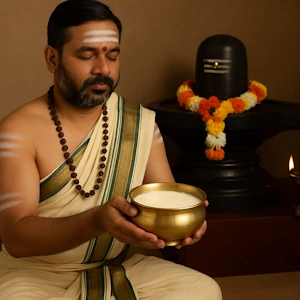
Why do we offer Naivedyam in puja?
Before we offer Naivedyam, we offer all the five Bhutas, the Pancha Bhutas:
Prithvi as chandana,
Jala as water itself for padya, arghya, achamaneeya, snana,
Agni as deepa,
Vayu as dhoopa, and
Akasha as flowers.
By symbolically offering all the five elements to divinity, we are saying that everything that I have, or I presume all that which are owned by me, I am offering to you.
Because all material objects are made up of the five elements.
Now Naivedyam. Why Naivedyam?
Isn’t that also made up of the five elements themselves?
Why offer Naivedyam then, separately?
Naivedyam stands for something else.
Naivedyam is invariably annam. Annam means everything that is edible — cooked or not cooked: rice, payasam, fruits, even drinks, milk, juice, panakam.
What is the significance of annam?
The five elements are at the level of the visible world — the world experienced through the senses.
But the universe is even beyond the visible world.
The whole world came out of Para Brahma.
A small part of Para Brahma only transformed itself into the visible world.
We have to express that we are recognizing this fact also.
Joining back all the material objects at our disposal with the Lord — by offering the five elements as jala, gandha, pushpa, dhoopa and deepa — we have done this.
Now we have to go beyond.
Upanishad says:
Annam Brahmeti Vyajanat
What is Brahma, Para Brahma? Annam — food.
How does your body come into existence, continue to exist?
It came into existence from the food that your mother consumed.
It continues to exist because of the food that you consume now.
So, if you consider your body as part of the physical world, then the cause behind it is food.
That’s why food is Brahma, Para Brahma.
Not food as a physical matter — the concept of creation, the theme of creation, which manifests through food — that is Para Brahma.
Because:
Annadyeva…
Asks the Upanishad — isn’t it from food that all the beings are born?
Without food, the world does not exist.
What about the non-living then? Like stone?
Where does stone come from? Doesn’t that also have a cause, a source, an origin?
Go on tracing back — that original source is Para Brahma, Paramatma.
But here, we are focusing on what is in our custody or possession, not the general concept.
We have bodies. We are living beings.
Source of the body is food.
So, for us, Para Brahma or Paramatma — the source of everything — is food.
For us, food is equivalent to Para Brahma, Paramatma.
That’s why we offer food to the Lord as a symbol of Para Brahma, Paramatma.
What happens when the body stops to exist?
It will become food for some other being.
Through that being, it will become food again.
Let’s say a snake dies. Its body decays under a coconut tree.
The tree would absorb the contents of the dead body of the snake and produce coconuts, which are again food.
At the time of Pralaya, everything goes back to Para Brahma.
And annam is a synonym of Para Brahma.
Annam prayanti, abhi samvishanti.
The Upanishad also says —
Prano Brahmeti, Mano Brahmeti, Vijnanam Brahmeti, Anandam Brahmeti
All these are Para Brahma only.
Nothing can be different from Para Brahma.
But in a physical puja, we can’t offer the mind or happiness to the Lord.
They are not tangible like food.
So we offer annam — food — as a symbol of Para Brahma.
If food is offered, then everything is offered — because annam stands for Para Brahma.





English
Shiva
Click on any topic to open
7
30
Astrology
Bhagavad Gita
Bhagavatam
Bharat Matha
Devi
Devi Mahatmyam
Ganapathy
Garuda Puranam
Glory of Venkatesha
Hanuman
Kathopanishad
Mahabharatam
Mantra Shastra
Mystique
Practical Wisdom
Purana Stories
Radhe Radhe
Ramayana
Rare Topics
Rigveda Explained
Rituals
Sages and Saints
Shiva
Spiritual books
Sri Suktam
Story of Sri Yantra
Temples
Vedas
Vishnu Sahasranama
Yoga Vasishta
26
17
10
0


