Why do We Offer Flowers to Bhagavan
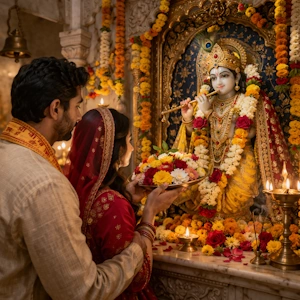
When you walk into a temple or sit before a home temple, you see flowers placed at the feet of the deity. Most people do it because they were taught to do it. But the tradition did not begin as a habit. It began as a precise understanding of what a flower is, what it represents at the level of existence, and what the act of offering it actually accomplishes.
What a flower is at its core
A flower is the final expression of a plant. The root draws water. The stem carries it. The leaves process sunlight. Everything the plant does across its entire life moves toward one outcome, which is the flower. The flower is not simply a part of the plant. It is the culmination of the entire plant's existence.
When you offer a flower, you are offering something that represents the complete effort of a living being. Not a leaf, not a branch, not a root. The most refined product of an entire life process.
Now go deeper — the five elements
The tradition recognises five elements as the building blocks of all existence. Earth, water, fire, air, and akasha. These are not simply physical substances. Each one is a level of existence arranged in order of subtlety.
Earth is the grossest. You can touch it, see it, smell it, taste it.
Water is subtler. You can touch it and taste it but cannot hold its shape.
Fire is subtler still. It has no fixed form.
Air is subtler than fire. You feel it but cannot see it.
Akasha is the subtlest of all five. It is the element of space itself. It is that within which everything else exists. It has no form, no weight, no resistance. It is pure expanse.
The Taittiriya Upanishad states directly that akasha arose first from Brahman. Everything else arose from akasha. It is the first and most fundamental manifestation of creation.
Why the flower represents akasha
Each element carries a specific quality perceived through a specific sense. The quality of akasha is not form, taste, heat, or touch. It is fragrance, perceived through the subtlest engagement of the senses.
Fragrance is the most subtle of all sense qualities. You cannot see it. You cannot touch it. You cannot locate exactly where it begins or ends. It simply pervades the space around it without occupying any fixed point. It fills the expanse without effort or resistance.
This is precisely the nature of akasha. Akasha does not occupy space. It is space. Fragrance does not occupy air. It permeates it invisibly and completely.
The flower, through its fragrance, is the carrier of the akasha tatwa. It is the one object in the physical world that can represent the most subtle element in a form that human hands can hold and offer.
The structure of Panchopachara worship
In Panchopachara, the five-fold worship, each of the five offerings corresponds to one of the five elements.
Gandha, fragrant paste or sandalwood, corresponds to earth.
Pushpa, the flower, corresponds to akasha.
Deepa, the lamp, corresponds to fire.
Jala offered corresponds to water.
Dhupa, incense, corresponds to air.
The five offerings together constitute a complete offering of all five elements. When you perform even a simple five-step worship, you are offering the entire manifest creation back to Bhagavan. Nothing is left out. The act is cosmically complete in miniature.
The problem akasha presents and how the flower solves it
Of the five elements, akasha is the one that cannot be physically handed over. You cannot cup space in your palms and place it at the deity's feet. It has no form to carry.
The flower solves this precisely. It carries akasha's quality, which is fragrance, in a form that can be physically offered. The flower is the body that makes the offering of akasha possible within the world of form. This is not a poetic workaround. It is a precise solution that the tradition arrived at through deep understanding of the relationship between the elements and the senses.
What the fragrance itself teaches
A flower releases fragrance without being asked. It gives without being pressed. The fragrance moves outward in all directions, without preference, without choosing who receives it.
This quality is worth sitting with during worship. You are not just placing an object at the deity's feet. You are placing something that embodies natural, effortless giving. The act of offering is meant to orient your inner state toward that same quality. Akasha does not withhold itself from any part of creation. The flower, in its fragrance, demonstrates that same unconditional pervasion.
What Bhagavan actually needs
The texts are clear on this point. Bhagavan does not need your flower. He is described as completely full, without any lack, without any need. The Bhagavata Purana and the Vishnu Purana both state this directly.
What the offering does is work on you, not on him.
When you pick a flower, you are making a choice to bring something living, refined, and subtle and place it at a point beyond yourself. That act of choosing, carrying, and placing with awareness shifts something in the person performing it.
One detail that reveals everything
In several temple traditions, a flower that has already been smelled by the worshipper is not offered. You do not enjoy it first and give the remainder. You give it before you take anything from it for yourself.
This is not a hygiene rule. It is a statement about the direction of the act. The offering comes before your own enjoyment. The tradition is training a specific inner posture through a small outer act.
Now understand what this means in the context of akasha. Akasha is the ground of all existence. It is the first thing that arose from Brahman. Everything in creation, including you, exists within it. To offer akasha back to Bhagavan, before claiming anything for yourself, is to acknowledge at the most fundamental level that nothing you have or are exists independently of him.
What the worshipper is actually saying
The tradition designed worship so that even a person without any theoretical knowledge, performing the act correctly, would unknowingly be making a complete philosophical statement about the nature of reality.
The flower placed at Bhagavan's feet is saying this. I offer you akasha, the ground of all existence, which arose from you first. I offer it in its most refined form, through fragrance that permeates all space the way you permeate all creation. I offer it before I take anything for myself. And I offer it as the culmination of a living being's entire effort, because that is the only quality of offering this act deserves.
Bhagavan does not become greater when you place that flower. The space between you and him becomes smaller. That is the point of the act. The flower is the occasion. The movement toward him is what the tradition is actually after.
Question 1: Why is a flower considered the most complete offering a plant can provide?
Answer: A flower is the final expression of a plant's entire life cycle. While roots, stems, and leaves perform functional roles like drawing water or processing sunlight, the flower is the ultimate culmination and refined product of that collective effort. Offering it signifies giving the very best of a living being's existence.
Question 2: What is the significance of the five elements in the tradition of worship?
Answer: The five elements—earth, water, fire, air, and space—are seen as the fundamental building blocks of all existence. Each represents a different level of subtlety. Worship involving these elements is a symbolic way of offering the entire manifest universe back to its source.
Question 3: How does the flower specifically represent the element of Akasha or space?
Answer: Every element is linked to a sense. The quality of Akasha is fragrance. Just as space is all-pervading and has no fixed form, fragrance permeates the air invisibly and effortlessly. the flower acts as a physical vessel that carries this subtle quality of fragrance, making it a tangible representative of space.
Question 4: What is the mysterious secret behind the structure of the five-fold worship?
Answer: The secret lies in the correspondence between the offerings and the elements: fragrant paste for earth, flowers for space, a lamp for fire, food for water, and incense for air. Together, they form a cosmic miniature, ensuring that no part of creation is left out of the offering.
Question 5: Why can space not be offered directly, and how does the flower solve this?
Answer: Space is the subtlest element; it has no weight or form to be grasped by human hands. The flower provides a precise solution by housing the fragrance of space within a physical body, allowing a person to "hold" and offer the element of space at the feet of the divine.
Question 6: What hidden lesson does the nature of a flower's fragrance teach the worshipper?
Answer: A flower releases its scent without being asked and without choosing who receives it. This represents unconditional, effortless giving. By offering the flower, the worshipper is encouraged to align their own inner state with this quality of natural, unbiased generosity.
Question 7: If the divine is already full and lacks nothing, why is the offering made?
Answer: The offering is not for the benefit of the divine, but for the transformation of the worshipper. It shifts the practitioner's awareness, moving them from a state of self-interest to a state of refined focus and surrender, reducing the perceived distance between them and the infinite.
Question 8: What is the deeper principle behind the rule of not smelling a flower before offering it?
Answer: This is a training in priority and posture. By giving the fragrance before enjoying it oneself, the worshipper acknowledges that the source of all existence deserves the first and most refined portion. it breaks the habit of self-centered consumption.
Question 9: How does the flower represent the philosophical statement of the worshipper?
Answer: Placing the flower is a silent declaration that the worshipper recognizes the ground of all existence as something that originated from the divine. It is an admission that nothing exists independently and that everything is being returned to its rightful origin.
Question 10: What is the ultimate "unlooked for" goal of placing a flower at the deity's feet?
Answer: The goal is not the physical act itself, but the movement of the heart. The flower is merely the occasion or the "bridge." The true objective is to make the space between the individual and the divine smaller until it eventually disappears.
Objection 1: It is a waste of a living thing to pluck a flower just to let it wither at a statue.
Reply: The flower is the peak of the plant's life. Using it as a tool for spiritual focus gives its brief existence a higher purpose beyond biological decay, turning a natural process into a conscious act of gratitude and beauty.
Objection 2: God is everywhere, so why do I need to place a flower in a specific spot?
Reply: While the divine may be everywhere, the human mind is not focused everywhere. The act of placing a flower helps a wandering mind anchor itself in a single point of devotion, making the abstract concept of "everywhere" a tangible reality for the practitioner.
Objection 3: This is just a superstitious habit passed down through generations.
Reply: While many follow it as a habit, the tradition is built on a precise understanding of elements and senses. It is a "technology" of consciousness designed to link the physical world to the subtle layers of existence through deliberate action.
Objection 4: A flower doesn't actually contain "space" any more than a rock does.
Reply: Technically, everything contains space. However, the flower is unique because it expresses the specific quality of space—fragrance—in a way that our senses can interact with. It serves as a symbolic representative that our human psychology can grasp.
Objection 5: Why would a creator care about a tiny flower?
Reply: The texts confirm the creator does not need the flower. The act is about the human heart. Just as a parent values a child's drawing not for the paper's worth but for the love behind it, the offering is a medium for human growth.
Objection 6: Fragrance is just chemical molecules, not a "mystical element" of space.
Reply: Science describes the "how" (molecules), but the tradition describes the "experience" (the sense of pervading space). These are two different languages describing the same reality. The tradition uses the sense of smell to train the mind to perceive the subtlest aspects of life.
Objection 7: Not smelling the flower first seems like an unnecessary, rigid rule.
Reply: It is a psychological exercise. Most of human life is spent asking "what is in it for me?" This rule creates a small, daily window where the first thought is directed toward something greater than the self.
Objection 8: Offering food and fire is just a primitive way of trying to please a deity.
Reply: These are symbolic representations of the five elements. By offering fire, water, and earth, the worshipper is mentally releasing their "ownership" over the material world and acknowledging their place within the cosmic cycle.
Objection 9: People can be spiritual without doing these outer rituals.
Reply: True, but rituals are physical anchors for the mind. Just as a flag represents a nation, the flower represents the subtlety of the soul. It makes the internal journey visible and disciplined.
Objection 10: If the plant's effort goes into the flower, plucking it stops its natural cycle of seeding.
Reply: In traditional practice, flowers are often taken from plants grown specifically for this purpose or gathered after they have fully bloomed. The intention is to align the plant's natural peak with the human's peak of devotion, creating a harmony between nature and spirit.






English
Rituals
Click on any topic to open
7
30
Astrology
Bhagavad Gita
Bhagavatam
Bharat Matha
Devi
Devi Mahatmyam
Ganapathy
Garuda Puranam
Glory of Venkatesha
Hanuman
Kathopanishad
Mahabharatam
Mantra Shastra
Mystique
Practical Wisdom
Purana Stories
Radhe Radhe
Ramayana
Rare Topics
Rigveda Explained
Rituals
Sages and Saints
Shiva
Spiritual books
Sri Suktam
Story of Sri Yantra
Temples
Vedas
Vishnu Sahasranama
Yoga Vasishta
26
17
10
0


