Why Do We Observe Impurity After Death and Child Birth?
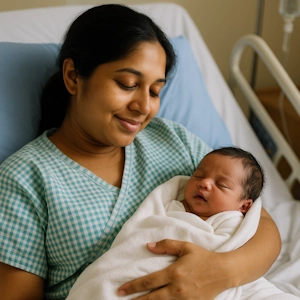
Why do we observe a period of impurity when there is a birth or a death?
What is the principle behind this?
We know we have a physical body, then the antaratma — the inner body consisting of mind, intelligence, thoughts, and emotions — then the core which is ever pure.
Impurity can occur in the physical body and the antaratma, never at the core which is ever pure.
When you take food, what happens?
A part of it is used up for the maintenance of the body.
The food digests and it will replenish all the cells that have died so far — cells of the bones, muscles, blood, marrow, skin.
They die continuously.
So new cells have to be produced.
Otherwise, the body will disappear in some time.
This is the reason we are taking food, also for energy.
But in that food itself, there is a part which is not good for the body.
That part is ejected from the body.
Body is intelligent.
Body will by itself throw out what is harmful for it.
You know if stool or urine is retained in the body for a long time, it will harm the body.
So, basically we can say:
The body will throw out on its own what could be harmful for it,
And retain what is good.
This is a process of separation.
Continuing to associate with something that is removed from the body is harmful for the body.
This we know very well.
That means wherever you see a separation, there is some impurity involved.
This is a clear inference.
Coming together or staying together or being together is good.
Separation is bad.
What happens at the time of a childbirth?
The child is separated from the mother's body.
If the child stays in the mother's womb beyond the period of pregnancy — say the delivery doesn't happen even after 11 months, 12 months — is it not harmful for the mother and the child?
So the mother's body knows when to eject the child out into the world.
Here also, there is a separation.
In fact, Ayurveda considers the ovum as a malam only.
It is either sent out at the end of the menstrual cycle or, if fertilized, at the end of pregnancy.
In either case, it is separated from the mother's body.
This separation is the impurity associated with birth.
Wherever you see a separation, there is impurity.
This will not apply in the case of purely material objects in which chetana is not there, life is not there.
What happens at death?
There is separation.
The life separates itself from the physical body.
Ejection of life from the body — impurity.
Not just these —
If you cut hair, there is an impurity, you have to take bath, because hair is removed from the body.
After you shave, after you clip nails, there is impurity.
In all these, there is separation.
During rituals, if you cut darbha grass or cut anything, you have to purify yourself.
This is universal — wherever there is separation, there is impurity.
When stool is separated from the body, you wash.
When urine is separated from the body, you are supposed to wash.
When sweat is separated from the body, you take bath or wipe it away.
Whenever the ejection happens, there is a period during which it still remains in the body — its effect, its influence.
After you clear your bowels, will you be able to come straight to the dining table and relish your food?
No, you need a little bit of time, during which you wash, wash your hands — 5 minutes —
Then when you feel pure again, you can have your food.
This impurity fades away over a period of time.
How long — this our sages knew.
So they fixed periods of impurity for various things — 1 day, 3 days, 10 days — depending on the gravity.
You should know —
If a miscarriage happens even prior to life coming into the body of the fetus, then the period of impurity is less.
At the time of childbirth, it is a full 10 days.
The list of don'ts also vary in the case of childbirth and death.
It's a very interesting subject.
We will also see why the relatives also have to observe a period of impurity — later.





English
Rituals
Click on any topic to open
7
30
Astrology
Bhagavad Gita
Bhagavatam
Bharat Matha
Devi
Devi Mahatmyam
Ganapathy
Garuda Puranam
Glory of Venkatesha
Hanuman
Kathopanishad
Mahabharatam
Mantra Shastra
Mystique
Practical Wisdom
Purana Stories
Radhe Radhe
Ramayana
Rare Topics
Rigveda Explained
Rituals
Sages and Saints
Shiva
Spiritual books
Sri Suktam
Story of Sri Yantra
Temples
Vedas
Vishnu Sahasranama
Yoga Vasishta
26
17
10
0


