Why do We Light a Lamp During Puja?
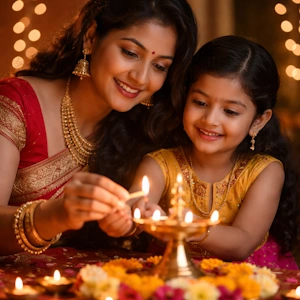
Think about what darkness feels like. It creates confusion, uncertainty, and unease. Light removes all of that instantly. This simple human experience is at the heart of why we light a lamp.
1. The lamp is a symbol of God
In Indian thought, God is not described as a person sitting somewhere. God is described as pure light and pure awareness. The Sanskrit word is Jyoti. When you light a lamp in front of the deity, you are not decorating the altar. You are saying: I recognize that you are light, and I am calling that light into this space right now.
2. It shifts your inner state
Before puja, your mind is scattered. You have been thinking about work, problems, and a hundred other things. The moment you light the lamp and watch the flame, something settles. The ritual of lighting creates a clear boundary. Life was happening out there. Now, for these few minutes, something different is happening here.
3. The wick burning is your story
The wick soaked in oil slowly burns and produces light. You are the wick. Your attachments and desires are the oil. The burning produces something useful, something luminous. The lamp quietly tells you that a life lived with awareness transforms even ordinary things into something meaningful.
4. The flame only gives
Watch a flame closely. It never pulls anything toward itself. It only radiates outward. You can light a thousand lamps from one flame and the original flame loses nothing. This is the nature of the divine. Endless giving without any loss. The lamp puts that truth in front of you every single day.
The one thing to remember
The lamp is not lit for God's benefit. God does not need your light. It is lit for you. It is a daily reminder to move from confusion toward clarity, from selfishness toward giving, from sleep toward wakefulness. That small flame is asking you a quiet question every morning: are you awake yet?
- Why does the lamp come before everything else in puja?
First understand the context. In Indian tradition, any sacred act begins with invoking light. Darkness here does not just mean the absence of sunlight. It means the absence of awareness. You cannot offer anything meaningful to the divine while your mind is asleep or scattered. The lamp is lit first because it signals that you are now present, awake, and ready. Everything that follows in the puja happens inside that space of awareness. Without the lamp, the rest of the ritual is just movement without meaning.
- What does it mean that God is described as light and not as a figure?
Here is what this means. A figure has limits. It exists in one place. It has a form and a boundary. Light has none of those restrictions. Light fills the entire space it enters. You cannot confine it. When ancient teachers described God as Jyoti, pure light, they were saying that the divine cannot be boxed into a location or a shape. It is the background reality behind everything. The lamp flame is a small, visible version of that boundless truth placed right in front of your eyes.
- Why do people use ghee or sesame oil in the lamp? Does the material matter?
There is another important detail here. The materials are not random choices. Ghee comes from milk, which itself is a concentrated form of nourishment. When ghee burns, it releases that stored nourishment as light and warmth. Sesame oil has a long history in Indian tradition of being associated with purity and the removal of negative forces. The choice of fuel is deliberate. You are not just burning anything. You are offering something that carries its own meaning. The act of giving up something valuable to produce light mirrors the inner truth the lamp is pointing toward.
- What is the connection between the lamp and the idea of the self?
Now look at the deeper point. The wick sits in oil and is slowly consumed. But in that consumption it produces light that benefits everyone around it. This is a direct map of human life. You have energy, time, and capacity. That is your oil. How you use those things, whether for yourself alone or in a way that illuminates others, determines whether your life produces light or just burns out uselessly. The lamp is teaching you about the direction of a meaningful life every single morning before you say a single word.
- Why does the flame never diminish when you light other lamps from it?
This is one of the most quietly powerful secrets of the lamp. A flame lit from another flame does not reduce the original. You can light ten, a hundred, a thousand lamps and the source remains exactly as it was. This models a principle that does not apply to material things. If you share money, you have less. If you share knowledge, skill, love, or awareness, the source does not shrink. It may even grow stronger. The lamp is placing this truth in your daily experience so that the idea stops being a philosophy and starts being something you have actually seen and felt.
- Why does the lamp settle the mind even before prayer begins?
Here is what this means. The human nervous system responds to light and flame in a very direct way. But beyond the physical, there is a psychological effect. The act of striking a match, adjusting the wick, watching the flame catch and stabilize, this sequence demands your attention. You cannot think about your problems and do this at the same time. The ritual captures you. By the time the flame is steady, your mind has already begun to slow down. The lamp has done its first job before you even fold your hands.
- Is there a reason lamps are placed at specific spots, like the threshold or the tulsi plant?
First understand the context. The threshold of a home is where the outside world meets the inner world. Lighting a lamp there is a statement. It declares that this home is a conscious space, not just a structure. The tulsi plant holds a specific place in Indian tradition as a symbol of purity and the presence of the divine in nature. Placing a lamp near it connects two forms of the sacred, the living plant and the burning flame. The location is not decoration. Each placement is a deliberate act of recognition.
- What does it mean when the flame flickers or bends in a particular direction?
There is another important detail here. Traditional Indian households read the flame as a living presence. A steady flame suggests stability and peace in the space. A restless, flickering flame suggests disturbance, either in the air of the room or in the atmosphere of the home. This is not superstition in the dismissive sense. It is a form of attention. When you watch the flame daily, you become sensitive to the quality of your environment. The flame gives you feedback in a wordless way. The practice trains you to notice what most people walk past without seeing.
- Why is the lamp described as being lit for you and not for God?
Here is what this means. If God is infinite awareness and pure light, God does not require a small clay lamp. The lamp changes nothing in the divine. It changes everything in you. This is a radical idea hidden inside a simple daily act. Religion is not about informing God that you exist. It is about waking yourself up to what already exists. The flame is a mirror. It shows you what pure, undivided, giving, steady awareness looks like. You are the one who needs reminding. The lamp does that reminding without a single word.
- What is the ultimate secret that the lamp carries?
Now look at the deeper point. The lamp holds a truth that most people walk past every day. It is this: light does not announce itself. It does not argue for its existence. It simply burns and the darkness disappears. There is no conflict. There is no effort. The darkness does not fight the light. It simply cannot remain when light is present. This is how wisdom works inside a person. You do not have to fight your confusion, your fears, or your habits directly. You simply have to bring more awareness into the space. When awareness grows, confusion retreats by itself. That is the oldest and most guarded secret of the lamp.
Objection 1: Lighting a lamp is just a cultural habit with no real meaning. People do it because their parents did it, nothing more.
Reply: Cultural transmission is how wisdom survives across centuries. The fact that a practice is inherited does not make it empty. Many people also brush their teeth because their parents taught them to. The habit is practical. The lamp carries practical benefits, a quieted mind, a moment of stillness, a daily reminder to be aware. Whether or not a person understands the meaning, the effect is real. Understanding the meaning simply makes the effect deeper.
Objection 2: God, if God exists, does not need rituals or flames. This is primitive worship.
Reply: The tradition itself agrees with you completely. It states clearly that the lamp is not for God. It is for the person lighting it. Ritual is a technology for changing the inner state of a human being. You do not call a shower primitive because you need it every day. The human mind needs regular anchoring, reminding, and steadying. That is what the lamp provides. The word primitive should not apply to something that addresses a genuine and permanent human need.
Objection 3: Burning ghee or oil in a lamp is wasteful and environmentally harmful.
Reply: This is a fair material concern. Traditional lamps using natural oils like sesame or coconut produce relatively clean burns and far less environmental harm than many modern habits that people do not question. Beyond that, the quantities involved in household lamp lighting are small. The question of environmental harm is worth asking, but it should be asked proportionately and consistently, not selectively aimed at traditional practices while ignoring far larger daily habits.
Objection 4: If light equals awareness, I can get the same effect by turning on a light switch.
Reply: You can. But notice what happens when you do. You flick a switch and move on immediately. There is no pause, no attention, no small act that costs you anything. The lamp requires your hands, your presence, your care. The flame must be watched for a moment to confirm it has caught. That act of presence is what creates the shift in state. The electric bulb removes darkness. The lamp removes the darkness inside you. They are doing different jobs.
Objection 5: These are just symbolic stories that intellectuals have invented to make simple village practices sound profound.
Reply: The symbolism did not come after the practice. It came with the practice from the beginning. Indian philosophical texts as old as three thousand years describe light as the nature of awareness and the self. The Brihadaranyaka Upanishad asks directly: what is the light of a human being when the sun has set and fire has gone out, and answers: the self is your light. The lamp grew from that understanding. The practice and the philosophy were never separate.
Objection 6: I can be spiritual without lighting any lamps or following any rituals.
Reply: You can, and the tradition does not disagree. It never claimed that lamps are the only path. It claims they are a support, a practical tool that helps the mind arrive at a state that would otherwise require years of disciplined practice to reach. If a person can achieve steady awareness without any ritual, they do not need the lamp. But for most people, the mind needs handles to hold. The lamp is one such handle. There is no rule that you must use it. The question is whether it helps you.
Objection 7: Watching a flame does not make you a better person. Goodness comes from actions in the world, not from rituals at home.
Reply: Agreed. The lamp never claims to replace action. It claims to prepare you for action. A mind that begins the day in quiet, grounded awareness makes better decisions than one that begins in noise and reaction. The lamp is not the destination. It is the starting condition. Whether that inner preparation then translates into better behavior in the world depends on the person. But a calm, awake mind is a better starting point than an agitated or scattered one.
Objection 8: The idea that a flame never diminishes when shared is just a poetic metaphor. It has no real teaching value.
Reply: Try sharing money and you will have less. Try sharing an idea and watch what happens. The idea survives fully in your mind after you give it away and now lives in another mind as well. Knowledge, wisdom, love, and creative energy follow the same logic as flame. They grow through sharing, not shrink. The lamp makes this principle visible and felt rather than merely argued about. A metaphor that is physically demonstrated in front of you every day is not just poetic. It is a form of training.
Objection 9: Different religions use candles, incense, or other lights. So lamp lighting is not unique or special to Indian tradition.
Reply: That observation actually supports the deeper point. Fire and light appear as sacred symbols in every major human tradition across every continent and every era. This consistency is not coincidence. It points to something in human experience that fire and light address directly. The Indian tradition explored this with particular depth and articulation. The fact that others arrived at similar practices independently suggests that the lamp is pointing at something true about human psychology and not just one culture's preference.
Objection 10: I am a rational person. I use logic and evidence. Traditions based on symbolism and ritual have no place in a modern, scientific life.
Reply: Science explains how things work. It does not explain why waking up with purpose feels different from waking up without it. It does not explain why a moment of stillness changes the quality of a day. These are real human experiences that rational inquiry has not replaced and has not tried to. The lamp belongs to the domain of inner life, not outer mechanism. A rational person who has never examined their inner life has left the most important territory unexplored. Lighting a lamp and observing what happens inside you is itself an empirical act. You are running an experiment. The results speak for themselves.
The one takeaway across all of this is simple. The lamp is not a relic of the past. It is a daily question placed in front of you. The question is whether you are willing to slow down long enough to see clearly. Everything else follows from that.






English
Mystique
Click on any topic to open
7
30
Astrology
Bhagavad Gita
Bhagavatam
Bharat Matha
Devi
Devi Mahatmyam
Ganapathy
Garuda Puranam
Glory of Venkatesha
Hanuman
Kathopanishad
Mahabharatam
Mantra Shastra
Mystique
Practical Wisdom
Purana Stories
Radhe Radhe
Ramayana
Rare Topics
Rigveda Explained
Rituals
Sages and Saints
Shiva
Spiritual books
Sri Suktam
Story of Sri Yantra
Temples
Vedas
Vishnu Sahasranama
Yoga Vasishta
26
17
10
0


